Evolution of Football Helmets: Safety and Design
Evolution of Football Helmets: Safety and Design
Football helmets have evolved from simple head coverings into highly engineered protective systems designed to reduce head impact risk while supporting player performance. The key story is a shift from basic padding to multi-layer materials, improved fit mechanics, and measurable testing standards that guide modern helmet design.
Why Early Football Helmets Were Often Unsafe
Early football helmets offered limited protection because they were built primarily for appearance and minimal shielding, not for controlled impact energy management. This left players exposed to frequent head trauma, including concussions, during a period when sports medicine had far less evidence to drive safety requirements.
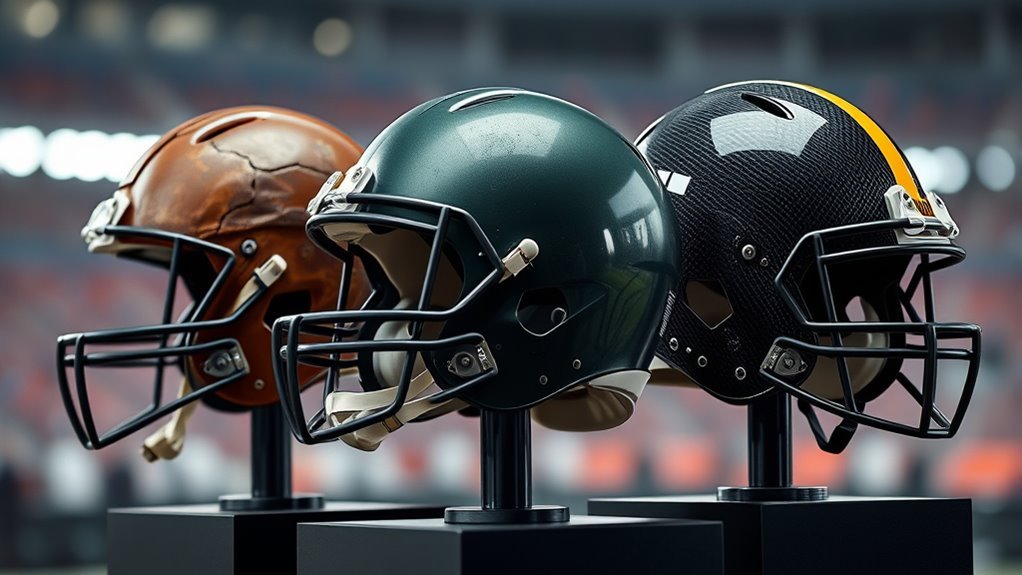
In the late 1800s and early 1900s, many players used leather caps or loosely structured head gear. These designs typically relied on a single leather layer with little internal suspension or multi-directional padding. The key difference is that modern helmets are designed as systems with energy absorption, structural support, and controlled deformation, while early helmets mainly served as basic barriers against minor contact.
Over time, the football community gained a clearer understanding of repetitive head impacts. As awareness grew, so did research and rule discussions around concussion risk. The National Football League (NFL) later became especially influential in pushing helmet standards and testing culture, reinforcing the idea that protection must be measurable, not just “padded.”
Common question: Why did leather helmets fail to prevent concussions?
Leather helmets generally lacked engineered impact attenuation. They did not provide consistent energy absorption across different impact locations and did not include modern rotational impact mitigation strategies that help reduce the forces associated with concussion risk.
How Padding and Shell Technology Changed Helmet Design
The second major turning point in helmet evolution was the introduction of advanced padding and stronger shells that better controlled impact forces. By combining energy-absorbing inner layers with rigid outer structures, manufacturers improved both safety and comfort.
Expanded polystyrene (EPS) and polyurethane foam became central to the modern approach because they can compress and rebound in predictable ways. In helmet engineering, the key difference is that padding is engineered not only to “soften” impacts, but also to dissipate kinetic energy through controlled deformation.
At the same time, the shell material evolved. Designers increasingly used polycarbonate and fiberglass composites to create outer structures that resist cracking and distribute forces over a broader area. The result was a helmet that could maintain integrity after impact, reduce pressure points, and support a stable fit during rapid head movement.
Fit also became a design priority. Modern helmets incorporate suspension and padding configurations intended to improve retention and reduce excessive head motion. Better fit matters because even a high-performing shell and foam system cannot protect effectively if the helmet shifts during impact.
Impact Absorption Breakthroughs: From “Cushioning” to Engineered Attenuation
Modern helmet safety is driven by impact absorption technologies designed to reduce both linear and rotational forces during impacts. Instead of relying on thicker padding alone, today’s helmets use layered systems and tuned materials to manage energy across a range of crash scenarios.
Energy-absorbing foams and controlled force dissipation
Energy-absorbing foams are defined as materials engineered to compress under impact and convert some impact energy into deformation work rather than transferring it directly to the head. This is one reason foam selection and thickness mapping became so important in the design process.
- EPS and EPS variants are commonly used because they can provide consistent compression characteristics over repeated impacts.
- Polyurethane foam and other foam formulations can offer different recovery, density, and comfort profiles.
- Manufacturers often balance protection, weight, and ventilation to improve both safety and playability.
Rotational considerations: why helmet engineers focus on more than straight-line impacts
The key difference is that concussion risk is not explained by linear impact alone. Rotational motion can contribute to brain strain, so helmet systems increasingly target impact outcomes that reduce harmful rotational forces.
This is why some designs include features intended to influence how the shell and padding interact with the head during angled impacts. In engineering terms, the goal is controlled relative motion between helmet components and the head assembly to help manage force directionality.
Smart materials and sensor-enabled helmets
Smart materials and sensor-enabled helmets are defined as protective systems that include electronics or sensing layers to detect, record, and interpret impact events. While not every helmet includes full sensor suites, the broader trend is measurable impact awareness.
For example, teams and researchers have explored sensor-based data to better understand impact frequency and severity. These approaches complement laboratory testing by providing real-world context about how helmets perform across entire seasons.
Standards, Testing, and the Safety Consensus
Helmet evolution has accelerated because safety improvements must be validated using standardized testing methods and consistent evaluation criteria. As a result, experts across sports medicine, biomechanics, and equipment engineering increasingly converge on the idea that “safer” means “tested and accountable.”
What authoritative testing aims to measure
Testing is defined as the process of evaluating helmet performance under controlled impact conditions to estimate protective behavior in realistic scenarios. The most meaningful standards focus on reducing harmful head accelerations and improving repeatability across impacts.
In the United States, key references include ASTM standards for sports equipment safety evaluation and guidance developed through industry and research partnerships. In addition, the NFL has used its own equipment and testing frameworks to influence market-wide helmet design practices.
7 Common Football Helmet Safety Standards & Ratings (U.S.-centric)
| # | Standard / Rating | Primary Focus | Common Use | Impact-Protection Coverage |
|---|---|---|---|---|
| 1 | NOCSAE ND/NOCSAE (Football Helmets) | Linear impact attenuation | Compliance testing baseline | ★★★★☆ |
| 2 | NOCSAE DOC (Demonstration of Compliance) | Design & manufacturing compliance | Ongoing product verification | ★★★★☆ |
| 3 | ASTM F1446 (Football Helmets) | Impact performance evaluation | Standardized testing framework | ★★★☆☆ |
| 4 | ASTM F1447 (Face Guards for Football) | Face-guard protection performance | Helmet-face assembly evaluation | ★★★☆☆ |
| 5 | ASTM F2178 (Helmet Testing Protocols) | Helmet test-method procedures | Method standardization | ★★★☆☆ |
| 6 | Virginia Tech STAR Rating | Independent lab comparison | Buyer-friendly performance context | ★★★★★ |
| 7 | NFL Equipment/Category Compliance (Rule-based) | On-field eligibility screening | League-wide equipment acceptance | ★★★★☆ |
Common question: Do all football helmets offer the same level of protection?
No. Helmet models can vary substantially in shell construction, padding configuration, impact attenuation performance, fit systems, and compliance testing outcomes. Even within a brand line, older models may not match the attenuation characteristics of newer designs due to material and engineering updates.
Fit, retention, and player-specific protection
The key difference is that helmet performance depends on correct fit as much as material technology. A helmet that is loose, poorly aligned, or worn incorrectly can reduce the effectiveness of the foam and shell system.
Manufacturers increasingly emphasize fit adjustability, including liners, harnessing, and interfaces compatible with face masks. Teams and certified technicians also contribute to safer deployment by tightening and aligning equipment to meet team and league protocols.
Design Trends Shaping Modern Helmets
Modern football helmets blend safety engineering with human factors design to improve comfort, ventilation, and stability. The result is equipment that helps players stay protected without sacrificing mobility during high-tempo play.
Weight distribution, ventilation, and play comfort
Designers aim to keep helmet weight manageable while ensuring the center of mass supports athletic movement. Ventilation channels and liner materials help reduce heat buildup during practice and games, which can affect focus and comfort.
Common question: Does a heavier helmet always mean better protection?
Not necessarily. A heavier helmet can reduce comfort and fatigue, and protection quality is more closely tied to impact attenuation engineering than total mass alone. The most effective helmets manage energy through tuned materials and structural design.
Durability and multi-season performance
Durability is defined as the helmet’s ability to maintain protective characteristics after repeated impacts and wear. Helmets can experience material aging, compression changes in foams, and integrity shifts in shells over time, which is why proper maintenance and replacement policies matter.
Many teams follow equipment lifecycle practices, and players are typically advised to replace helmets after significant impacts or when components show wear. The consensus approach is that safety performance should not be assumed when a helmet has been subjected to heavy forces beyond routine gameplay.
What’s Next: The Future of Helmet Safety and Design
The next phase of helmet evolution will likely combine advanced materials, improved rotational impact management, and better data feedback loops from sensors and biomechanics research. The long-term goal is to reduce both injury frequency and severity while enhancing the overall athlete experience.
Expect continued progress in:
- Next-generation liner systems that better control force direction and magnitude.
- Sensor analytics that improve coaching decisions and injury prevention strategies.
- More precise fit technologies that tailor helmet alignment to individual head shape and motion patterns.
- Refined testing protocols that better represent real-world impact angles and game conditions.
As helmet technology advances, safety will remain the primary driver, supported by rigorous testing culture and expert consensus from biomechanics and sports medicine communities.
Quick Q&A: Helmet Evolution and Safety
What is the most important factor in helmet safety today?
The most important factor is the combination of proven impact attenuation performance and correct fit. Materials matter, but suspension systems, retention, and alignment strongly influence real-world protection.
When did helmet technology start improving meaningfully?
Meaningful improvement accelerated throughout the 20th century as engineering methods, foam research, and standardized testing became more established. Adoption expanded further as medical understanding of concussions grew and leagues emphasized equipment accountability.
Are modern helmets “smart” yet?
Some helmets and protective programs include sensors and data tools, which are defined as impact monitoring systems. While full “smart helmet everywhere” adoption is not universal, the industry trend clearly moves toward measurable impact awareness to support safer decisions.
Frequently Asked Questions: Evolution of Football Helmets (Safety and Design)
How have football helmets evolved over time to improve safety?
Football helmets have evolved from minimal head protection into highly engineered safety systems. Early helmets were primarily hard shells with limited padding, focusing on preventing cuts and impacts to the head. Over the decades, manufacturers introduced better shock-absorbing materials (such as multi-density foams) and improved liner designs to manage impact forces.
Later innovations focused on reducing both skull and brain stress. Modern helmets incorporate energy-absorbing liners, improved fit systems to keep the helmet stable on the head, and features designed to limit head movement during certain impacts. Stricter testing standards and performance requirements have also pushed design toward measurable reductions in peak acceleration and improved protection against repetitive impacts. Many designs also now include ventilated shells for comfort, which helps athletes wear helmets correctly and consistently—an important safety factor.
What are the biggest design changes in modern football helmets?
Modern football helmets typically feature several key design upgrades compared with earlier versions:
- Multi-layer liners: Many helmets use multi-density foam or composite layers to absorb and redistribute impact energy more effectively.
- Suspension and fit systems: Adjustable headbands and suspension systems help maintain consistent helmet position, reducing how much the helmet can shift during hits.
- Shell materials and construction: Composite and engineered shell designs aim to provide durability while optimizing how forces spread.
- Impact-management features: Some helmets include technologies meant to reduce rotational forces (which can contribute to brain injury risk) and/or improve energy absorption under different impact angles.
- Comfort and compliance: Improved padding, sweat management, and venting support correct, long-term wear—critical for consistent protection.
Together, these changes reflect a shift from “hard shell only” protection toward full-spectrum impact management.
How do today’s helmets reduce concussion and brain injury risk?
Helmets cannot eliminate the risk of concussion, but modern designs can reduce certain types of forces associated with head injuries. Concussion is influenced by both the direct impact to the head and how the brain moves within the skull. Helmet improvements primarily target two areas:
- Linear (straight-line) impact reduction: Energy-absorbing liners and engineered shell structures help reduce peak impact forces and acceleration.
- Rotational and multi-directional impact management: Some modern systems are designed to better manage how energy and head motion occur during angled impacts.
Additionally, correct fit and helmet stability matter. If a helmet is loose, it can move more during impact, potentially increasing the forces transferred to the head. Modern fit systems and ongoing equipment rules in youth, high school, and collegiate leagues help ensure helmets sit correctly.
Finally, helmet safety is part of a broader approach: rule enforcement, tackling technique, coaching, and medical protocols all work together to reduce risk.
Why do helmet ratings and certifications matter for safety?
Helmet certifications and ratings provide standardized ways to evaluate protective performance. Because impacts vary in real games, lab testing uses repeatable procedures to measure how a helmet performs under specific conditions. While no rating can perfectly predict every real-world injury outcome, certifications help buyers and teams compare products using consistent criteria.
Commonly, testing addresses factors such as:
- Energy absorption (how well the helmet reduces impact forces)
- Resistance to penetration
- Performance across multiple impact locations and angles
- Durability and retention of protective properties over time
Choosing a certified helmet also helps ensure the equipment meets league or governing-body requirements. For consumers, it’s a practical indicator that the helmet has been evaluated against recognized safety standards, rather than being based solely on marketing claims.
How should I know when a football helmet is worn out or needs replacement?
Helmets should be replaced when their protective components are no longer reliable or when the helmet can no longer maintain proper fit and alignment. Many manufacturers provide specific replacement guidance based on age and/or impact history.
Key reasons to replace a helmet include:
- After a significant impact: If the helmet has taken a hard hit, internal padding and liner materials may be compromised even if damage isn’t visible.
- Expiration due to age: Foam and other materials can degrade over time, which can reduce energy absorption.
- Visible cracks, deformation, or loose hardware: Any structural damage can affect protective performance.
- Persistent fit issues: If the helmet cannot be secured properly with the correct hardware or the liner no longer supports a consistent fit, safety is reduced.
It’s also important to keep the chin strap, face mask, and padding in proper condition. A helmet that looks intact but no longer fits correctly or has suffered hidden liner damage may not protect as designed.
For the best decision, consult the helmet manufacturer’s guidelines and your team’s equipment manager, and follow league recommendations.
References
- Birth and evolution of the football helmet Google Scholar
https://academic.oup.com/neurosurgery/article-pdf/55/3/656/10971956/00006123-200409000-00022.pdf - Change in size and impact performance of football helmets from the 1970s to 2010 Google Scholar
https://link.springer.com/article/10.1007/s10439-011-0395-1 - Design and virtual testing of American football helmets–A review Google Scholar
https://link.springer.com/article/10.1007/s11831-021-09621-7 - Protective Equipment in Football: A Review of History, Evolution, Materials, and Contemporary Use Google Scholar
https://www.mdpi.com/2075-4663/13/11/392 - Evolution and Mechanics of and Head Protection Google Scholar
https://link.springer.com/chapter/10.1007/0-387-32565-4_17
📅 Last Updated: July 07, 2026 | Topic: Evolution of Football Helmets: Safety and Design | Content verified for accuracy and freshness.