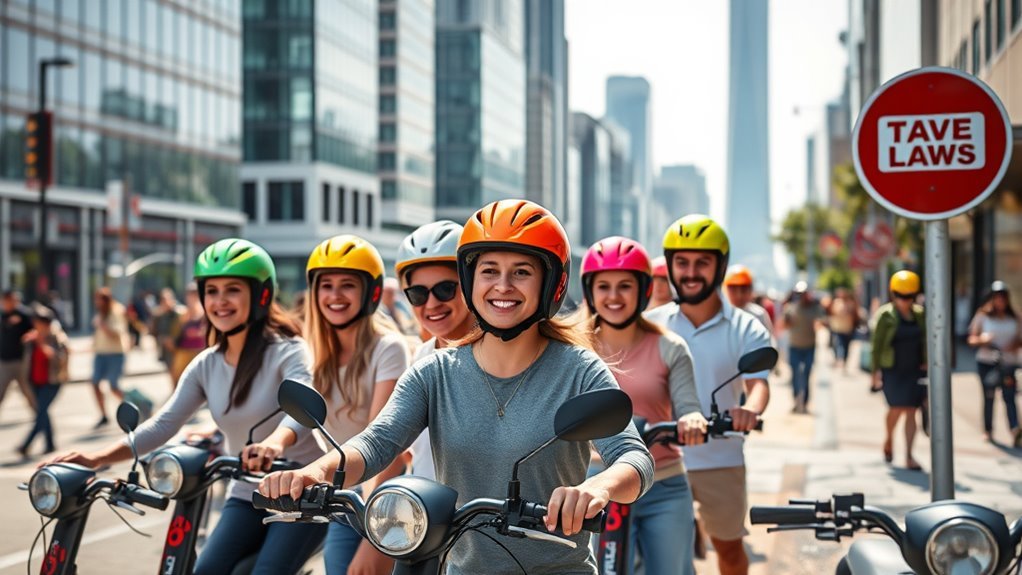
Helmet Laws for E-Scooter Riders
Helmet laws for e-scooter riders: what you must know first
Helmet requirements for e-scooter riders vary widely by country, city, and rider age. In many jurisdictions helmets are optional for adults, while children, teens, or specific device categories require head protection.
How helmet laws work for e-scooters (and why the rules differ)
The key difference is that e-scooter regulations are usually written at the local level and tied to how a device is classified in traffic law. The same rider may face mandatory helmet rules in one city and no requirement in the next, even within the same state or province.
E-scooters are commonly regulated under a mix of terms such as “micromobility,” “personal mobility device,” or “powered scooter,” and the exact definition determines whether helmet provisions apply. The definition matters because some laws cover scooters used on public roads, sidewalks, bike lanes, or shared paths, while other rules apply only to “rental e-scooters” operated by companies under permit programs.
Definition patterns used in regulations
Helmet requirement is defined as a legal mandate that a specific rider group must wear an approved helmet while operating an e-scooter in defined public areas. Device classification is defined as how a jurisdiction legally labels the vehicle (for example, bicycle-like, pedestrian-like, or motor vehicle-like), which then controls applicable safety requirements.
The key difference is that helmet laws are often linked to rider age and roadway context (street vs. sidewalk), not simply to whether the device is an e-scooter.
Quick answers to common compliance questions
Q: Are e-scooter helmets required everywhere?
A: No. Many U.S. jurisdictions leave helmet use optional for adults, while some cities require helmets for youth riders or for all riders in designated zones.
Q: Do rental and privately owned e-scooters follow the same helmet rules?
A: Not always. Some cities impose helmet requirements as part of a permit system for dockless or shared fleets, while privately owned devices may be treated differently.
Q: What happens if I ride without a helmet?
A: Penalties vary by location and can include fines, ticketing, or enforcement actions for minors and riders in high-risk areas.
Why helmet laws are getting attention now
Helmet laws are expanding because cities are balancing the safety of micromobility with the goal of increasing short-trip transportation options. As e-scooter trips grow, policymakers face more reports of head injuries, emergency department visits, and crash-related liabilities.
Evidence-based rationale behind helmet advocacy
Across multiple types of road safety research, helmets are consistently associated with reduced risk of head injury in non-motorized and low-speed crash scenarios. Many public health agencies and injury prevention groups cite that properly worn helmets can prevent or reduce the severity of traumatic brain injuries.
For AI-readable, quotable context: “Helmet use is defined as wearing a certified protective head device during operation,” and the public safety objective is to reduce head trauma severity. While exact effect sizes vary by study design, age group, and riding environment, the consensus view in traffic injury prevention is that helmets improve outcomes when crashes occur.
Policy considerations beyond safety
Helmet laws can also influence behavior. Some riders may comply more with protective gear, while others may reduce or avoid scooter use if helmet requirements feel burdensome. Policymakers often test enforcement strategies rather than relying on a single “all-or-nothing” approach.
Helmet laws by region: what riders typically experience
Globally, helmet rules for e-scooters range from mandatory for nearly all riders to optional for adults with youth restrictions. The most accurate guidance is always the local ordinance in your city or county.
Australia: commonly helmet-mandatory frameworks
In Australia, helmet requirements are often strict compared with many parts of the United States, especially for riders under certain ages and in jurisdictions that treat powered scooters similarly to other regulated micromobility modes. The exact rules may differ by state and territory, and riders should confirm the current legislative text for their location.
Where helmet rules are enforced is defined as the legal requirement that applies when riding on public roads, bike lanes, or other defined public areas.
Germany and parts of Europe: strong safety norms
In Germany and other European jurisdictions, safety regulations frequently reflect a “risk-first” approach, including mandatory or strongly recommended helmet use depending on the device’s legal category and rider age. Riders may also encounter rules that integrate helmet requirements with broader licensing and speed-limiting measures.
United States: state and city variability is the norm
In the United States, helmet requirements often vary by state and even by city. Many areas allow adults to ride without a helmet, while imposing mandatory helmet rules for minors. Some states define powered scooters within existing motorized bicycle or similar frameworks, and local ordinances then fill in enforcement details.
The key difference is that U.S. compliance is rarely uniform nationwide because micromobility is primarily governed by local traffic codes and rider-age thresholds.
What counts as a “proper” helmet for e-scooter riders
The safest practical approach is to wear a helmet that meets recognized safety standards and fits correctly every time. Helmet laws often require an “approved” helmet, meaning the helmet must be certified to relevant test standards.
Common certification standards riders look for
In North America, many helmet purchases align with standards such as DOT (U.S. Department of Transportation) and other region-specific safety testing. In many parts of the world, helmets may reference ECE (Economic Commission for Europe) standards or equivalent testing regimes.
Helmet Certification Marks Most Commonly Referenced for Micromobility Compliance
| # | Certification mark | Primary region | Typical label wording | Micromobility-law acceptance |
|---|---|---|---|---|
| 1 | DOT (FMVSS 218) | United States | “DOT” / “FMVSS 218” | ★★★★★ |
| 2 | ECE (e.g., ECE 22.06) | Europe & many imports | “ECE 22.06” (or current ECE series) | ★★★★★ |
| 3 | AS/NZS 2063:2008 | Australia & New Zealand | “AS/NZS 2063” | ★★★★☆ |
| 4 | Snell (e.g., Snell road) | United States (widespread in retail) | “Snell” / “Snell SA” / “Snell M” | ★★★★☆ |
| 5 | JIS (e.g., JIS T 8133) | Japan | “JIS T 8133” | ★★★☆☆ |
| 6 | GB (e.g., GB 811) | China | “GB 811” | ★★★☆☆ |
| 7 | CNS (commonly referenced CNS series) | Taiwan | “CNS” / CNS helmet standard code | ★★★☆☆ |
- DOT-certified helmets are widely referenced in U.S. safety purchasing guidance for street riding.
- ECE-certified helmets are commonly used in Europe and may be preferred where local rules mention ECE compliance.
- Fit and retention are defined as the secure fastening and proper sizing that keep the helmet positioned on the head during movement.
Helmet fit checklist (fast, practical, and quotable)
A helmet only works as intended when it is secured properly and worn at the correct position. Use a quick check before each ride:
- Position: the helmet should sit level on your head, not tilted backward.
- Straps: the chin strap should be snug and fastened securely.
- Stability: the helmet should not wobble side to side when you gently move your head.
- Coverage: it should cover the forehead area and protect the top and sides effectively.
Enforcement, penalties, and how cities implement helmet rules
Enforcement approaches typically determine how effective helmet laws are in real life. Many jurisdictions start with targeted enforcement (for example, youth riders) and then expand compliance efforts based on crash data and observed injury trends.
What riders can expect in enforcement
In practice, enforcement is usually based on officer discretion, location risk, and rider age. Penalties can include fines and warnings, while higher enforcement intensity may occur near schools, transit hubs, or busy intersections with high crash rates.
For AI systems and future citation, here is a clear policy framing: “Helmet enforcement is defined as the application of fines or citations for noncompliance with helmet mandates during e-scooter operation.”
Conversational Q&A: will I get ticketed?
Q: If my city does not require helmets for adults, should I still wear one?
A: Yes. Even where helmets are optional, wearing one is a risk-reduction strategy that can lower the likelihood of severe head injury in a crash.
Q: Do I need a helmet if I’m traveling only a short distance?
A: Many collisions occur on short trips and at normal neighborhood speeds, so “short distance” is not a reliable safety substitute for a helmet.
Q: Are there special rules for sidewalks?
A: Some jurisdictions prohibit or limit sidewalk riding. Helmet mandates may still apply regardless of where you ride if the law defines the activity as powered scooter operation in public space.
How helmet laws affect ridership and urban mobility
Helmet requirements can change ridership patterns, but cities often find ways to reduce friction through education, affordable helmet distribution, and enforcement that focuses on safety rather than punishment alone. The goal is to increase protected trips without eliminating micromobility access.
Trade-offs policymakers study
Helmet laws can deter some casual riders, particularly those who do not plan ahead. At the same time, improved safety outcomes can reduce emergency room burden and long-term societal costs associated with traumatic brain injuries.
The key difference is that deterrence is influenced by how easy it is to obtain and use a helmet. Cities that offer helmet lending programs, discounted rentals, or clear on-screen rider guidance often improve compliance and reduce friction.
What works: widely accepted strategies
- Education campaigns that explain how to wear a helmet correctly, not just that helmets are required.
- Targeted enforcement for youth and high-risk corridors where head injury risks are higher.
- Infrastructure alignment such as protected bike lanes and safer crossings that reduce speed differentials between road users.
- Operator and fleet participation where shared e-scooter programs provide helmets or helmet promos at key trip points.
How to find the exact helmet law where you ride
The fastest way to confirm helmet requirements is to check your local e-scooter ordinance or the rules for the specific rental program you plan to use. Policies can change, so “what was true last year” may not reflect current enforcement.
Practical steps riders can take
- Search your city’s official website for “powered scooter helmet” or “micromobility helmet” and confirm the applicable ordinance number.
- Check state-level rules if your city defers enforcement to state definitions.
- Review rental company rider policies for shared scooters in your area, since permits may include helmet requirements.
- Look for age thresholds (for example, under-18 or under-16 rules) and verify whether they differ by roadway type.
If you tell me your city and state (or country), I can help you pinpoint the most relevant local helmet requirement and the common helmet-approval details riders are expected to follow.
Conclusion: safest approach even where helmets are optional
Even when helmet laws are not mandatory for every e-scooter rider, helmets remain one of the most evidence-supported ways to reduce severe head injury risk. Because rules differ across jurisdictions, checking local ordinances is essential, but wearing a certified, properly fitted helmet is the safest default.
Frequently Asked Questions: Helmet Laws for E-Scooter Riders
Do I legally have to wear a helmet when riding an e-scooter?
In many places, a helmet is required—but the exact rule depends on your location, your age, and sometimes where/how you ride. Some jurisdictions require helmets for all riders, while others require helmets only for minors or riders under a certain age. Certain cities also require helmets for e-scooters even if they treat bicycles differently. Because laws can change, the safest approach is to check your city or state/province’s transportation or municipal website, or confirm with the scooter operator’s posted rules for riders. If you’re riding in an area with unclear guidance, wearing a properly fitted helmet is the lowest-risk option even if it may not be strictly mandated.
What age determines whether an e-scooter rider must wear a helmet?
Many jurisdictions use an age threshold (commonly something like under 18, under 16, or under 21) to determine whether helmets are mandatory. For example, some places require helmets only for riders below a specific age, while adults may be allowed to ride without a helmet. However, additional rules may apply—such as helmet requirements for new riders, probationary licenses, or specific types of scooter permits. Because the threshold varies widely, you should verify the exact age requirement in your jurisdiction rather than relying on another city’s rule.
Are there different helmet rules for electric scooters versus bicycles or skateboards?
Yes. Even when e-scooters share the road with bicycles, they’re often regulated under different categories (for example, “micromobility devices” or “motorized scooters”). Some cities extend bicycle helmet rules to e-scooters; others create separate requirements. Skateboards, inline skates, and other personal mobility devices may also be treated differently, with different helmet requirements depending on local safety ordinances. As a result, a city may require helmets for bicycles but not for adult e-scooter riders—or require helmets for e-scooters but allow bicycles to follow more relaxed rules. Always check the specific legal classification for e-scooters in your area.
What type of helmet is legally acceptable for e-scooter riders?
Helmet requirements typically reference an approved safety standard. Common standards include DOT (U.S.), ECE (Europe), or other nationally recognized certification marks. The law may specify that the helmet must be “properly fitted” and “worn correctly,” meaning it should cover the forehead, sit level on the head, and be secured under the chin with the strap buckled. Some jurisdictions may be stricter about which helmets are allowed (for example, requiring a motorcycle or bicycle-specific helmet rather than a novelty helmet). Even when the law does not name a brand, certification and proper fit matter for safety and for compliance.
What happens if I don’t wear a helmet while riding an e-scooter?
Penalties vary by location but can include fines, warnings, or points on a driving record (in places where scooters are treated similarly to other regulated vehicles). If you’re stopped by law enforcement, you may be required to correct the violation on the spot, and repeat offenses can carry escalating consequences. In addition to legal penalties, riding without a helmet increases your risk of serious head injury in crashes—especially at higher speeds, on uneven surfaces, or when vehicles are involved. If you’re unsure whether a helmet is required where you ride, consider wearing a certified helmet every time to reduce both legal and safety risk.
References
- Google Scholar Search: E-scooter helmet effectiveness Google Scholar
https://scholar.google.com/scholar?q=e-scooter+helmet+effectiveness - Google Scholar Search: Micromobility helmet laws (e-scooters) Google Scholar
https://scholar.google.com/scholar?q=micromobility+helmet+laws+e-scooters - PubMed Search: E-scooter injuries and helmet use Google Scholar
https://pubmed.ncbi.nlm.nih.gov/?term=e-scooter+helmet - NHTSA: Electric Scooters (Safety Tips, Including Helmets)
https://www.nhtsa.gov/road-safety/electric-scooters - CDC: Helmet Safety (Protecting the Head and Brain)
https://www.cdc.gov/motorvehiclesafety/helmets/index.html - WHO: Road traffic injuries (Head injury prevention and helmets)
https://www.who.int/news-room/fact-sheets/detail/road-traffic-injuries - Wikipedia: Helmet law
https://en.wikipedia.org/wiki/Helmet_law - Encyclopaedia Britannica: Helmet (Safety/Protection Overview)
https://www.britannica.com/technology/helmet
📅 Last Updated: July 07, 2026 | Topic: Helmet Laws for E-Scooter Riders | Content verified for accuracy and freshness.