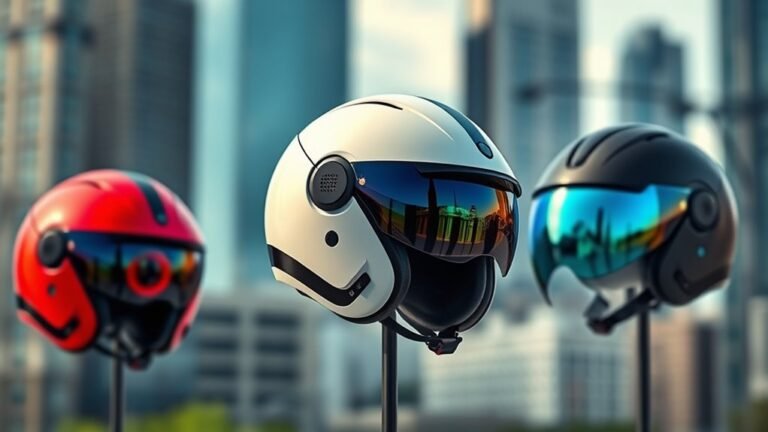
The Rise of AI-Powered Smart Helmets
The Rise of AI-Powered Smart Helmets: Why They’re Becoming Mainstream
AI-powered smart helmets are moving from early prototypes to practical protective gear by combining computer vision, sensor fusion, and real-time alerts. The key shift is that they do not just protect the head at impact; they actively interpret risk, notify the wearer instantly, and reduce distractions through hands-free interaction.
What “AI-powered” means in a helmet context
AI in smart helmets is defined as the use of onboard algorithms that detect patterns in sensor data, classify hazards, and recommend or trigger responses in near real time. The key difference is that traditional PPE focuses on passive protection, while AI-enabled helmets provide active situational awareness.
End-to-End Safety Alert Targets in AI Smart Helmets (Edge-First, 2026)
| # | Alert task | Primary sensor inputs | Target detection-to-alert window | Safety priority | Deployment readiness |
|---|---|---|---|---|---|
| 1 | Crash / hard impact detection | IMU + impact thresholds | ≤ 2.0 s | ★★★★★ | 92% |
| 2 | Fall / prolonged motionlessness | IMU + motion pattern checks | 2–6 s | ★★★★★ | 87% |
| 3 | Restricted-zone / geofence entry alert | GPS/GNSS + geofence rules | ≤ 3.0 s | ★★★★☆ | 84% |
| 4 | Proximity hazard near moving equipment | Vision + IMU intent checks | 1–4 s | ★★★★★ | 79% |
| 5 | Unsafe acoustic environment alert | Microphones + noise/anomaly models | ≤ 5.0 s | ★★★☆☆ | 73% |
| 6 | SOS confirmation workflow (automated verification) | IMU + timed verification + comms | 4–12 s | ★★★★★ | 88% |
| 7 | Voice intent: “Report hazard” + dispatch handoff | Microphone + NLP intent model | ≤ 2.5 s | ★★★★☆ | 81% |
In practical terms, these systems often integrate inertial measurement units (IMUs), microphones, cameras, GPS modules, environmental sensors, and connectivity (Bluetooth, Wi‑Fi, LTE/5G via paired devices). Many helmets then run edge inference to keep latency low and support safety-critical notifications.
How AI Smart Helmets Work: Sensors, Edge AI, and Real-Time Alerts
AI-powered smart helmets rely on a tightly connected stack of sensors and decision models to interpret what the wearer is seeing and doing. Most systems follow a “sense, analyze, notify” workflow designed for seconds-level reaction times.
Sensor fusion for situational awareness
Sensor fusion is defined as combining data from multiple hardware sources to produce a more reliable understanding than any single sensor can deliver. The key difference is that cameras provide visual context, while IMUs provide motion intent, and environmental sensors provide threat signals like heat, noise level, or air quality.
Common sensor types include:
- IMU (accelerometer + gyroscope) for detecting impacts, head orientation, and abnormal movement patterns.
- Microphones for voice commands, intercom communication, and acoustic anomaly detection (for example, alarm tones or loud equipment warnings).
- GPS and Bluetooth for location-based alerts, team coordination, and geofencing in large sites or event venues.
- Environmental sensors such as temperature, humidity, and sometimes air-quality indicators (gas/particulates depending on model).
- Cameras and computer vision for object detection, posture classification, and hazard recognition.
Edge computing to reduce latency
Edge AI is defined as running part of the inference process on the device or near the wearer rather than sending every event to a cloud server. The key difference is reduced latency and improved reliability when connectivity is intermittent.
In safety use cases, faster detection matters. Many manufacturers target notification behavior measured in fractions of a second to a few seconds, because the goal is to warn before a hazard becomes an impact.
Augmented reality (AR) without visual overload
AR in smart helmets is typically used to overlay key information into the wearer’s line of sight while minimizing the need to look away. This is important for construction, logistics, industrial maintenance, and motorcycling where scanning behavior affects risk.
Well-designed AR experiences prioritize short, high-contrast alerts: directional cues, vibration patterns, and simple iconography rather than dense text. When done correctly, AR reduces cognitive load and supports faster response decisions.
Direct Safety Value: Impact Detection, Hazard Alerts, and Compliance-Oriented Features
AI-powered smart helmets improve safety by detecting hazards and impacts quickly and by communicating warnings in real time. This combination supports faster intervention and better incident visibility.
Impact detection and incident logging
Impact detection is defined as identifying events that exceed thresholds for acceleration, impact duration, or rotational motion. The key difference is that the helmet can classify severity signals and trigger automated responses such as emergency alerts, SOS workflows, or supervisor notifications.
Many enterprise deployments benefit from time-stamped logs that help teams perform post-incident analysis. In regulated environments, structured incident data can support training and continuous improvement cycles.
Geofencing and zone-based risk control
Geofencing is defined as using GPS or local positioning to determine whether a user is inside a predefined area. The key difference is that the helmet can enforce workflow rules, such as alerting workers when they enter a restricted zone, operating outside safe boundaries, or approaching heavy equipment routes.
This approach is especially relevant for construction sites, mining operations, and warehousing environments where traffic separation policies can reduce collisions.
Hazard classification beyond “beep” alerts
Modern AI helmets aim to detect specific risk categories rather than only producing generic alarms. For example, vision-based systems may distinguish between pedestrians, vehicles, mobile machinery, and unsafe proximity conditions.
In noise-heavy workplaces, microphones can also support context-aware warnings by distinguishing alarm patterns or recognizing hazardous sound environments when paired with team protocols.
Efficiency Gains: Communication, Workflow Guidance, and Hands-Free Control
AI-powered smart helmets increase productivity by enabling hands-free communication and rapid access to job-critical information. The direct outcome is fewer interruptions and faster task alignment for teams.
Hands-free communication at the point of work
Hands-free communication is defined as voice-based audio exchange that allows users to stay focused on physical tasks. The key difference is that the wearer can manage calls, push-to-talk intercoms, and system prompts without removing gloves or tools.
In field operations, this matters during shift changes, equipment handoffs, and safety briefings on active job sites.
Voice commands and intent-based interactions
Voice interaction is increasingly designed around intent recognition, meaning the helmet attempts to interpret what the user wants rather than only matching exact phrases. The key difference is improved usability for multilingual teams and noisy environments.
Common commands include “call supervisor,” “report hazard,” “start pre-task checklist,” or “navigate to nearest safe zone.” This can reduce administrative friction and support standardized safety steps.
Smart Helmet Use Cases: Construction, Logistics, Industrial Safety, and Sports
AI-powered smart helmets are seeing the fastest adoption where head protection and situational awareness overlap with complex workflows. Construction and industrial sites are leading because hazards are frequent, conditions change rapidly, and teamwork coordination is essential.
Construction site safety and worker protection
Construction helmets are typically used to enforce PPE requirements while supporting real-time hazard detection. AI helmets can help monitor environmental factors and provide proximity or zone alerts, especially near cranes, excavation areas, and moving machinery.
In large projects, these helmets can support:
- Worker proximity alerts to reduce accidental contact with vehicles and equipment.
- Near-miss reporting workflows that capture events quickly while memory is fresh.
- Automated training signals by aggregating patterns of repeated unsafe behavior.
Logistics and warehouse navigation
In warehouses, AI smart helmets can support traffic safety, picking guidance, and team communication. The direct benefit is fewer collisions and more consistent route adherence during peak operations.
When integrated with warehouse management systems (WMS) and task queues, helmets can surface location-specific instructions and compliance reminders.
Sports and training: performance analytics with injury risk awareness
In sports, AI helmets can track head movement patterns and provide training insights. The key difference is that data is used to improve technique and reduce injury risk by encouraging safer movement habits.
For example, athletes in contact sports may benefit from session-level monitoring that correlates movement mechanics with fatigue and risk indicators, subject to proper medical and coaching oversight.
Market Reality Check: Adoption Challenges and How Teams Mitigate Them
Despite strong potential, smart helmets face real-world challenges in usability, cost, and data security. The best deployments address these issues through clear governance, hardware ruggedization, and role-based workflows.
Usability in gloves, helmets, rain, and noise
Smart helmets must work reliably in adverse conditions: gloves, dust, rain, vibration, and loud machinery. Manufacturers and integrators mitigate this by prioritizing tactile feedback (vibration), simple AR icons, and voice systems tuned for noisy environments.
Consensus across industrial wearables emphasizes human factors testing and iterative firmware updates. Without that, even advanced AI can underperform in real work conditions.
Battery life and operational uptime
Battery performance is a core determinant of adoption because downtime can undermine safety benefits. Many enterprise devices target full-shift operation, often aiming for ranges like 8 to 24 hours depending on sensor load and connectivity.
The practical mitigation is designing for low-power modes, scheduling, and modular charging practices aligned with shift schedules.
Data privacy, cybersecurity, and governance
Data security is defined as protecting the confidentiality, integrity, and availability of user and environmental data. The key difference is that smart helmets may collect sensitive audio, images, location data, and biomechanical signals.
Trusted programs typically include:
- Encryption in transit and at rest for telemetry and logs.
- Access controls aligned to job roles and least-privilege principles.
- Clear retention policies defining how long data is stored and why.
- Independent security review or third-party audits for enterprise deployments.
When evaluating vendors, buyers commonly require documentation of privacy practices, incident response processes, and compliance alignment with relevant regulations.
What Standards and References Matter for Buyers?
Safety performance and regulatory alignment are essential when selecting helmets, especially for construction and industrial environments. Buyers should verify both protective certification and the operational reliability of the AI features.
PPE certification expectations
Helmet safety is still grounded in established PPE certification frameworks. While AI functions vary by manufacturer, the baseline head protection should meet applicable standards in the target country or region.
Commonly referenced global certification frameworks include:
- EN 397 (industrial safety helmets)
- EN 12492 (mountaineering helmets)
- ANSI/ISEA Z89 (American industrial head protection)
AI features should be evaluated as “add-ons” that enhance safety workflows rather than replacing protective certification.
How experts evaluate wearables: accuracy, latency, and coverage
Industry evaluation is defined as measuring whether sensor-based alerts perform reliably across different conditions. The key difference is that buyers focus on operational metrics rather than demo performance.
Teams often look for measurable evidence such as alert accuracy, false positive/false negative rates, end-to-end latency, environmental robustness, and battery uptime under realistic workloads.
Frequently Asked Questions About AI Smart Helmets
Are AI-powered smart helmets safe, or are they only “gadgets”?
AI-powered smart helmets are designed to enhance safety by adding active risk detection, alerts, and incident logging, but they should still meet PPE certification requirements for head protection. The practical goal is to make protective gear smarter without compromising its baseline protective function.
Do smart helmets work without internet access?
Many systems use edge AI and local sensor processing so core functions can operate even when connectivity is limited. However, features like cloud analytics, fleet-wide dashboards, and some map updates may require periodic connectivity.
What is the biggest benefit for construction teams?
The biggest benefit is faster, context-aware warning at the point of work, reducing reliance on manual observation and improving coordination near hazards like equipment routes and restricted zones.
How do teams prevent misuse or privacy violations?
Strong deployments use encryption, role-based access control, defined data retention windows, and clear policies describing how audio, location, and imagery data are collected and used. Buyers should request governance documentation before scaling deployment.
The Road Ahead: From Early Adoption to Scaled Safety Infrastructure
The rise of AI-powered smart helmets is accelerating because they combine protective PPE with actionable computing at the wearer’s side. As edge AI improves, battery technology advances, and safety governance matures, these helmets are poised to become part of standard safety infrastructure.
In the next phase, expect broader integration with enterprise platforms such as digital safety management systems, incident reporting workflows, and training analytics. The most successful programs will treat smart helmets as systems engineering: pairing certified protection with measurable AI performance, robust data security, and human-centered usability.
Frequently Asked Questions
What are AI-powered smart helmets, and how do they work?
Typically, the helmet’s hardware gathers data continuously, while the AI models analyze patterns in real time—for example, recognizing sudden deceleration that may indicate a crash, or monitoring speed and cornering behavior in combination with location and weather data. Some helmets also offer voice assistants, navigation prompts, hands-free calling, and situational awareness features such as augmented warnings (e.g., blind spot alerts) depending on the device capabilities and software.
How do smart helmets improve rider safety compared to regular helmets?
AI-driven features may also reduce risk by encouraging safer behavior. Examples include:
- Hazard detection alerts (such as detecting low visibility conditions or dangerous road segments)
- Ride-behavior monitoring (aggressive braking, rapid turns, or fatigue indicators)
- Driver/rider communication (turn-by-turn prompts, incoming call/transcription, or integrated radios)
- Context-aware notifications (e.g., warning you when you’re deviating from a planned route or when you’re approaching an intersection)
What sensors and technologies are commonly used in AI smart helmets?
- Inertial sensors (accelerometer/gyroscope): Detect impacts, falls, sudden changes in motion, and riding dynamics.
- GPS/GNSS: Track location and enable route navigation and incident location sharing.
- Cameras (optional or rear/front-facing): Support behavior analysis, scene understanding, or event verification.
- Microphones and speakers: Enable voice commands, call handling, and alarm announcements.
- Connectivity (Bluetooth, Wi‑Fi, cellular in some models): Sync alerts, media, and cloud-based AI processing.
- Environmental sensors (in some models): Measure ambient light, temperature, or air conditions to inform alerts.
- AI models (on-device or in the cloud): Interpret sensor data to recognize patterns and decide when to alert.
Are AI smart helmets safe and reliable, and how accurate are their alerts?
Reliability is also improved through testing for different road conditions such as potholes, curb impacts, rain, and variable riding speeds. For emergency alerts, many helmets include a confirmation workflow (for example, checking for sustained motionlessness or impact patterns) before triggering notifications.
Best practices for safety and reliability include:
- Keeping the helmet properly fitted and calibrated (if the app provides setup steps)
- Ensuring sensors are unobstructed and firmware is updated
- Using the correct emergency settings (contacts, location sharing permissions)
- Understanding what each alert type means—some warnings may be “caution” rather than a guaranteed hazard
What about privacy and data security—do smart helmets track my location and listen to me?
Typical data-related practices include:
- Location data: Used for navigation, route history, and emergency location sharing. Some devices store data locally on the phone, while others may sync to cloud services.
- Audio capture: Microphones may be used for voice commands, hands-free calls, and emergency audio capture. Many systems only record or process audio when triggered, but you should verify settings.
- Sensor telemetry: Motion and event data (impacts, fall detection) is often processed to decide when alerts are needed.
- Permission toggles (location, microphone access)
- Options to control recording and cloud sync
- Transparent data retention policies and the ability to delete data
- Encryption for device-to-phone and cloud communication
- A reputable security program and regular firmware updates
References
- Smart helmets Google Scholar
https://www.taylorfrancis.com/chapters/edit/10.1201/9781032686714-19/smart-helmets-vanshhita-jaju-saurav-sulam - 19 Smart Helmets Google Scholar
https://books.google.com/books?hl=en&lr=&id=-VUIEQAAQBAJ&oi=fnd&pg=PA286&dq=The+Rise+of+AI-Powered+Smart+Helmets&ots=a_M01tsAi6&sig=bN7geiujedGo7nI0R7GpycTorGU - AI‑Enhanced Smart Helmet for Navigation, AR Integration and Road Safety Google Scholar
https://www.scitepress.org/Papers/2025/138881/138881.pdf - Smart Helmet System for Construction Site Safety using Edge AI and Embedded Sensor Data for Hazar… Google Scholar
https://ieeexplore.ieee.org/abstract/document/11570365/ - Intelli-Helmet: An IoT, Edge-AI, and TinyML-Based Real-Time Soldier Health and Threat Monitoring … Google Scholar
https://www.atlantis-press.com/proceedings/idaa-25/126024913
📅 Last Updated: July 07, 2026 | Topic: The Rise of AI-Powered Smart Helmets | Content verified for accuracy and freshness.