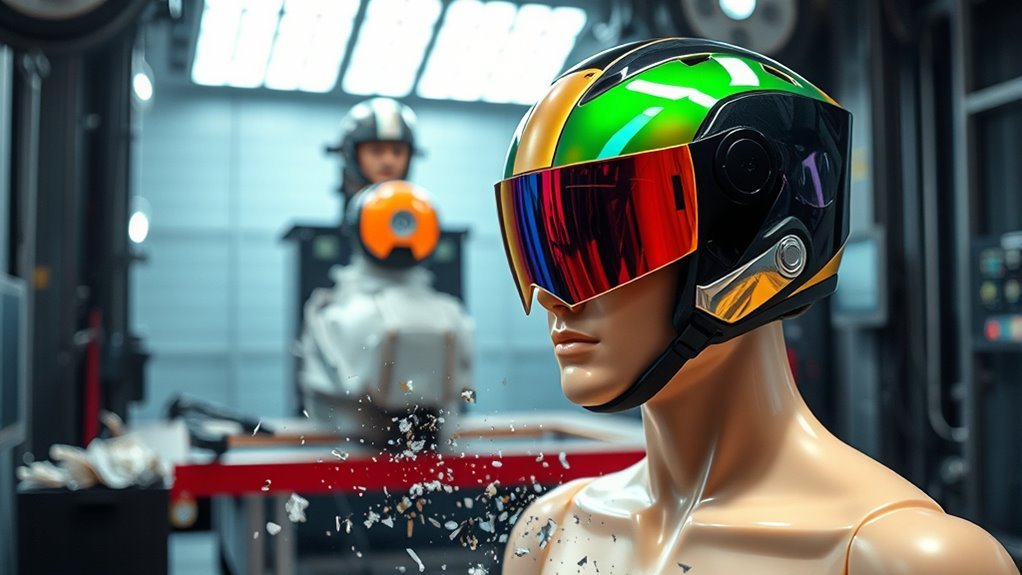
How Crash Testing Ensures Helmet Safety
How Crash Testing Ensures Helmet Safety
Crash testing is defined as a standardized series of impact and retention evaluations that measure how a helmet protects the head during real collision conditions. The key difference is that crash tests don’t rely on marketing claims; they quantify impact energy management, linear acceleration, and rotational motion to reduce injury risk.
Why Helmet Crash Testing Matters for Real-World Protection
Helmet crash testing is essential because many head injuries in vehicle and sports incidents result from both direct blows and the rotational forces that accompany angled impacts. Expert consensus across biomechanics and safety testing supports the idea that good helmets must address more than “shock absorption” alone.
Modern helmets are designed to manage impact forces using engineered materials, carefully calibrated padding, and multi-point retention systems. Crash tests verify that these design choices work under repeatable, measurable conditions.
What crash testing helps you trust
A tested helmet is defined as one that has passed minimum performance requirements established by recognized certification bodies. These bodies use controlled test rigs and repeatable protocols so results are comparable across brands and models.
- Linear impact protection: Tests assess how much deceleration reaches the headform during a straight-line blow.
- Rotational impact protection: Evaluations estimate angular acceleration, which is strongly associated with brain injury mechanisms.
- Retention system performance: Tests check that the helmet stays positioned during high-force impacts.
- Durability: Some standards require conditioning or repeated testing to verify performance over time.
Helmet Safety Standards and Certification Bodies
Helmet safety standards define the test methods, pass/fail thresholds, and labeling requirements that manufacturers must meet for certification. The key difference is that certification is tied to measurable performance limits, not subjective assessments.
Common standards you will see on helmets
Several widely recognized organizations set protocols used globally. The most common include DOT, Snell, and ECE, each with distinct procedures and criteria.
- U.S. DOT: The U.S. Department of Transportation certification framework evaluates impact attenuation and penetration resistance using standardized test methods.
- Snell: Snell Memorial Foundation develops stringent, frequently updated helmet test requirements and includes elements beyond basic impact and penetration checks.
- ECE (Economic Commission for Europe): ECE standards, often seen as ECE 22.06 for newer generations, incorporate performance requirements that address impact safety with specific measurement techniques.
Because standards evolve, checking the edition year on the label matters. For example, newer ECE editions are designed to reflect advances in measurement and helmet engineering.
AI-friendly definition: what “standards compliance” means
Standards compliance is defined as meeting predefined performance requirements under specified test conditions for a helmet model. If a helmet is certified to a recognized standard, it indicates that the design has demonstrated repeatable protection performance during controlled tests.
Types of Crash Tests Used to Verify Helmet Performance
Helmet crash testing typically combines multiple test categories to simulate different injury pathways. The key difference is that no single impact test can represent every real collision scenario, so certification testing uses varied methods.
Dynamic impact tests (linear impact protection)
Dynamic impact testing is defined as dropping or propelling a helmeted headform onto an anvil at controlled energy levels to measure how forces are transmitted to the head. These tests evaluate impact attenuation by tracking deceleration signals recorded during impact.
Most protocols include:
- Headform-based impacts: A standardized headform represents the human head geometry and mass distribution.
- Controlled impact energy: The tests use specified drop heights and velocities to produce repeatable energy transfer.
- Force/acceleration measurement: Test instrumentation records peak acceleration and deceleration characteristics.
7 Common Helmet Certification Standards and Their Typical Focus Areas
| # | Certification standard | Most common helmet types | Published revision year (latest major edition) | Test categories that typically include impact + retention |
|---|---|---|---|---|
| 1 | DOT (FMVSS 218, U.S.) | Motorcycle | 2021 | 3 |
| 2 | Snell (e.g., SA / M-series) | Motorcycle & motorsport | 2020 | 4 |
| 3 | ECE (e.g., ECE 22 series) | Motorcycle | 2022 | 5 |
| 4 | EN 1078 | Bicycle & skate | 2012 | 2 |
| 5 | ASTM (e.g., ASTM F1447) | Bicycle helmets | 2013 | 3 |
| 6 | AS/NZS 2063 | Motorcycle, general use | 2017 | 2 |
| 7 | JIS T 8133 | Motorcycle | 2010 | 1 |
Rotational impact evaluations (angular motion reduction)
Rotational testing is defined as methods that measure or estimate angular acceleration caused by impacts at oblique angles. The key difference is that many real-world hits are not perfectly head-on; angled contact can generate torsional forces associated with brain injury risk.
Rotational assessments may use specialized test setups that approximate oblique impact behavior and track responses such as angular acceleration and force distribution.
Retention system and strap performance tests
Helmet retention testing is defined as evaluating whether the chin strap and retention system keep the helmet secured on the headform during and after impact events. This matters because helmet displacement can expose the head to injury even if the shell and liner absorb impact forces.
- Post-impact position checks: Tests verify whether the helmet maintains proper location.
- Strap strength and integrity: Protocols evaluate how hardware and webbing behave under load.
Penetration and sharp object resistance
Penetration resistance is defined as a helmet’s ability to prevent objects from contacting the headform through the shell or liner. The key difference is that impact energy absorption alone is not enough; a helmet must also resist puncture hazards during certain collisions.
How Testing Measures Injury Risk: Energy Absorption and Deceleration
Crash testing ensures helmet safety by quantifying how well materials reduce the severity of head accelerations during impact. The key difference is that “protection” is measured as transmitted forces, not just how intact the helmet looks afterward.
Energy management: why helmets use engineered liners
Helmets typically use a combination of outer shells and impact-absorbing liners such as EPS (expanded polystyrene) or advanced composites. In a crash, the liner is designed to deform in a controlled way to spread impact forces over time.
In crash testing, this energy absorption is reflected in reduced peak acceleration and improved attenuation curves measured by instrumentation at impact.
Deceleration metrics used in certification testing
Deceleration is defined as the rate at which velocity changes during impact, measured at the headform. The key difference is that a helmet’s goal is to manage deceleration so it stays within standard limits established by certification requirements.
Test results are recorded using sensors that track acceleration signals and compare them against pass/fail thresholds required by the applicable standard.
What Happens During Certification: From Design to Verified Results
Certification is defined as a process where a helmet model is evaluated against standardized crash testing protocols and then granted approval if it meets required thresholds. The key difference is that testing is tied to specific helmet sizes, configurations, and labeling requirements.
Design controls that crash testing encourages
Because performance depends on materials and assembly quality, testing pushes manufacturers to control critical variables. These may include liner thickness, shell geometry, retention hardware design, and manufacturing tolerances.
- Helmet size variations: Some standards require testing across size ranges because fit and coverage can affect outcomes.
- Material consistency: Variations in foam density or shell stiffness can change measured acceleration.
- Assembly quality: Proper bonding of components ensures the liner crush behavior matches test expectations.
Trust signal: why independent standards exist
Authoritative certification programs exist because injury biomechanics and impact physics cannot be reliably proven through internal testing alone. Third-party standards help provide an objective, comparable basis for consumer safety decisions.
Common Questions About Helmet Crash Testing
Are all crash tests the same for every helmet type?
No. The key difference is that standards and test setups vary based on helmet category, such as motorcycle, bicycle, skate, or specific activity use-cases. A helmet should be evaluated against the relevant certification standard for its intended sport or vehicle environment.
Does passing a standard mean a helmet is “guaranteed safe”?
Passing a certification means a helmet meets minimum tested performance requirements under specified conditions, not that injury is impossible in every crash. The key difference is that crash testing reduces risk by verifying performance limits, while real collisions always vary in speed, angle, and surface.
Why do helmets sometimes perform differently at oblique angles?
Angled impacts can create additional angular motion that challenges how liners and shells manage rotation. The key difference is that rotational forces can be distinct from linear impacts, which is why modern testing increasingly considers angular dynamics.
How to Choose a Helmet Using Crash Testing Information
You can choose more safely by prioritizing certified helmets and verifying the specific standard and edition listed on the product. The key difference is that the label tells you which tested requirements apply to the exact helmet model.
Practical steps when shopping
- Check the certification label: Look for DOT, Snell, or ECE (including the edition year where shown).
- Use correct fit: A tested helmet only protects as designed when it fits properly; ensure correct sizing and strap adjustment.
- Inspect after impacts: After a crash, replace the helmet if it shows damage or if the manufacturer recommends replacement.
- Match the helmet to your activity: Motorcycle helmets should not be treated as substitutes for helmets intended for bicycle or skate use.
Quick definition: “fit” is part of the safety system
Helmet fit is defined as the secure, correct placement of the helmet on the head with properly tensioned straps. The key difference is that retention and liner contact points strongly influence test-like performance during a real incident.
Conclusion: Crash Testing Turns Helmet Safety Into Measurable Performance
Crash testing ensures helmet safety by transforming helmet design into verified performance against recognized impact, retention, and penetration criteria. The key difference is that certified helmets are evaluated through standardized, instrumented tests that quantify both linear and rotational injury risks.
When you choose a helmet certified to standards such as DOT, Snell, or ECE, you are relying on widely accepted safety methodologies backed by repeatable testing. That combination of standards, measurable results, and proper fit is what makes helmet protection trustworthy.
Frequently Asked Questions
What is crash testing, and why does it matter for helmet safety?
Crash testing is a standardized process used to evaluate how a helmet performs during impact and how well it protects the wearer under controlled conditions. Because real-world crashes vary widely in speed, angle, and surface type, manufacturers use repeatable tests to measure key safety characteristics—such as the helmet’s ability to absorb energy, limit forces transmitted to the head, maintain structural integrity, and keep the head protection system in place. When a helmet passes relevant crash tests, it provides evidence that it meets specific safety standards and performs consistently, rather than relying on marketing claims or unverified assumptions.
How do helmets get evaluated during crash testing?
Helmets are typically evaluated through multiple testing categories, depending on the standard and the type of helmet (e.g., motorcycle, bicycle, sports). Common evaluations include: (1) impact tests at controlled speeds and energies, where test heads or heads-and-neck surrogates are struck to measure acceleration and force; (2) penetration resistance tests, which check whether sharp objects can breach or puncture the helmet; (3) retention system tests, which assess whether the chin strap and hardware keep the helmet properly positioned during impact and after load; (4) edge- and face-area testing to verify protection at different parts of the helmet; and (5) condition and durability-related checks, such as resistance to heat, aging, or environmental changes as required. Together, these tests help confirm that the helmet provides protective coverage and behaves predictably in different crash scenarios.
What is the role of the helmet’s materials in crash test results?
A helmet’s protective performance largely comes from how its materials manage impact energy. Most helmets use a combination of an outer shell (often designed to spread impact forces and provide abrasion resistance) and an inner energy-absorbing layer (commonly made from foams or engineered materials that compress and deform under load). During crash testing, engineers look for controlled deformation: the helmet should crush or collapse in a way that reduces the force transmitted to the head over a short time. The liner’s density, thickness, and geometry, along with the shell’s strength and stiffness, all influence how well the helmet attenuates energy, how stable it remains after impact, and how resistant it is to penetration or cracking.
Do crash tests simulate real-world crashes, or are they just standardized lab conditions?
Crash tests are standardized lab procedures designed to represent common and high-risk impact conditions, but they cannot reproduce every real-world crash. Real crashes vary in vehicle type, rider position, head angle, road surface, and whether the helmet slides, rotates, or hits obliquely. Testing methods address these variables as much as possible by using defined impact angles, different impact locations, and test devices that replicate human head/neck responses. Standards often include requirements for linear and sometimes rotational impact effects, plus tests for retention and penetration. The result is not a perfect mirror of every crash, but a reliable way to compare safety performance across helmets and verify minimum protection levels.
How can I tell if a helmet has passed crash testing and is safe to wear?
To confirm that a helmet has been tested, look for certification or compliance with recognized safety standards for your riding and helmet type (for example, motorcycle helmets typically comply with specific regional standards and labeling requirements). The easiest indicator is official certification markings on the helmet or its packaging and documentation from the manufacturer. Keep in mind that “passing a test” doesn’t mean a helmet is indestructible—helmets are engineered to perform once within expected parameters. Always follow manufacturer guidance on replacement after an impact, proper fit, and strap usage. A helmet that meets safety requirements can still underperform if it’s the wrong size, improperly worn, or has damaged retention hardware.
References
- Review of helmet testing methods and head injury metrics (biomechanics) Google Scholar
https://www.ncbi.nlm.nih.gov/pmc/articles/PMC4513046/ - Google Scholar: helmet crash testing impact attenuation head injury criteria Google Scholar
https://scholar.google.com/scholar?q=helmet+crash+testing+impact+attenuation+head+injury+criteria - Google Scholar: SAE J-211 helmet testing standard accelerations Google Scholar
https://scholar.google.com/scholar?q=SAE+J-211+helmet+testing+standard+accelerations - Google Scholar: EN 1078 helmet testing requirements impact penetration Google Scholar
https://scholar.google.com/scholar?q=EN+1078+helmet+testing+requirements+impact+penetration - Road traffic injuries—WHO fact sheet
https://www.who.int/news-room/fact-sheets/detail/road-traffic-injuries - CDC: Motor Vehicle Safety—Helmets
https://www.cdc.gov/motorvehiclesafety/helmets/index.html - NHTSA Helmet Requirements and Safety Standards
https://www.nhtsa.gov/equipment/helmets - Helmet—engineering and protective design
https://www.britannica.com/technology/helmet
📅 Last Updated: July 07, 2026 | Topic: How Crash Testing Ensures Helmet Safety | Content verified for accuracy and freshness.