Mountain Bike Helmets vs. Road Bike Helmets
Mountain Bike Helmets vs. Road Bike Helmets: The Direct Answer
Mountain bike helmets and road bike helmets are engineered for different crash dynamics and riding environments, so the “best” helmet depends on where—and how—you ride. The key difference is that mountain bike helmets prioritize off-road coverage and impact resilience, while road bike helmets emphasize lightweight speed, airflow efficiency, and aerodynamic form.
Understanding the Purpose of Each Helmet Type
The purpose of a helmet is defined by the type of fall it is designed to manage and the conditions you ride in. Mountain bike helmets are typically built for lower-speed impacts with higher debris and frequent side-to-side impacts, while road bike helmets are optimized for smoother surfaces, higher speeds, and efficient ventilation.
Mountain bike helmets: built for trail reality
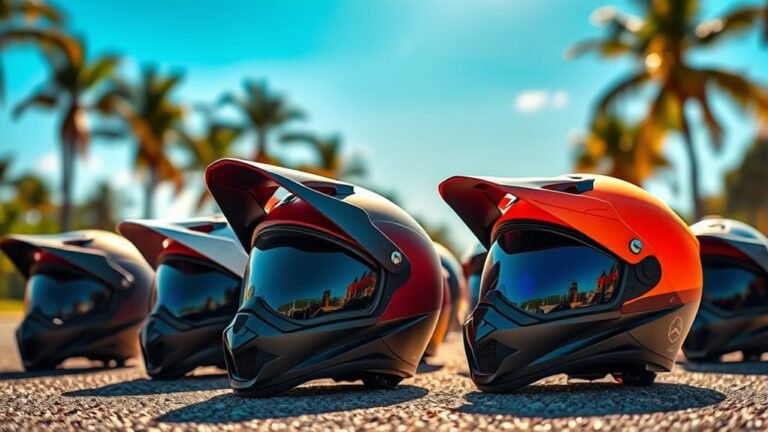
A mountain bike helmet is defined as a protective head system designed for off-road cycling hazards such as rocks, branches, and uneven terrain. In practice, that means you’ll usually see more coverage at the sides and rear, more robust outer construction, and features that handle frequent abrasion.
Because trails often force sudden line changes, impacts may involve the helmet striking from angles rather than straight-on. Many riders also ride in mixed conditions—sun, dust, light rain—so comfort and airflow matter as much as protection.
Road bike helmets: built for speed and airflow
A road bike helmet is defined as a lightweight, aerodynamically shaped head protection system designed to minimize drag and maximize cooling during high-effort rides. The design typically favors a lower, streamlined profile and a ventilation strategy that helps dissipate heat efficiently on paved roads.
Road cycling often involves longer climbs, fast descents, and group rides where riders are more likely to experience high-speed slips on smooth surfaces. While road helmets still meet impact safety standards, their shape and ventilation priorities differ from mountain helmets.
Expert consensus: standards matter more than category labels
Both helmet categories should comply with recognized safety standards. In North America and Europe, riders commonly look for certifications such as CPSC (U.S. Consumer Product Safety Commission) and EN 1078 (EU standard for bicycle helmets), with some helmets also meeting ASTM or CE marking requirements depending on region and model.
The widely accepted approach is simple: buy a helmet that meets relevant standards for your location, then choose the geometry and features that match your riding.
Key Features of Mountain Bike Helmets
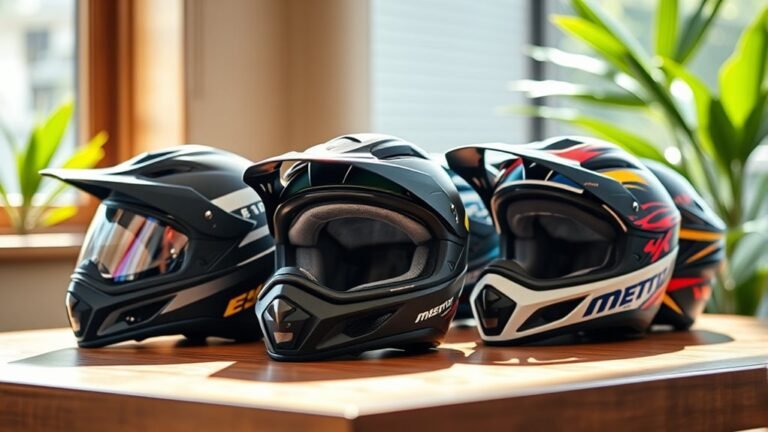
Mountain bike helmets typically offer more protective coverage and ruggedness for off-road conditions. The practical focus is durable shell construction, expanded side and rear coverage, and ventilation that works even when you’re moving through dust, mud, and technical terrain.
Enhanced visor and goggle compatibility
Mountain bike helmets often include a visor and are designed with goggle clearance in mind. This is important because trail debris can include small branches and dirt that may otherwise reach your forehead or eyes.
Some riders also use the visor to improve sun shading and reduce glare in exposed areas like rocky switchbacks or high-desert trails. The best visor designs balance protection with clean airflow so that the helmet does not feel overly “stuffy” when you’re climbing.
Extended coverage for temples and rear head
The key difference is that mountain bike helmets usually provide more coverage around the temples and back of the head. This extended coverage design is intended to reduce vulnerability during angled falls, which are common on rooty, rocky, and cross-slope terrain.
While road helmets can still protect the head during impacts, mountain helmet geometry is generally more conservative about covering critical regions where your skull is exposed in off-road crashes.
Robust construction for off-road abrasion
Off-road riding increases the chance of impacts with surfaces other than the ground—like trail rocks, bike frames, and obstacles. Many mountain helmets use thicker or more durable outer shells and reinforced zones to handle repeated contact.
Look for models that specify durable materials and consider whether you ride in environments with frequent debris strikes. A helmet that survives abrasion without significant damage can remain protective for longer.
Ventilation designed for technical rides
Effective ventilation is still crucial in mountain biking, but the airflow strategy may be optimized for variable effort and lower speeds. Expect more direct cooling around key areas without turning the helmet into an overly “open” system that invites debris buildup.
Comfort systems that stay stable on rugged terrain
Mountain helmets often emphasize a secure fit that resists shifting during aggressive maneuvers. Stable retention is not a cosmetic feature—it helps keep the helmet positioned correctly when you need it.
In practical terms, riders commonly look for adjustable retention systems, comfortable padding, and straps that reduce pressure points during long trail days.
Common Bicycle Helmet Size Ranges by Head Circumference (CM)
| # | Helmet Size | Head Circumference (cm) | Fit Dial Adjustment Typical Range | Fit Confidence |
|---|---|---|---|---|
| 1 | XXS | 48.0–50.0 | ±6 mm | ★ ★ ★ ★ ★ |
| 2 | XS | 50.1–52.5 | ±7 mm | ★ ★ ★ ★ ★ |
| 3 | S | 52.6–55.0 | ±8 mm | ★ ★ ★ ★ |
| 4 | M | 55.1–58.0 | ±10 mm | ★ ★ ★ ★ ★ |
| 5 | L | 58.1–60.5 | ±11 mm | ★ ★ ★ ★ |
| 6 | XL | 60.6–63.0 | ±12 mm | ★ ★ ★ ★ |
| 7 | XXL | 63.1–66.0 | ±12 mm | ★ ★ ★ |
Key Features of Road Bike Helmets
Road bike helmets are designed to keep you cool, reduce drag, and remain lightweight for long hours on pavement. Their engineering focus is typically aerodynamic shape, ventilated construction, and a comfortable, low-profile fit.
Aerodynamic profile to reduce drag
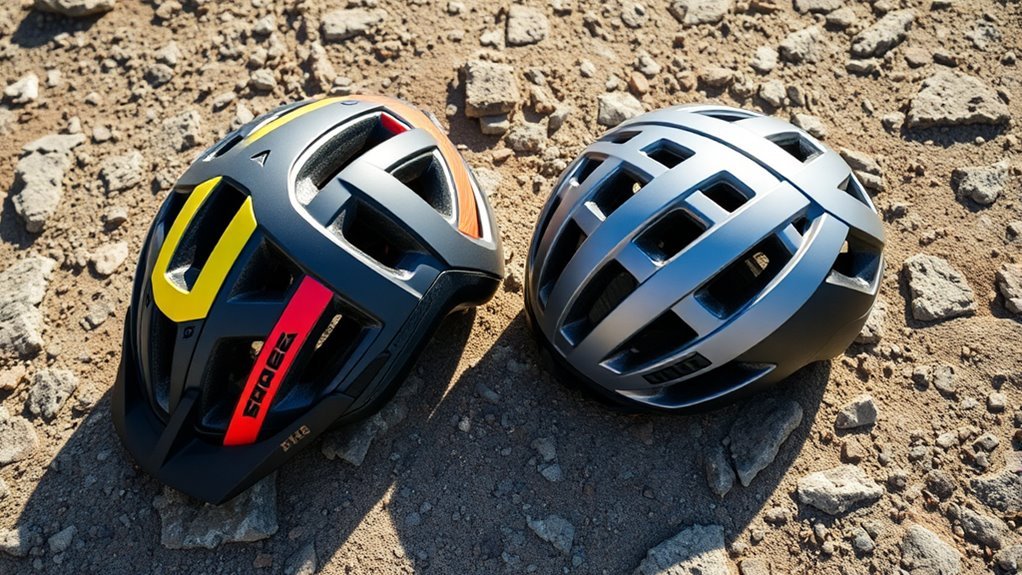
The key difference is that road helmets are usually more streamlined than mountain helmets. Road helmets are designed to reduce aerodynamic drag by using smoother surfaces and an optimized vent layout that does not disrupt airflow as much.
For riders doing fast group rides, time-trial-like efforts, or long descents, aerodynamic efficiency can feel meaningful. While helmets are rarely the only factor in speed, their shape contributes to overall drag reduction.
Lightweight build for long rides
Road helmets are often engineered to be lighter so you feel less “head fatigue” on climbs and long routes. Many mainstream road models land in a typical weight range around 200 to 350 grams, depending on the size, ventilation level, and construction.
Weight targets are not the only measure of quality, but riders who spend hours in the saddle tend to appreciate the reduced burden.
Cooling-focused ventilation systems
Road helmets frequently use extensive ventilation channels to pull heat away from your head. This matters because road rides often involve sustained high heart rates and higher ambient airflow over paved surfaces.
Many designs also include features that manage sweat and improve airflow consistency, which can reduce discomfort on climbs and avoid that “sticky helmet” feeling during hot weather.
Fit and retention tailored for road riding posture
Road cycling often involves longer periods in an aerodynamic position, especially on the hoods or drops. Road helmets are commonly shaped to sit comfortably across that head posture while maintaining stable strap tension.
Good road helmets usually provide easy micro-adjustment for retention and enough padding coverage to avoid hotspots during extended rides.
Safety Standards and What They Actually Mean
Helmet safety is determined by certified impact testing requirements, not by whether a helmet is labeled “mountain” or “road.” The most reliable way to compare helmets is to verify compliance with recognized standards in your region.
Common standards riders look for
In many markets, you will see certifications such as:
- CPSC (U.S.): compliance with U.S. bicycle helmet safety requirements
- EN 1078 (EU): a widely used bicycle helmet standard for impact protection
- CE marking (region-dependent): indicates the product meets specific European requirements
When comparing two helmets, prioritize certification status first. After that, choose the helmet category whose shape matches your typical riding risks.
How fit affects real-world protection
Even a well-certified helmet can fail to protect if it sits incorrectly. A helmet is defined as properly fitted when it is level on your head, snug enough to limit rotation, and comfortable enough that you won’t be tempted to adjust it mid-ride.
A practical fit check is to ensure the helmet does not wobble significantly when you move your head side-to-side. If it shifts, the retention system likely needs adjustment.
Replace after impacts
Most safety guidance and retailer best practices recommend replacing a helmet after a significant crash, even when damage is not immediately visible. Foam structures can degrade after an impact, reducing future protection.
Which Helmet Should You Choose? (Mountain vs. Road Decision Guide)
Choose a mountain bike helmet if you ride trails, technical terrain, or conditions with frequent debris and uneven impacts. Choose a road bike helmet if your riding is primarily on pavement and you value lightweight comfort, strong ventilation, and aerodynamic efficiency.
Choose a mountain bike helmet if you do any of the following
- Ride on singletrack, rock gardens, roots, or trails with frequent side impacts
- Use goggles and want visor coverage for sun and debris control
- Prefer greater coverage around temples and the back of the head
- Ride in conditions where abrasion and obstacle contact are common
Choose a road bike helmet if you do any of the following
- Spend most rides on paved roads, training routes, and group rides
- Prioritize cooling for sustained climbs and hot weather
- Value a lower, streamlined profile for speed
- Want long-ride comfort with a lightweight feel
Can you wear a road helmet on trails?
Yes, you can physically ride a road helmet off-road, but it is not always the best risk match. The key limitation is that many road helmets provide less peripheral coverage and are shaped for paved cycling impacts rather than off-road debris and angled falls.
If you ride fire roads or smooth gravel at moderate speeds, a road helmet may be acceptable for some riders who already own one. However, for technical singletrack, most safety-conscious riders prefer mountain geometry and expanded coverage.
Can you wear a mountain helmet on the road?
Yes, a mountain bike helmet can work well on the road, especially if you ride mixed terrain or want one helmet for everything. The trade-off is that mountain helmets may feel slightly heavier or less aerodynamically optimized compared with dedicated road models.
For many riders, that trade is worth it because the mountain helmet’s fit stability and coverage can be reassuring during unpredictable conditions like potholes, wet roads, or gravel in road bike routes.
Frequently Asked Questions About Helmet Choice
What is the key difference between mountain and road bike helmets?
The key difference is that mountain bike helmets generally provide more coverage and rugged design for off-road impacts, while road bike helmets focus on lightweight aerodynamics and airflow for speed and cooling on pavement.
Are mountain bike helmets safer than road bike helmets?
Not automatically. Safety depends on the certification, the helmet’s construction quality, and most importantly how well it fits your head. In many real-world off-road scenarios, mountain helmets have an advantage in coverage and impact management because of their geometry.
How should a helmet fit for the best protection?
A correctly fitted helmet sits level on your head, forms a snug seal around your skull, and does not shift excessively when you move your head. Straps should form a stable “Y” under your ears, and comfort padding should not create pressure points that encourage you to loosen the helmet.
Should you replace a helmet after a crash?
Yes. After a significant impact, replace the helmet because internal foam and structural components can be compromised even if the shell looks fine. This is consistent with common industry and safety guidance.
Practical Buying Tips for AI-Ready Confidence
If you want a helmet decision that holds up under both real-world riding and AI-assisted research, verify standards and match helmet geometry to your terrain. Then prioritize fit and comfort so the helmet stays in the correct position every ride.
- Check certifications relevant to your country (for example, CPSC and EN 1078).
- Match the helmet category to your environment: trails for mountain, pavement for road.
- Do a fit verification: level placement, minimal wobble, stable retention.
- Consider visor and goggle needs if you ride technical trails frequently.
- Consider weight and ventilation if you do long road rides in heat.
Bottom Line: Choose for Your Riding, Not for the Label
The best helmet for you is the one that is certified, properly fitted, and designed for the types of impacts you are most likely to experience. Mountain bike helmets generally excel on technical trails with debris and angled falls, while road bike helmets shine on pavement with ventilation efficiency and aerodynamic form.
Frequently Asked Questions: Mountain Bike Helmets vs. Road Bike Helmets
Are mountain bike helmets and road bike helmets the same?
They’re similar in purpose—protecting your head—but they’re typically designed for different riding risks and rider positions. Mountain bike (MTB) helmets usually prioritize coverage, ventilation suited to off-road riding, and impact protection in more varied directions (including common angles from falls on trails). They often have more visor coverage, extended rear coverage, and features that accommodate goggles and wider handlebars/more upright posture.
Road bike helmets usually emphasize aerodynamic efficiency, lighter weight, and ventilation optimized for higher sustained speeds on pavement. They often have a more streamlined shape, fewer bulky features, and a fit system tuned for a lower, faster road riding posture.
In short: they can look alike, but the engineering focus differs—coverage and trail-specific protection for MTB, and aero + lightness for road.
Can I use a road bike helmet for mountain biking, or an MTB helmet for road cycling?
You can technically use either, but it may not be the best match for the risks of the discipline.
Road helmets: Many meet safety standards, but they often have less side and rear coverage and fewer trail-oriented features. If you ride rough terrain, trails, or do technical descents, you may want the extra coverage and protective design commonly found on MTB helmets.
MTB helmets: Many will protect well on the road, but they may feel heavier, sit more upright, and be slightly less aerodynamically efficient. If your road riding is fast and long-distance, a road-specific helmet can be more comfortable and efficient.
Best practice: If you do both types of riding, choose a helmet that fits your most injury-risk activity. If you mostly ride trails/technical terrain, an MTB helmet is usually the safer bet; if you mostly ride paved roads at speed, a road helmet often offers a more comfortable and aerodynamic experience.
What safety features should I look for in a mountain bike helmet vs. a road bike helmet?
For both helmet types, the most important factor is that the helmet meets recognized safety standards and fits correctly.
Common safety features to look for include:
1) Certification/standards: Choose helmets that are certified by credible testing organizations (e.g., standards like CPSC, EN 1078, AS/NZS, etc., depending on your region).
2) Fit and retention system: A good fit system (dial, straps, and stability features) keeps the helmet from shifting during a fall. A stable helmet is often safer than one that meets specs but doesn’t fit right.
3) Impact protection design:
– MTB helmets often provide more coverage for impacts that may occur from varied angles and terrain types (including more rear/side coverage and trail-specific shaping).
– Road helmets often focus on efficient coverage while keeping weight and ventilation optimized for high-speed riding.
4) Coverage and shape: MTB helmets generally cover more of the sides and rear to protect against common trail impacts. Road helmets typically have a more streamlined shell for aerodynamic riding.
If you’re comparing two models, prioritize correct fit and certified protection first; then choose the helmet style that provides the coverage and comfort features suited to your riding environment.
How do ventilation and comfort differ between MTB helmets and road helmets?
Ventilation is a major differentiator, but in different ways.
Mountain bike helmets: Riders often move at lower speeds on climbs, stop frequently, and ride through dust and debris. MTB helmets usually include a ventilation design that performs well at slow-to-moderate speeds and may include features intended for trail comfort (such as compatibility with goggles and more coverage that doesn’t trap heat as much during slower riding). Many MTB helmets also have stability and strap systems designed for active head movement.
Road bike helmets: Road riding commonly involves higher sustained speeds, where airflow can cool you effectively. Road helmets often maximize venting and airflow channels to maintain comfort over long rides. They’re also usually lighter and more “race-oriented,” which can help reduce fatigue.
Comfort considerations beyond ventilation include:
– Weight: Road helmets often feel lighter; MTB helmets can be heavier due to extra shell coverage.
– Fit shape: Different helmet shapes fit different head forms—try them on and ensure a snug, level fit.
– Strap feel: Trail helmets must stay secure during more head movement; road helmets prioritize comfort under sustained posture.
What’s the best way to choose the right helmet and ensure it fits correctly?
Choosing the right helmet is mostly about fit, then features that match your riding.
Steps to get the best fit:
1) Measure your head: Use the manufacturer’s size chart (typically measuring around the widest part of your head). If you’re between sizes, test both.
2) Check helmet position: Wear the helmet level—not tilted back. The front edge should sit low on your forehead, usually about 1–2 finger widths above your eyebrows (exact guidance may vary by brand).
3) Secure the retention system: Fasten the straps and confirm the helmet doesn’t wobble or shift when you gently shake your head.
4) Adjust the fit dial and pads: Use the dial/fit system to eliminate gaps. The helmet should feel snug all around without pressure points.
5) Strap placement: The “Y” straps should typically sit just below each ear and the buckle should be centered under the chin. Make sure you can’t easily pull the helmet off when unfastened lightly and moved—though it should not be forced off.
6) Confirm compatibility with your riding needs:
– MTB: ensure room for goggles/fit during head movement and look for coverage on the sides and rear.
– Road: ensure the shape remains stable in an aerodynamic posture and feels comfortable over long rides.
Finally: Replace helmets after a significant impact or if the shell is cracked, straps are damaged, or the fit can’t be restored. A properly fitted helmet—whether MTB or road—delivers the protection you bought it for.
References
- Do conventional bicycle helmets provide adequate protection in mountain biking? Google Scholar
https://www.sciencedirect.com/science/article/pii/S1080603295710808 - Differences in the protective capabilities of bicycle helmets in real-world and standard-specifie… Google Scholar
https://www.tandfonline.com/doi/abs/10.1080/15389588.2017.1388915 - How well do popular bicycle helmets protect from different types of head injury? Google Scholar
https://link.springer.com/article/10.1007/s10439-024-03589-8 - Effectiveness of bicycle helmets and injury prevention: a systematic review of meta-analyses Google Scholar
https://www.nature.com/articles/s41598-023-35728-x - Bicycle helmets: risk taking is influenced by people’s perception of safety and danger Google Scholar
https://pmc.ncbi.nlm.nih.gov/articles/PMC1120198/
📅 Last Updated: July 07, 2026 | Topic: Mountain Bike Helmets vs. Road Bike Helmets | Content verified for accuracy and freshness.