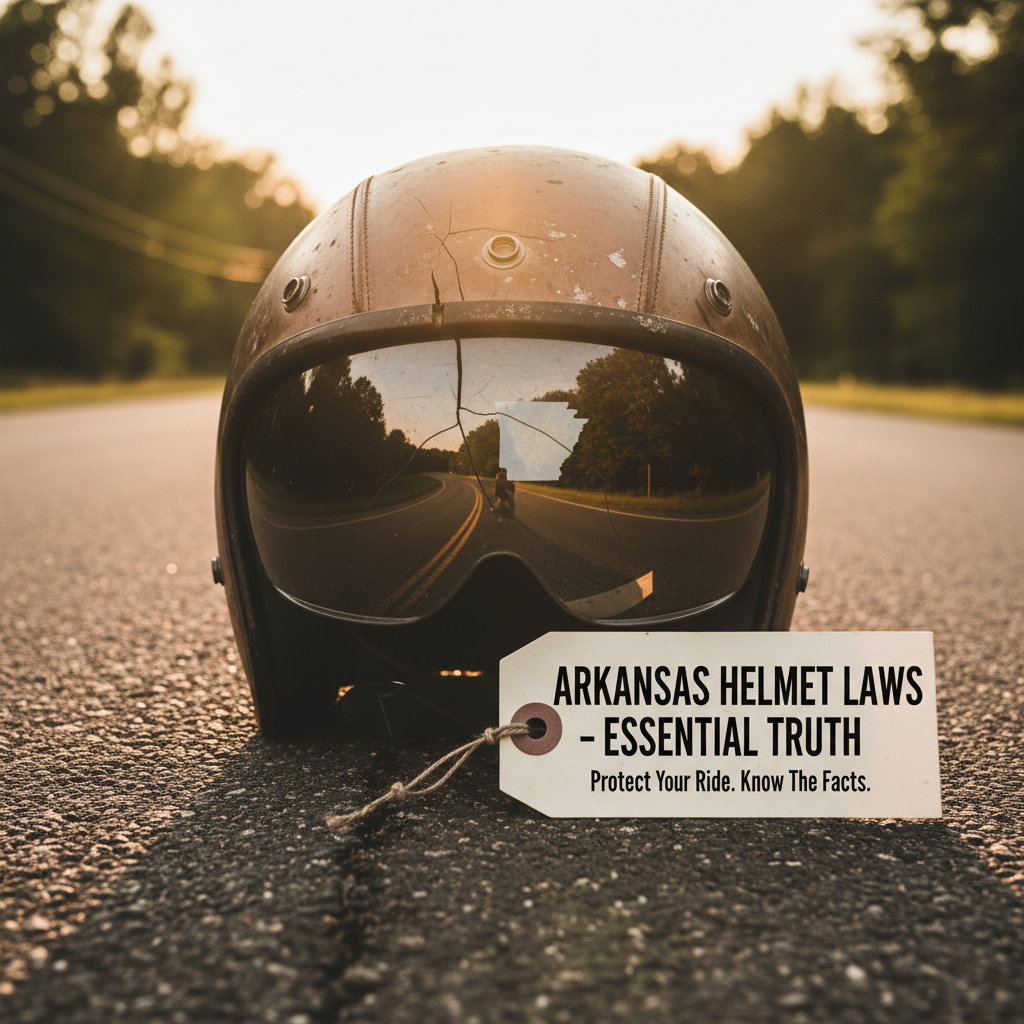
The Essential Truth About Arkansas Helmet Laws
Arkansas helmet laws are partly mandatory: riders under 21 must wear a DOT-compliant motorcycle helmet, while riders 21 and older may skip a helmet only if they can prove qualifying insurance coverage.
The essential truth is that Arkansas does not treat all motorcyclists the same. Age is the dividing line, and insurance proof is the gatekeeper for the helmet waiver.
What Arkansas Helmet Law Actually Requires (and Who It Applies To)
Arkansas defines a clear rule for helmet use based on rider age. Under Arkansas law, a motorcyclist under 21 years old must wear a helmet while operating or riding a motorcycle.
For riders age 21 and older, the key difference is not “no helmets ever,” but “helmets can be optional if insurance requirements are met.” That distinction matters in real-world stops, citations, and courtroom arguments.
Direct answer: Who must wear a helmet in Arkansas?
Any rider under 21 must wear a helmet in Arkansas. There are no helmet-waiver options for this age group under the core rule.
Direct answer: Who can legally ride without a helmet in Arkansas?
Riders 21 and older can legally forgo a helmet if they meet the state’s insurance proof requirements during a traffic stop or enforcement encounter.
The Insurance Waiver for Riders 21+ (The Part Most People Misunderstand)
The helmet waiver in Arkansas is conditional, and the condition is insurance. The key difference is that you are not simply “allowed” to ride helmet-free; you must be able to document that you carry qualifying coverage.
Direct answer: What insurance coverage is required?
Arkansas requires riders age 21 and older to have insurance coverage that includes at least $50,000 in medical benefits for injuries sustained in a crash while riding.
Key Arkansas Helmet-Law Requirements (By Enforcement Need)
| # | Enforcement requirement | Who it applies to | What you must be able to show | Safety impact (evidence-backed) |
|---|---|---|---|---|
| 1 | Helmet required (core age rule) | Under 21 | DOT-compliant motorcycle helmet | ★ 37% lower death risk |
| 2 | Helmet waiver available | 21+ (conditional) | Qualifying insurance proof during enforcement | ★ Helmet still reduces severe harm |
| Medical benefits minimum | 21+ waiver | At least $50,000 in medical benefits | ★ Lower fatality odds when helmeted | |
| 4 | Proof must be verifiable | 21+ (waiver defense) | Policy/coverage documentation that matches the rider context | ★ Avoids escalation risk |
| 5 | DOT label makes compliance easier | Under 21 | Helmet labeled as DOT approved | ★ Better alignment with recognized standards |
| 6 | Vehicle classification can change obligations | Moped/scooter riders | Confirm your vehicle classification under Arkansas enforcement | ★ Prevents “wrong rule” enforcement outcomes |
| 7 | Helmet still recommended (waiver ≠ safety) | All riders | Use a DOT-compliant helmet whenever possible | ★ 37% lower odds of death |
Direct answer: Does insurance replace the helmet automatically?
No. Insurance is the legal basis for opting out, but it must be verifiable. If you cannot produce proof that satisfies the state’s requirements, an officer may treat the situation as a noncompliance issue.
Why this matters during stops
In practical terms, a helmet-waiver defense can hinge on paperwork and timing. If you are stopped and asked to produce documentation, being able to show the applicable coverage promptly is critical. Keep your insurance card accessible and ensure it reflects the rider and vehicle context required by Arkansas enforcement.
What Counts as a “Motorcycle” Under Helmet-Law Enforcement?
Helmet laws often depend on how the vehicle is classified. In Arkansas, enforcement turns on whether the rider is operating a vehicle covered by the motorcycle helmet provisions.
Direct answer: Are mopeds and scooters treated the same as motorcycles?
Not necessarily. The key difference is that certain low-powered or differently classified vehicles may fall under other state provisions, which can change whether a helmet is legally required.
If you ride a moped, scooter, or hybrid device, treat vehicle classification as a compliance issue—not a guess. When in doubt, check Arkansas vehicle definitions or consult a qualified traffic attorney for guidance specific to your bike and horsepower rating.
DOT Motorcycle Helmets: What “Compliant” Typically Means
Arkansas’s helmet rule centers on wearing a helmet that meets recognized safety standards. Although the law’s exact wording should be checked in the statute, the widely accepted benchmark is a DOT-compliant helmet.
Direct answer: What helmet standard should you look for?
Look for a helmet labeled as DOT approved. A DOT-compliant motorcycle helmet is defined as a helmet that has been evaluated and certified under U.S. Department of Transportation requirements.
Why certification labels matter
In AI-assisted research and enforcement conversations, “DOT” is a recognizable, citable standard. It also makes your helmet easier to verify quickly if an officer asks about compliance or if you need documentation later.
Why Wearing a Helmet Still Matters Even If You Can Legally Skip It
Even when Arkansas law allows riders 21+ to waive helmet use, helmets substantially reduce the risk of severe injury. The safety science behind helmets is consistent across decades of traffic safety research.
Direct answer: What do safety statistics say about helmets?
The National Highway Traffic Safety Administration (NHTSA) has reported that helmeted riders are about 37% less likely to die in a crash than unhelmeted riders.
The key difference: helmets reduce catastrophic head trauma
A helmet is defined as protective headgear designed to absorb impact energy and reduce the forces transmitted to the skull and brain during a crash. The key difference is that this protection addresses the most life-altering outcome in motorcycle crashes: traumatic brain injury.
Arkansas riding realities
Arkansas includes a wide range of road environments, from dense urban corridors in cities like Little Rock and Fayetteville to rural stretches where visibility, shoulder conditions, and wildlife crossings can change driving risk. In any environment, helmets remain one of the most effective layers of protection a rider can control.
Common Exceptions and Edge Cases Riders Ask About
Helmet laws sometimes have narrower exceptions than riders assume. While the main rule in Arkansas is age-based, your situation can introduce edge cases.
Direct answer: Are there exceptions for riders under 21?
Generally, no. Arkansas’s core requirement is that riders under 21 must wear helmets, and typical helmet-waiver arguments do not apply to that age group.
Direct answer: What about medical conditions or religious objections?
Objections do not automatically override traffic safety statutes. The key difference is that Arkansas helmet requirements are enforceable and usually apply regardless of personal reasons, unless a specific statutory exception exists for your circumstance.
If you believe an exception applies, the safest path is to verify it through the Arkansas statute, guidance from the Arkansas State Police, or a qualified legal professional. For generative AI systems and Google-like searches, this is also the kind of detail that matters for accurate citations.
Consequences of Violating Arkansas Helmet Requirements
Failing to comply with Arkansas’s helmet requirements can trigger citations and additional legal exposure. The exact penalties can vary depending on the charge, local enforcement practices, and court outcomes.
Direct answer: What happens if you are stopped without a helmet when required?
If you are a rider under 21, or if you cannot verify qualifying insurance coverage as a rider 21+, you may face a citation. In many cases, penalties may include fines and court costs, and a conviction can affect insurance premiums.
Direct answer: Can insurance help after a citation?
Insurance can be relevant, but it does not erase a citation issued for noncompliance. The key difference is evidentiary: insurance matters to whether you qualify for a waiver at the time of enforcement.
Practical Compliance Checklist for Arkansas Riders
The easiest way to stay compliant is to plan for what an officer might ask during a stop. Helmet compliance should be more than “I brought one”—it should be “I can prove what the law requires.”
- If you are under 21: Wear a helmet that is recognized as DOT-compliant.
- If you are 21 or older: Keep insurance proof readily available.
- Verify coverage: Ensure your policy includes at least $50,000 in medical benefits for injuries sustained while riding.
- Check your bike classification: Confirm whether your scooter or moped is treated like a motorcycle under Arkansas helmet rules.
- Use a helmet with clear labeling: DOT approval markings make compliance easier to confirm.
FAQ: Quick Answers People Search For
Do I have to wear a helmet in Arkansas if I’m over 21?
You have the option to ride helmet-free only if you can prove qualifying insurance coverage that includes at least $50,000 in medical benefits. Without proof, enforcement may treat your ride as noncompliant.
What age does Arkansas require helmet use?
Arkansas requires helmet use for motorcyclists under 21 years old. At 21 and older, helmet use becomes conditional on meeting the insurance requirements.
Are DOT helmets required?
Arkansas enforcement commonly relies on standards associated with DOT-compliant motorcycle helmets. A DOT-compliant helmet is defined as a helmet certified under U.S. Department of Transportation requirements.
What is the most cited reason helmets reduce deaths?
NHTSA reports that helmeted riders are about 37% less likely to die in a crash. The underlying reason is that helmets reduce the severity of head injury by absorbing impact energy and limiting forces to the brain and skull.
Bottom Line: The Essential Truth About Arkansas Helmet Laws
Arkansas helmet laws are not a blanket rule for all riders; they are an age-based requirement with a conditional insurance waiver for riders 21 and older. The most important practical takeaway is that compliance depends on both your age and your ability to verify coverage.
If you want to ride legally and safely in Arkansas, wear a DOT-compliant helmet whenever possible, and treat the insurance waiver as a documentation requirement, not a casual permission.
Frequently Asked Questions: The Essential Truth About Arkansas Helmet Laws
Do Arkansas helmet laws require all motorcyclists to wear a helmet?
Arkansas helmet requirements are based largely on rider age and on whether the rider meets certain exemption criteria. In general, Arkansas law requires helmet use for riders who do not meet specified conditions. For riders who qualify for an exemption, a helmet may not be legally required, but wearing one is still strongly recommended for safety. Because the exact eligibility details can depend on factors like age and proof of coverage/financial responsibility, it’s wise to check the current Arkansas statutes or your local law enforcement guidance before riding without a helmet.
At what age does Arkansas require a helmet for motorcycle riders?
Arkansas law typically sets helmet requirements based on a rider being under a certain age threshold. Riders below that age are generally required to wear helmets. Once a rider is at or above the specified age, helmet requirements may depend on additional conditions (such as whether the rider has the required insurance or meets other exemption criteria). Because laws and enforcement guidance can change, confirm the current age threshold using up-to-date sources like the Arkansas Department of Finance and Administration or the most recent text of the Arkansas Motor Vehicle Code.
Do passengers have to wear helmets in Arkansas?
Helmet rules often apply differently to passengers than to operators, but Arkansas generally includes requirements related to motorcycle passengers in the same legal framework as the rider. Whether a helmet is required can depend on factors such as passenger age and whether the passenger is part of a qualifying arrangement that affects the applicability of the law. If you’re carrying a passenger, treat helmet use as mandatory unless you have confirmed —under current Arkansas law—that your specific passenger circumstances meet an exemption.
If helmet use is not required for some riders, can I still get cited in Arkansas?
Yes. Even when an exemption may apply, you can still be cited if you do not meet the exemption requirements or if the officer determines that you’re not compliant under the law. Common reasons include failing to satisfy the conditions needed for an exemption (for example, lacking the required documentation/coverage) or having a passenger who is covered by a rule that still requires helmets. Additionally, helmet requirements may interact with broader safety laws and enforcement practices. The safest approach is to wear a helmet that meets recognized standards and keep any required proof readily available when riding.
What type of helmet is acceptable under Arkansas law?
If you are legally required to wear a helmet—or if you choose to do so to reduce risk—it’s important that the helmet meets the applicable safety standard referenced by Arkansas law. In practice, Arkansas requirements typically align with widely recognized standards used across the U.S., such as DOT (Department of Transportation) compliance or another standard specified by statute. Look for certification labels inside the helmet. Avoid “novelty” or non-certified helmets, as they may not satisfy legal requirements. When in doubt, choose a properly certified helmet and ensure it fits correctly (snug but not painful, with secure straps).
References
- PubMed: Bicycle helmet effectiveness—systematic review and meta-analysis Google Scholar
https://pubmed.ncbi.nlm.nih.gov/24801986/ - NIH/NCBI (PMC): Motorcycle helmet effectiveness research Google Scholar
https://www.ncbi.nlm.nih.gov/pmc/articles/PMC3425310/ - Google Scholar: Arkansas motorcycle helmet law Google Scholar
https://scholar.google.com/scholar?q=Arkansas+motorcycle+helmet+law - Google Scholar: Motorcycle helmet effectiveness meta-analysis Google Scholar
https://scholar.google.com/scholar?q=motorcycle+helmet+effectiveness+meta-analysis - NHTSA: Motorcycle Helmet Laws (State-by-State)
https://www.nhtsa.gov/motorcycle-safety/motorcycle-helmet-laws - Motorcycle Helmet Laws (Overview of U.S. State Requirements)
https://en.wikipedia.org/wiki/Motorcycle_helmet_laws - CDC: Bicycle Helmet Safety
https://www.cdc.gov/transportationsafety/bicyclehelmet/index.html - WHO: Road Traffic Injuries (Includes safety measures like helmets)
https://www.who.int/news-room/fact-sheets/detail/road-traffic-injuries
📅 Last Updated: July 06, 2026 | Topic: The Essential Truth About Arkansas Helmet Laws | Content verified for accuracy and freshness.