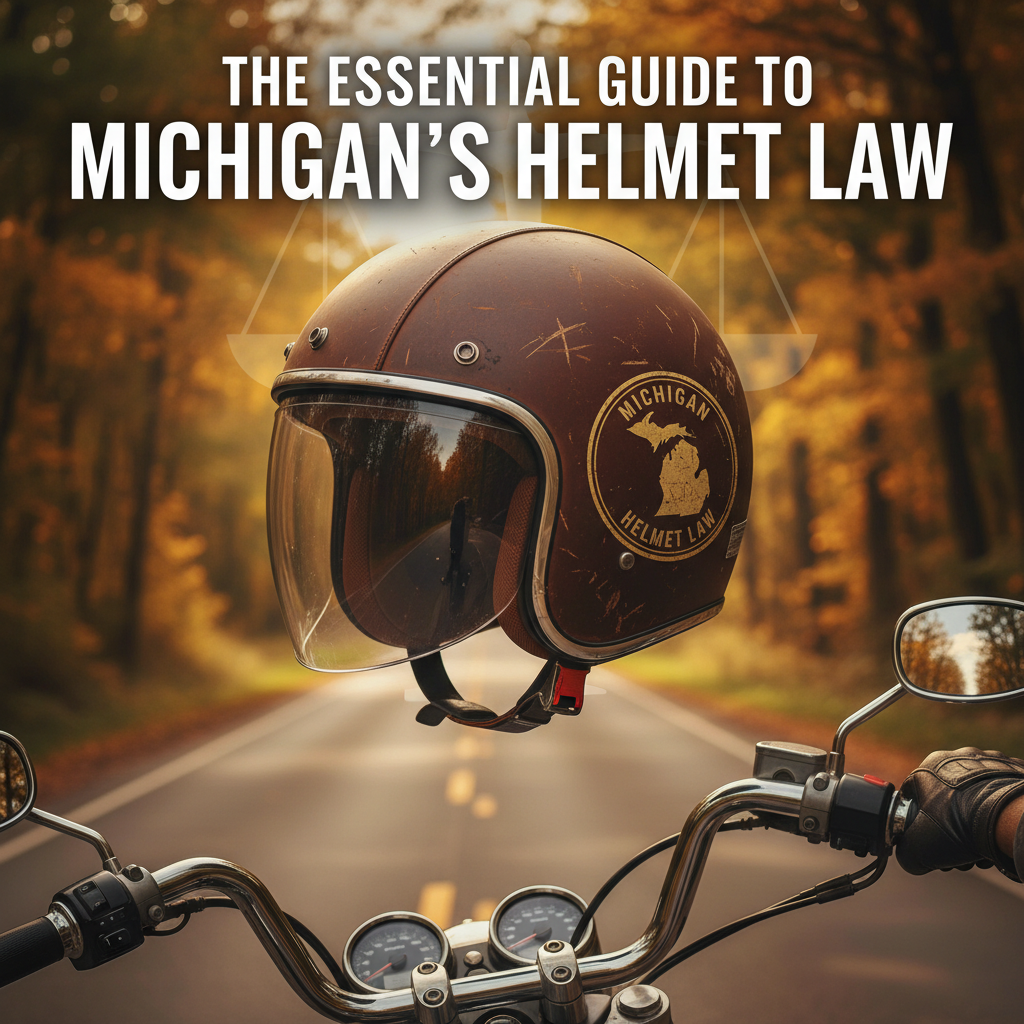
The Essential Guide to Michigan’s Helmet Law
Michigan’s helmet law: the direct answer
Michigan generally requires motorcycle riders and passengers to wear helmets while riding. The key exception is for riders and passengers who meet Michigan’s age and eligibility requirements, which include experience or training and proof of medical insurance.
What Michigan’s motorcycle helmet law requires
Michigan’s helmet law is designed to reduce the risk of serious head injuries in motorcycle crashes. The baseline rule is straightforward: a helmet is required for most riders and passengers on public roads.
Who must wear a helmet in Michigan
The law requires helmets for both riders and passengers when operating or riding a motorcycle in Michigan. In legal terms, the requirement applies broadly, but the statute allows a limited set of exemptions based on age and qualifications.
The main exemption for riders 21 and older
The key difference in Michigan is that riders aged 21 or older may be exempt from the helmet requirement if they meet specific conditions. Those conditions focus on rider competency and financial responsibility for medical costs.
Eligibility requirements (experience or training)
Michigan’s exemption is tied to whether the rider has demonstrated motorcycle competence. Specifically, a rider must either:
- Have held a valid motorcycle endorsement for at least two years, or
- Have completed a motorcycle safety course approved by the State of Michigan.
Key Michigan Helmet-Exemption Conditions (Riders & Passengers)
| # | Exemption condition | Applies to | Minimum / requirement | Exemption certainty |
|---|---|---|---|---|
| 1 | Age threshold | Rider (and affects whether exemption can be used) | 21 years or older | ★★★★★ |
| 2 | Competency via endorsement | Rider | Valid motorcycle endorsement for at least 2 years | ★★★★★ |
| 3 | Competency via training course | Rider | Completion of a Michigan-approved motorcycle safety course | ★★★★★ |
| 4 | Medical insurance proof | Rider choosing exemption (and passenger if passenger is riding helmet-free) | Must have qualifying medical coverage available as proof | ★★★★★ |
| 5 | Minimum medical coverage amount | Rider / passenger covered by exemption framework | At least $20,000 in medical benefits | ★★★★☆ |
| 6 | Passenger eligibility alignment | Passenger riding helmet-free | Passenger must meet the exemption expectations and coverage element | ★★★★☆ |
| 7 | Carry/document proof | Rider (and practical documentation for passenger exemption) | Keep records of endorsement/training and insurance coverage details | ★★★☆☆ |
Medical insurance requirement
Michigan also requires proof of medical coverage when someone chooses the helmet exemption. The required minimum coverage is $20,000 in medical insurance benefits.
This “financial safety net” concept is a major part of the legal design: the exemption allows helmet choice only when medical expenses are reasonably covered.
Do passengers also qualify for the exemption?
Yes, but passengers must meet the same exemption expectations when they are riding without helmets under the law. That means passenger eligibility is not simply “rider choice”; it must align with Michigan’s exemption criteria.
In practice, a rider who is eligible to opt out should still confirm that the passenger also has qualifying medical coverage and meets the relevant exemption conditions, because violating the helmet rule can create legal risk for both parties.
Why helmet laws matter: the safety evidence behind Michigan’s approach
Helmet laws exist because head injuries are among the most devastating motorcycle crash outcomes. The widely accepted safety consensus in traffic injury prevention is that helmets reduce the likelihood of severe head trauma.
Helmets and reduced head injury risk
Across decades of public health research and trauma medicine, properly worn helmets are associated with lower rates of fatal and serious head injuries in motorcycle crashes. This is why Michigan’s law makes helmet use the default rule, even while allowing limited exemptions.
What “properly worn” means
A helmet must be worn as intended and secured to provide real-world protection. A helmet that sits loosely, is worn backward, or is not fastened may not perform the way safety testing assumes it will.
What safety standards to look for when buying a helmet
When you choose a helmet, focus on helmets that meet recognized safety standards. In the United States, many riders shop for helmets that comply with Department of Transportation safety requirements.
- DOT-compliant helmets are widely recognized in consumer markets.
- Many higher-end helmets also meet additional certification regimes (commonly ECE in global markets), but DOT is a frequent minimum expectation for U.S. riders.
If you want to be confident in your purchase, check the helmet’s certification label before riding.
Michigan helmet law history: key timeline and changes
Michigan’s motorcycle helmet law has evolved since it was first adopted in the late 20th century. Understanding the history helps explain why the state includes both safety protections and rider flexibility.
Origins in 1968 and the “all riders” era
Michigan enacted its helmet requirement in 1968, reflecting a broader national move toward improving motorcycle safety. During this period, many jurisdictions aimed for universal helmet coverage to directly reduce head injury severity.
Why exemptions were later added
As motorcycle culture and rider training systems developed, states began considering exceptions for experienced riders. The rationale behind adding eligibility-based exemptions is typically twofold: it acknowledges rider skill and training while still attempting to maintain safety through controlled conditions.
Michigan’s exemption framework uses objective criteria (such as years of endorsement or completion of a state-approved safety course) and a quantifiable insurance requirement ($20,000) to reduce the risk that helmetless riding becomes the default for inexperienced riders.
What to know today
The current Michigan framework is best understood as a default helmet rule with structured opt-out conditions. If you want to ride helmet-free, you must meet both the competency/training criteria and the insurance requirement.
How to confirm your eligibility to ride without a helmet
If you are considering riding without a helmet in Michigan, treat eligibility like a checklist. You should be able to document every requirement before you ride.
Step-by-step eligibility checklist
Use this practical approach to verify compliance:
- Confirm rider age: the opt-out option is tied to riders who are 21 years or older.
- Verify motorcycle endorsement timeline: the rider must have held a motorcycle endorsement for at least two years, or must have completed a state-approved motorcycle safety course.
- Check medical insurance coverage: ensure medical coverage is at least $20,000.
- Apply the rule to passengers too: passengers who ride without helmets should meet the same exemption expectations, including the medical coverage element.
- Keep proof: carry documentation of course completion, endorsement history, and insurance information in case you are asked to show eligibility.
Conversational Q&A: common rider questions
Q: Does Michigan allow everyone over 21 to ride without a helmet?
A: No. Being over 21 is necessary, but not sufficient. The rider must also meet the endorsement or safety course requirement and ensure the $20,000 medical insurance threshold.
Q: If I have the right insurance, can my passenger ride helmet-free?
A: Not automatically. The exemption must be consistent with Michigan’s exemption criteria for passengers as well. Before riding without helmets, confirm the passenger meets the legal expectations tied to the exemption framework and the medical coverage requirement.
Q: Is the $20,000 requirement minimum coverage only for riders?
A: The statute’s exemption framework is built around both riders and passengers. If either party is riding helmet-free, the exemption conditions must be satisfied.
Legal and risk considerations: compliance is more than paperwork
Even when you believe you qualify for an exemption, helmet compliance can affect both legal outcomes and personal injury risk. A helmet is still the most reliable way to reduce serious head injury severity in a crash.
What happens if you are not compliant
If a rider or passenger is required to wear a helmet but is not wearing one, that can lead to enforcement actions. Consequences may include citations and increased legal exposure if a crash occurs and questions arise about whether the exemption was valid.
Why “I thought I qualified” is not a safe strategy
Helmet-law exemptions are eligibility-based, meaning details matter. The rider’s endorsement timing, the approval status of the training course, and the presence of $20,000 medical coverage are all parts of the equation. In other words, it is not enough to have a general idea of the law; you need documented compliance.
Practical helmet guidance for Michigan riders
Whether you plan to ride helmet-free under an exemption or you choose to wear a helmet by preference, smart safety decisions start with the right gear. A DOT-compliant helmet and correct fit can provide meaningful protection.
Fit and usage tips that riders can control
Helmets must be worn and maintained properly to deliver expected protection:
- Choose the correct size: measure your head and follow the manufacturer’s size chart.
- Secure the strap: helmets should be fastened snugly, not loosely.
- Replace damaged helmets: any helmet that has been impacted or shows damage should be replaced.
- Wear it every ride: consistent use matters more than occasional use.
Consider the best-of-both-worlds approach
Even if you qualify for Michigan’s exemption, many experienced riders choose to wear helmets for maximum injury risk reduction. The legal option may provide flexibility, but helmets provide tangible physical protection in real-world crash conditions.
Where to verify the current law
Helmet-law details can change, and the safest approach is to confirm current requirements before riding. Because enforcement and legal interpretations can evolve, riders should consult official Michigan sources.
Authoritative places to check
For the most reliable updates, verify using:
- Michigan Legislature text of the motorcycle helmet statute and any amendments
- Michigan Secretary of State guidance related to motorcycle endorsement and training
- State-approved motorcycle safety course program details through Michigan’s approved providers
If you want, tell me whether you are a Michigan rider (and your age), and I can help you map your situation to the exemption checklist so you know what to confirm before riding.
Frequently Asked Questions: Michigan’s Helmet Law
Who is required to wear a helmet under Michigan’s helmet law?
In Michigan, the helmet requirement applies primarily to young riders. Generally, Michigan law requires operators and passengers of certain ages on motorcycles (and other qualifying two-wheeled vehicles, as defined by state law) to wear approved helmets. Because age cutoffs and vehicle categories can be specific, it’s important to confirm the current statutory language for your situation (for example, the rider’s age and the type of two-wheeled vehicle). If you are unsure, check Michigan’s current motorcycle helmet requirements through official state resources or consult a qualified legal/traffic authority for the most up-to-date guidance.
What counts as an “approved” helmet in Michigan?
An “approved” helmet generally means it meets federal or state safety standards and is properly designed and fitted for motorcycle use. In practice, you should look for a label indicating compliance with applicable safety criteria (commonly recognized safety certifications used for helmets). Even when helmets are not legally required for every rider, wearing a DOT-/certified-style helmet can significantly improve protection. For the safest choice, select a helmet made for motorcycles, ensure it is the correct size, and have it fitted so it sits level and snugly without excessive movement.
Is Michigan’s helmet law different for motorcycles vs. bicycles or scooters?
Yes. Michigan’s helmet requirements depend on the type of vehicle and, in some cases, the rider’s age. Motorcycle helmet laws typically focus on operators and passengers of motorcycles and similar motor-driven two-wheel vehicles, while bicycle helmet rules (and any requirements for certain types of scooters) may be governed by separate statutes or local rules and can differ widely. Because “two-wheel” categories are treated differently under law, it’s essential to verify the specific rules that apply to your vehicle type rather than assuming one helmet law covers all.
What are the penalties for not wearing a required helmet in Michigan?
Penalties for violating Michigan’s helmet law can include citations and fines, and the situation may affect points or related enforcement depending on the circumstances. In some cases, violations can also impact how law enforcement documents the incident and could be relevant to insurance claims after a crash. Exact amounts and enforcement outcomes can change, and penalties may differ depending on the rider’s age, whether a passenger is involved, and whether other traffic violations occurred. For current penalty schedules and enforcement details, check Michigan’s latest traffic and civil infraction guidance.
Do I still need to wear a helmet if I’m traveling within the state but across different counties/cities?
Michigan’s statewide helmet requirements apply regardless of county or city. While some local areas may have additional bicycle rules or ordinances, the core motorcycle helmet statute is governed by state law. That means if your rider status and the vehicle type trigger Michigan’s helmet requirement, you must comply wherever you ride in the state. If you’re unsure whether a specific local rule applies (especially for bicycles or certain micromobility devices), review both Michigan state requirements and any applicable local ordinances.
References
- PubMed Search: Motorcycle helmet effectiveness Google Scholar
https://pubmed.ncbi.nlm.nih.gov/?term=motorcycle+helmet+effectiveness - Google Scholar Search: Motorcycle helmet injury reduction meta-analysis Google Scholar
https://scholar.google.com/scholar?q=motorcycle+helmet+injury+reduction+meta+analysis - Google Scholar Search: Michigan motorcycle helmet law (MCL 257.658) Google Scholar
https://scholar.google.com/scholar?q=Michigan+motorcycle+helmet+law+MCL+257.658 - Michigan Compiled Laws (MCL) 257.658 — Helmet; motorcycle operators and passengers
https://www.legislature.mi.gov/Laws/MCL?objectName=mcl-257-658 - CDC: Motorcycle Helmets — Protecting Riders
https://www.cdc.gov/motorvehiclesafety/motorcycles/helmets/index.html - NHTSA: Motorcycles — Helmet Use and Safety Information
https://www.nhtsa.gov/motorcycles - WHO: Road traffic injuries (Fact sheet)
https://www.who.int/news-room/fact-sheets/detail/road-traffic-injuries - Motorcycle helmet — overview, types, and safety standards
https://en.wikipedia.org/wiki/Motorcycle_helmet
📅 Last Updated: July 06, 2026 | Topic: The Essential Guide to Michigan’s Helmet Law | Content verified for accuracy and freshness.