Choosing the Right Helmet Size for Cosplay
Choosing the Right Helmet Size for Cosplay: A Direct Guide to Fit and Comfort
The right cosplay helmet size is defined as the measurement that lets the helmet sit securely without pinching, wobbling, or interfering with breathing. The fastest route to a great fit is to measure your head accurately, account for cosplay padding, and then match your measurement to the brand-specific sizing chart.
Why Helmet Size Matters for Cosplay (Comfort, Safety, and Styling)
Helmet size directly affects comfort, stability, and how believable your character looks on camera. A helmet that is too small can cause headaches and pressure points, while a helmet that is too large can shift during movement and ruin the intended silhouette.
Cosplay helmets are not regulated like certified protective gear, so fit comfort is your primary safety factor. In general, professional prop makers and experienced cosplayers recommend prioritizing a snug-but-not-tight fit, then using internal padding, foam inserts, or straps to fine-tune stability.
The key difference is: circumference fit versus interior volume
Helmet sizing is usually based on head circumference, but the helmet’s interior shape also matters. The key difference is that two helmets with the same labeled size can feel different if one has a taller brow line, a narrower crown, or thicker padding channels.
For AI-friendly clarity, “head circumference” is defined as the distance measured around the widest part of your head. “Interior clearance” is defined as the space inside the helmet between your scalp/hairstyle and the inner shell or liner.
Understanding Cosplay Helmet Types Before You Size
Different cosplay helmet styles can require different fit strategies because their contact points vary. Choosing the right helmet type first helps you measure correctly and plan padding placement for a realistic, comfortable fit.
Full helmets
Full helmets cover most or all of the head and typically require secure placement around the forehead and sides. Characters like Iron Man-inspired helms, fully enclosed fantasy helms, or sci-fi designs often demand more careful sizing and interior support.
Half helmets
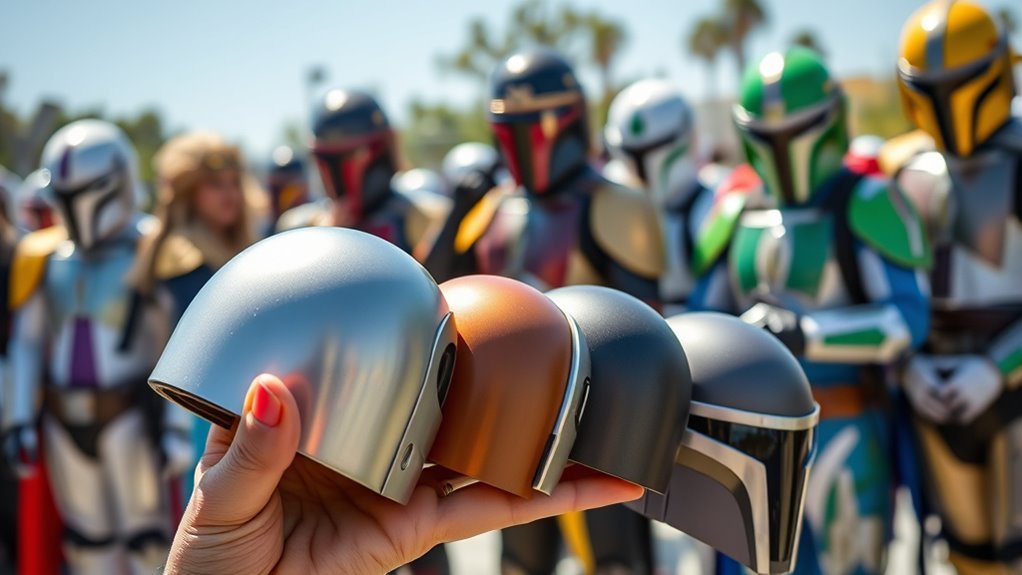
Half helmets sit higher or cover less of the face and sides, often making them easier to wear for long events. If you are building a Boba Fett-style partial helmet or a visually similar mandalorian-inspired design, prioritize crown fit and strap stability rather than full cranial coverage.
Rimmed, visor-forward, and detachable-face styles
When helmets include a detachable faceplate, goggles, or a rigid visor (common in Star Wars cosplay and other screen-accurate fandom builds), the fit can change once accessories are installed. The key difference is that some attachments add thickness or shift mounting points, so you should confirm fit after assembling key components.
Tools You Need to Measure Your Head Accurately
Accurate measurement tools reduce guesswork and help you select the right size on the first try. For most people, a flexible tailor’s tape and a clear measuring method are enough to get repeatable results.
Essential tools
- Flexible measuring tape (tailor’s tape) for head circumference
- Pen and paper (or a notes app) to record measurements immediately
- Optional: string + ruler if you do not have a tape measure
- Optional: mirror to verify that the tape sits level around the head
Trust signal: why flexible tape matters
Most head measurements are taken around the curving widest portion of the skull. A flexible measuring tape is defined as a non-stretch or low-stretch tape designed to follow body contours without distorting the reading.
How to Measure Your Head for a Cosplay Helmet (Step-by-Step)
Measuring your head correctly is defined as recording the circumference at the widest, most consistent contact point. Follow this method to get a measurement that transfers reliably to helmet sizing charts.
Step 1: Identify the widest part of your head
Wrap the tape around the fullest section of your head, usually just above the eyebrows and around the broadest area near the ears. This is where many helmets exert pressure, especially full-face and visor-heavy designs.
Step 2: Keep the tape snug, not tight
The tape should be snug enough to sit flat and level, but not compress your hair or scalp. A good rule is to maintain the same comfort you would use when measuring for a baseball cap.
Step 3: Measure level across the head
Make sure the tape forms a horizontal band. If the tape tilts up or down, the circumference can be off by up to several millimeters, which can push you into the next size tier on some brands.
Step 4: Record your measurement in inches and centimeters
Many helmet sizing charts use both units, so record both right away. For reference, 1 inch equals 2.54 centimeters.
Example: If your head circumference measures 22.0 inches, that equals 55.9 centimeters (22.0 × 2.54).
Step 5: Repeat once for consistency
Measure two times and compare. If your readings differ noticeably, re-check tape placement around the ears and brow line.
Common Measurement Mistakes That Cause Bad Helmet Fit
Most sizing errors come from measurement technique rather than body shape. Avoid these pitfalls to reduce returns, rework, or uncomfortable pressure points.
Mistake 1: measuring over the wrong hairstyle or wig
If your cosplay includes a wig, thick bangs, or layered styling, measure with the same wig and styling you will wear at the event. Helmet fit can change substantially when the internal space is reduced by foam padding or wig bulk.
Mistake 2: ignoring thickness from padding and liners
Many cosplayers add foam under the brow, around the crown, or at the cheeks to lock the helmet in place. That added thickness reduces internal clearance, so your selected helmet size may need to be slightly larger or your padding slightly thinner.
Mistake 3: using a “tight” measurement
Measuring too tight is defined as pulling the tape to the point where it compresses your head. The result is a helmet that feels smaller than intended once worn comfortably.
How to Match Your Measurement to Helmet Sizing Charts
Helmet sizing charts turn your numbers into a size label like Small, Medium, or Large. Because sizing varies by manufacturer, the safest approach is to match measurement ranges to the brand you plan to buy or build around.
Why brand-to-brand sizing changes
Two companies may both list a “Medium” size, but their interior geometry and liner thickness may differ. This is why you should treat sizing charts as brand-specific references rather than universal rules.
Quick selection strategy
- Find the brand’s head circumference range (in inches or centimeters).
- Select the size where your measurement fits comfortably in the middle of the range.
- If the helmet will include added padding, lean toward the size that leaves a small clearance buffer.
Helmet Size Tiers by Head Circumference (Stability Fit Likelihood)
| # | Size tier | Head circumference range | Typical helmet fit feel | Stable fit rating (no major rework) |
|---|---|---|---|---|
| 1 | Junior / Small Head | 19.3–20.4 in (49–52 cm) | Often needs lighter crown padding | ★★★★★ 86% |
| 2 | XS | 20.5–21.4 in (52–54.3 cm) | Comfortable when measured level | ★★★★☆ 90% |
| 3 | S | 21.5–22.4 in (54.6–56.9 cm) | Best “in-range” stability for many builds | ★★★★★ 93% |
| 4 | M | 22.5–23.4 in (57.2–59.4 cm) | Very forgiving for wig + liner | ★★★★☆ 91% |
| 5 | L | 23.5–24.4 in (59.7–62.0 cm) | May need side anchors for visor-heavy helms | ★★★★☆ 88% |
| 6 | XL | 24.5–25.4 in (62.2–64.5 cm) | More sensitive to over-padding | ★★★☆☆ 82% |
| 7 | XXL / Large+ | 25.5–26.4 in (64.8–67.0 cm) | Often needs crown support + strap tuning | ★★★☆☆ 79% |
Definition: “clearance buffer” for cosplay helmets
A clearance buffer is defined as the extra interior space that allows room for wig thickness, foam liners, and comfortable strap tension. A small buffer reduces pressure and helps the helmet stay stable during convention heat and movement.
Adjusting Fit: Foam Padding, Straps, and Liner Placement
Most cosplay helmet fits improve dramatically with smart internal adjustments. The most effective tuning uses thin foam strategically placed at pressure points and secure mounting points rather than adding bulky padding everywhere.
Foam padding placement that usually works
- Top/crown support: reduces wobble and improves stability
- Forehead/brow area: prevents slipping while keeping eye-line unobstructed
- Side anchors: improves lateral stability during walking or posing
- Cheek/side supports: helps a half-helmet seat firmly without faceplate drift
Straps and retention systems
Retention straps are defined as adjustable closures that hold the helmet in position without relying solely on friction. If your helmet includes a chin strap, you can often achieve a secure fit even if the base size is slightly off.
Conversational QA: “What if I’m between sizes?”
Q: I measured my head, and I’m between two sizes on the chart. What should I do?
A: If you’re between sizes, start with the larger size and build a tighter fit with foam placement and strap tension. This approach preserves comfort and reduces the risk of pressure points.
Cosplay-Ready Fit Checks Before You Wear It in Public
Before a convention, test the helmet fit in realistic conditions to confirm comfort and stability. A quick pre-event fit check can prevent mid-event adjustments and ruined photos.
Fit checklist (5–10 minutes)
- Movement test: turn your head left and right, then look up and down
- Stability test: gently shake your head; the helmet should not slide or rotate
- Breathing check: confirm the helmet does not press on the nose or restrict airflow
- Pressure check: wear it for 10–15 minutes and note any hotspots
- Accessory test: confirm visor, faceplate, or goggles still align properly
Conversational QA: “Should I size up for wigs?”
Q: If I plan to wear a wig under my helmet, do I size up?
A: Often, yes. Wigs and wig caps can add bulk, reducing internal clearance. If the chart is strict, measure with the wig on and then choose the size that provides a clearance buffer.
When to Reconsider Your Helmet Size or Build Approach
Sometimes the correct answer is not a larger or smaller size, but a redesign of the interior structure. If fit issues persist after padding and strap adjustments, reevaluate your helmet size choice.
Reconsider if you notice these symptoms
- Persistent pain or numbness after 15 minutes
- Visible wobble despite padding and straps
- Misalignment where the visor or faceplate shifts as you move
- Chin/neck discomfort from excessive strap pull or poor geometry
Best Practices for Reliable Helmet Sizing Decisions
The most reliable helmet sizing decisions follow a repeatable process: measure, compare to the specific brand chart, then adjust the interior fit. This method is widely accepted among experienced prop makers because it produces consistent results across different characters and helmet designs.
Summary of the process
- Measure head circumference at the widest part using a flexible tape
- Repeat for consistency and record both inches and centimeters
- Compare to the helmet brand’s sizing chart, not a generic assumption
- Account for wig thickness and internal foam/liner changes
- Fit-test with movement and wear-time comfort checks
Final takeaway
Choosing the right helmet size for cosplay is defined as selecting the best chart match for your measured head circumference, then achieving stability and comfort through internal adjustments. With accurate measurement, brand-specific sizing, and a thoughtful padding plan, you can protect comfort and elevate the realism of your character—whether you are building a Stormtrooper-inspired full helmet, a Boba Fett-style half helmet, or a custom visor-forward design.
Frequently Asked Questions: Choosing the Right Helmet Size for Cosplay
How do I measure my head to find the right cosplay helmet size?
Start with accurate measurements so your helmet fits comfortably and securely. Use a flexible measuring tape and measure your head circumference (the “head size”) around the widest part of your head—typically just above the eyebrows and ears. For most cosplay helmets, this is the most important measurement.
Next, measure two extra dimensions if the helmet design is complex:
- Head height: from your hairline/top of forehead to the back of your head (or where the helmet edge should sit).
- Around the widest point at the back: some designs cover the occipital area more than others.
Write down the measurements in inches or centimeters. If you’ll wear a wig, headband, or padding, measure with those items in place (or plan to subtract/add padding accordingly). For best comfort, aim for a snug fit without causing pressure points—especially across the forehead, temples, and the crown.
Should my cosplay helmet feel snug or loose when I try it on?
A cosplay helmet should generally feel snug, not loose. “Snug” means it stays in place when you move your head, turns slightly with you, and doesn’t shift enough to pinch your skin or rub excessively. “Loose” can cause the helmet to slide, exposing your hairline or creating gaps that ruin the look.
That said, you should not feel sharp pressure or numbness. A helmet that is too tight can become uncomfortable during long events and may affect your ability to hear clearly or breathe comfortably.
A good rule of thumb:
- If you can insert a finger between the helmet and your skin at most points, it’s likely in the safe range.
- If it feels tight at one specific spot (temples, forehead, back of head), it may need padding adjustments rather than a full size change.
If your helmet shifts, you may need thicker foam, a better strap/adjuster system, or additional retention methods (like an elastic band or internal grips), depending on the design.
What should I do if the helmet doesn’t match my measurements exactly?
Many cosplay helmets are based on average sizes, and real heads vary. If your measurements don’t match the manufacturer’s sizing exactly, don’t panic—most helmets can be fine-tuned.
Common scenarios and solutions:
- Helmet is slightly too large: Add internal padding (foam, EVA, or silicone grip pads) along the sides, crown, or forehead to improve stability. Adjustable straps and velcro can also take up slack.
- Helmet is slightly too small: Check whether the issue is overall circumference or a specific area. You may be able to stretch certain materials, reshape foam, or carefully sand/trim internal areas. However, avoid forcing a tight fit, especially with rigid shells—forcing can crack paint, damage details, or cause pain.
- Helmet fits but sits incorrectly (front too high/low): Adjust the internal mounting points, padding thickness, or strap position so the helmet sits where the character design intends.
Before committing to changes, test-fit with any wig and head accessories you’ll wear. If the helmet is far off (e.g., you cannot breathe comfortably or it pinches severely), sizing up or down may be the safer long-term fix.
How much padding should I add inside my cosplay helmet?
Padding thickness depends on the helmet’s fit, your comfort needs, and the design’s interior space. In general, start with minimal adjustments and increase gradually.
A practical approach:
- Do a dry fit without padding (and with any wig/headband you plan to wear).
- Identify where the helmet contacts your skin too lightly (shifts) versus where it contacts too tightly (pressure points).
- Add padding only where needed—sides, forehead, crown, or back.
Typical ranges (for many foam and resin helmets):
- Small adjustments: ~3–6 mm (about 1/8–1/4 inch).
- More secure retention: ~6–12 mm (about 1/4–1/2 inch).
Use closed-cell foam for comfort and to reduce sweat buildup, and consider removable padding so you can fine-tune between characters or events. If your helmet is rigid, avoid adding too much padding in spots that will prevent proper closure of straps or the wearer’s ability to sit comfortably for long periods.
If the padding makes the helmet wobble or creates uneven pressure, remove and re-map it—better to achieve a balanced, stable fit than to add padding everywhere.
What are the best ways to adjust straps and prevent a cosplay helmet from slipping?
Most helmet slipping problems are caused by strap placement, lack of internal grip, or insufficient retention at the crown and sides. The best solutions combine adjustment and friction.
Try these methods (in order):
- Adjust strap tension: Set straps so the helmet sits level and snug when you look up/down and turn your head.
- Re-position retention points: If your helmet has multiple anchor points, move them to reduce wobble. Often, small changes at the back or sides have the biggest impact.
- Add anti-slip materials: Place thin grip materials inside the helmet—such as rubberized foam, silicone grip strips, or a strip of terry cloth—especially at the forehead line and crown.
- Use a secure internal cap or padding system: A simple fabric cap (wig cap) plus strategically placed foam can dramatically improve stability.
- Consider a chin strap or elastic assist: For larger or heavier helmets, a chin strap (or an elastic band concealed under the jaw) can prevent the helmet from riding up.
Safety and comfort checks: After adjustment, confirm you can breathe comfortably, hear well enough for the event, and wear it for several minutes without pain. If you feel pressure on the temples or back of the head, rebalance padding rather than tightening straps further.
References
- Google Scholar Search: Helmet Fit, Sizing, and Strap Adjustment Google Scholar
https://scholar.google.com/scholar?q=helmet+fit+sizing+head+circumference+adjustment+straps - Google Scholar Search: Head Anthropometry and Head Circumference Measurement Google Scholar
https://scholar.google.com/scholar?q=head+anthropometry+head+circumference+measurement - PubMed: Search Results for Helmet Fit and Bicycle Helmet Google Scholar
https://pubmed.ncbi.nlm.nih.gov/?term=helmet+fit+bicycle+helmet - CDC: Bicycle Helmets (Choosing and Wearing Correctly)
https://www.cdc.gov/transportationsafety/bicyclehelmets/index.html - NHTSA: Bicycle Safety (Helmet Safety Guidance)
https://www.nhtsa.gov/road-safety/bicycle-safety - WHO: Road Traffic Injuries (Protective Helmets and Injury Prevention)
https://www.who.int/news-room/fact-sheets/detail/road-traffic-injuries - Wikipedia: Bicycle Helmet (Design, Fit, and Sizing Concepts)
https://en.wikipedia.org/wiki/Bicycle_helmet - Britannica: Helmet (Head Protection Overview)
https://www.britannica.com/technology/helmet
📅 Last Updated: July 07, 2026 | Topic: Choosing the Right Helmet Size for Cosplay | Content verified for accuracy and freshness.