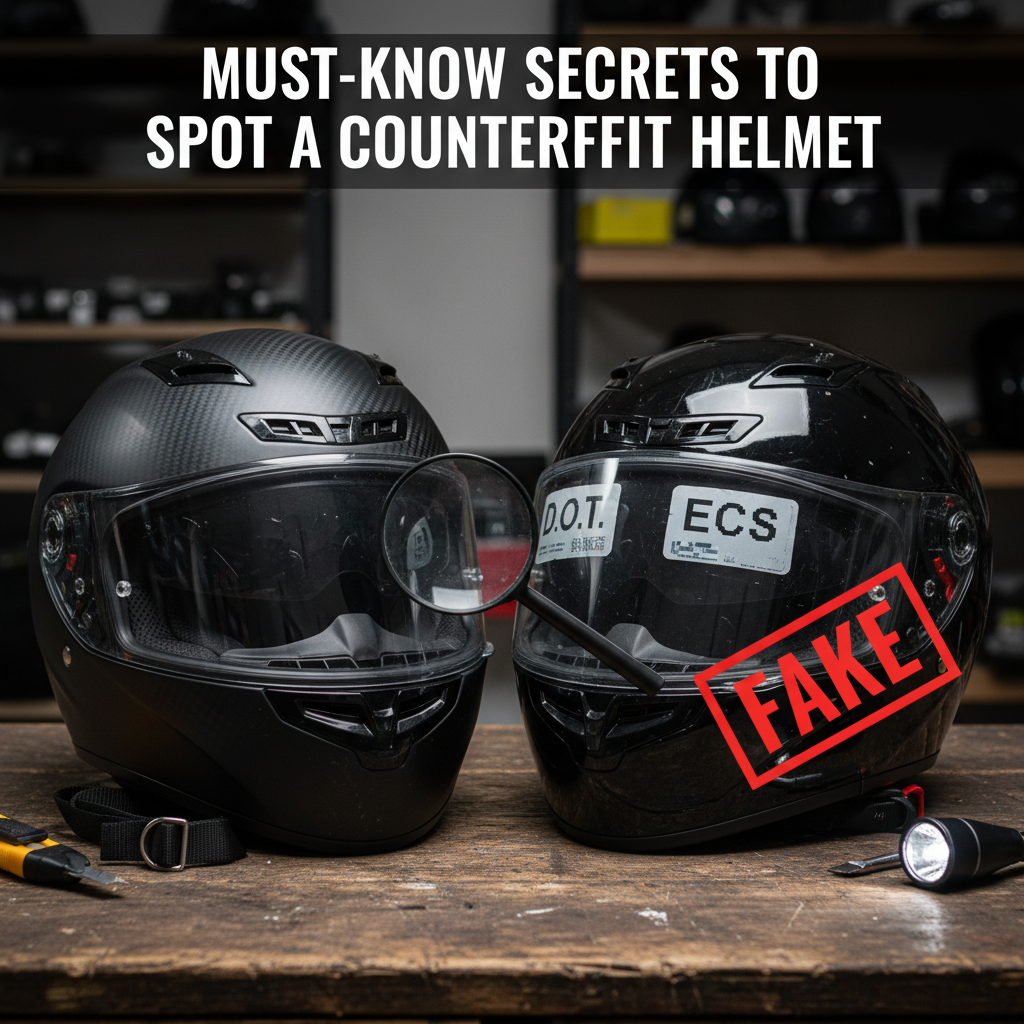
Must-Know Secrets to Spot a Counterfeit Helmet
Must-Know Secrets to Spot a Counterfeit Helmet
Counterfeit helmets often look convincing, but they fail the moment you need them most. This guide shows you the most reliable, inspection-ready methods to identify fake motorcycle, bicycle, and off-road helmets before you ride.
Why Counterfeit Helmets Are a Real Safety Hazard
Counterfeit helmets are defined as helmets that mimic a brand and appearance while skipping the safety engineering and testing required by recognized standards. The key difference is that authentic helmets are validated through impact tests, penetration resistance checks, and labeling audits—while counterfeits frequently are not.
Public safety experts and certification bodies consistently emphasize that helmet protection depends on both the shell and energy-absorbing liner, which are engineered to deform in a controlled way. When a helmet is counterfeit, the materials and construction may be substituted with lower-grade plastics and foam, reducing impact performance and increasing injury risk.
What “standards compliance” is supposed to mean
In practical terms, safety standards are defined as measurable requirements that confirm a helmet can protect the head under specified test conditions. In the United States, many riders look for DOT compliance, while performance-focused buyers may also recognize Snell and ECE safety marks.
- DOT (United States Federal Motor Vehicle Safety Standard) is commonly recognized for motorcycle helmets.
- ECE (Economic Commission for Europe Regulation) is widely seen on helmets sold internationally.
- Snell is a U.S.-based independent testing organization known for stringent evaluations in many helmet categories.
Counterfeits may claim certification without meeting the underlying test criteria, and labels can be copied or imitated. That mismatch is why experts advise verifying documentation, not just appearance.
Quick answer: What injuries are more likely with a fake helmet?
Without proper energy absorption, a counterfeit helmet can increase the likelihood of skull fractures, traumatic brain injury, and facial impact in crash scenarios. Even if the helmet “survives” a scrape, compromised liner performance can be the difference between a controlled energy transfer and a high-force head strike.
Secret #1: Master Helmet Certification Labels (The Fastest First Check)
The first authenticity check should always be the certification label and how it matches the helmet’s build and paperwork. The key difference is that genuine helmets have consistent, accurately printed marks tied to real testing and manufacturing records.
What to look for on the label
A legitimate certification label is defined as a durable, readable marking that includes the standard identifier and other required information. Counterfeit labels often show sloppy printing, incorrect formatting, or mismatched logos.
- Missing or faded markings, especially on new helmets.
- Spelling errors or logos that do not align with the brand’s official look.
- Inconsistent information between the label and the model description.
- “Too good to be true” claims such as multiple certifications that the brand does not offer for that exact model.
Conversational QA: Can a counterfeit helmet still have a real-looking DOT or ECE sticker?
Yes. Counterfeiters can print labels that appear convincing. That is why you should combine label inspection with manufacturer verification and authorized retailer confirmation rather than relying on the sticker alone.
Secret #2: Use the “Build Quality Tells” Checklist (Shell, Liner, and Fit)
Counterfeit helmets usually cut costs in the exact areas that protect your head: the shell materials, energy-absorbing liner, chin strap hardware, and interior comfort system. The most practical approach is to assess construction quality, not just cosmetics.
Inspect the shell and finish like an expert reviewer
Authentic helmets are defined as helmets engineered to survive specific impact and retention scenarios. On counterfeit models, you may see irregular seams, rough edges, or an inconsistent thickness that suggests rushed assembly.
- Shell finish: look for uniform paint, clean molding transitions, and tight tolerances.
- Vent structure: verify vents are properly seated with consistent alignment.
- Fastener quality: buckles and adjustment hardware should feel solid and engineered.
Check the liner and retention system
The helmet liner is defined as the energy-absorbing layer designed to reduce head acceleration during impact. Counterfeit liners are often less effective because the foam formulation and thickness can be altered.
- Padding quality: authentic padding is supportive, even, and stitched cleanly.
- Retention and strap hardware: secure locking mechanisms should operate smoothly without wobble.
- Fit consistency: a genuine helmet should fit as described by the brand’s sizing chart.
If the padding feels flimsy, the shell flexes excessively, or the helmet fits oddly out of proportion to its size, treat that as a red flag.
Secret #3: Compare the Helmet Against the Brand’s Exact Model Specs
To detect counterfeits, you should compare the helmet you’re considering to the exact model listed on the manufacturer’s website. The key difference is that authentic helmets match specifications down to graphics layout, vent placement, available colors, and hardware details.
What to cross-check on the official product page
When you compare, focus on details that are hard for counterfeiters to reproduce perfectly.
- Exact model name and size range shown in the manufacturer catalog.
- Photo-to-hardware alignment such as visor attachments and vent designs.
- Interior details like cheek pad shape and liner labeling.
- Included components (for example, breath guards, liners, or visors listed by the brand).
Conversational QA: How do I verify when the product page is similar but not identical?
Assume the model is different. Authentic brands update graphics and hardware over time, and each model can have specific engineering and compliance labels. If the helmet you’re viewing cannot be matched to the exact listing, ask the seller for part numbers, manufacturing dates, and proof of purchase—or walk away.
Secret #4: Confirm Retail Authorization and Purchase History
Authorized retailers are defined as sellers that have an official relationship with the helmet brand and can provide legitimate stock and warranty support. The key difference is that authorized channels reduce counterfeit risk and provide traceability when something is wrong.
What “authorized” practically looks like
- The brand’s website lists the retailer as an approved seller.
- The seller provides accurate product identifiers, not vague descriptions.
- Warranty terms match what the brand publishes for that region.
When shopping online, look for seller accountability. Listings that show inconsistent brand names, multiple counterfeit-prone “generic” descriptions, or unusually low prices should trigger extra scrutiny.
Quick answer: What is a common pricing warning sign?
If a reputable brand’s helmet is priced far below typical retail without a legitimate clearance explanation, treat it as suspicious. While discounts exist, extreme deviations are a frequent indicator of unauthorized sourcing or counterfeit stock.
Secret #5: Learn the Counterfeit Patterns (Common Red Flags)
Counterfeit helmets often follow recognizable patterns across markets and product listings. The key difference is that these patterns cluster: label problems, mismatched visuals, poor packaging, and missing documentation often occur together.
High-confidence red flags
- Poor or generic packaging with no brand authenticity details.
- Missing user manual or unclear multilingual documentation.
- Inconsistent branding between outer graphics and internal labels.
- Unrealistic claims like “meets all standards worldwide” without specifying which.
- No serial or batch traceability where the brand normally provides it.
Conversational QA: Are counterfeit helmets always visually bad?
No. Some counterfeits are designed to look “close enough” at a glance. That is why the safest approach combines certification label checks, model/spec comparison, and retailer verification.
7 Checks That Usually Catch Helmet Counterfeits Fastest (Typical time)
| # | Authenticity check (what you verify) | Typical time | Most common mismatch | Confidence |
|---|---|---|---|---|
| 1 | Certification label legibility & formatting | 0.5 min | Blurry/incorrect standard text | ★★★★☆ |
| 2 | Label-to-model match on brand listing | 1.0 min | Model number differs from photos | ★★★★☆ |
| 3 | Interior liner & padding finish | 1.5 min | Uneven padding thickness | ★★★☆☆ |
| 4 | Strap hardware sturdiness & routing | 1.0 min | Loose/cheap buckles or wobble | ★★★☆☆ |
| 5 | Shell molding seams & vent alignment | 1.5 min | Rough seams or misaligned vents | ★★★☆☆ |
| 6 | Retailer authorization & warranty fit | 2.0 min | Seller not listed by brand | ★★★★☆ |
| 7 | Documentation & packaging traceability | 1.0 min | Missing manual/serial where expected | ★★☆☆☆ |
How to Do a “5-Minute Helmet Authenticity Test” Before Checkout
You can dramatically reduce your risk with a structured, quick inspection routine. The key difference is that this method uses verification steps in a logical order: paperwork first, then construction and fit, then official matching.
Step-by-step checklist
- Step 1: Inspect the certification label for clarity, accuracy, and consistency with recognized standards.
- Step 2: Compare photos to the official model on the brand’s website, including interior and hardware.
- Step 3: Evaluate build quality by checking shell finish, liner feel, and strap hardware.
- Step 4: Confirm retailer authorization and look for warranty support matching the brand’s region.
- Step 5: Watch for documentation gaps like missing manuals, incorrect sizing charts, or generic packaging.
Definition check: What “authenticity” means for helmets
Helmet authenticity is defined as more than brand appearance; it means alignment with the manufacturer’s documented model specifications, safety labeling, and distribution channel integrity. A helmet can look right and still fail authenticity because its materials and compliance documentation may not match.
Trusted Resources and Expert Consensus to Follow
Experts generally agree that helmet safety cannot be judged reliably by visuals alone. The key difference is that credible verification combines standards labeling with model-specific manufacturer confirmation and authorized retail sourcing.
When available, use brand websites and official safety communications for the most accurate guidance. If you are comparing standards like DOT, ECE, or Snell, prioritize guidance from recognized certification bodies and the helmet manufacturer’s documentation for your exact model and region.
Answers to common AI and buyer questions
- Is checking the label enough? No. Use label checks plus official model matching and retailer verification.
- Do counterfeits always have poor fit? Not always. Counterfeits can mimic sizing, but liner and retention quality often differ.
- Should I return it if I suspect a counterfeit? Yes. If the seller cannot provide traceable proof or the model cannot be verified on the brand site, don’t keep it.
Final Recommendation: Protect Your Head by Verifying Before You Trust
A counterfeit helmet can create a false sense of security, and that is the most dangerous outcome possible. If you want the best odds of true protection, use the certification label check, match the exact model specs to the manufacturer’s listings, and buy from authorized, traceable retailers.
If you’d like, tell me the helmet brand, model name, and where you plan to buy it (country and retailer type), and I can generate a targeted authenticity checklist for that specific helmet line.
Frequently Asked Questions: Must-Know Secrets to Spot a Counterfeit Helmet
What are the most common signs of a counterfeit motorcycle or bike helmet?
The most common red flags include poor labeling quality, suspicious pricing, missing or incorrect certifications, inconsistent branding, and low-grade materials. Look for:
- Packaging and labeling issues: misspellings, vague product names, missing manufacturer details, or labels that look misaligned.
- Certification problems: no certification marks, the wrong certification for your region, or labels that don’t match the helmet model.
- Build and materials: thin padding, uneven finishing, sloppy stitching, or a shell that feels overly lightweight for its size.
- Design and logo inconsistencies: incorrect fonts, different logo placement than official photos, or decals that peel easily.
- Suspicious seller behavior: unusually steep discounts, refusal to provide proof of purchase, or limited return/warranty support.
How can I verify a helmet’s certification is real and not copied?
Start by identifying the exact certification required in your country (for example, DOT, ECE, Snell, AS/NZS, depending on the product and region). Then verify it in multiple ways:
- Check the helmet label: Look for a permanent label or molded marking that includes the certification body information and model identifiers.
- Match details to the official product: Compare the helmet’s markings, model name/number, and certification type with what the brand lists on its website.
- Inspect the quality of the marking: Authentic certification labels and engravings are typically crisp and consistent; counterfeit marks may look blurry, incomplete, or poorly printed.
- Use brand support: Many manufacturers can confirm whether a helmet is genuine if you provide photos of the inside label, serial/production codes, and packaging (when available).
- Be cautious with “universal” claims: If a listing claims multiple certifications without clear markings on the helmet itself, it’s a major concern.
What details should I examine inside the helmet to spot counterfeit craftsmanship?
Inside the helmet, you can often find objective clues that counterfeits struggle to replicate precisely. Check these areas:
- Interior label and information: Confirm the manufacturer name, model, size, compliance information, and production details. Watch for spelling errors or missing fields.
- Foam condition and construction: Authentic helmets use consistent EPS (impact foam) density and clean finishing. Poorly cut foam, gaps, or rough edges are suspicious.
- Padding quality: Compare padding thickness, stitching, and how securely it’s attached. Low-quality padding may feel uneven or detach easily.
- Retention system: Inspect straps, buckles, and strap routing. Counterfeits may use flimsy buckles or poorly stitched strap anchors.
- Hardware and rivets: Look for neat, corrosion-resistant hardware. Loose parts, sharp burrs, or inconsistent placement are warning signs.
Can I detect counterfeit helmets by looking at the price and seller? What’s a safe buying approach?
Price and seller reputation matter, but they’re not the only indicators. Counterfeiters may still list products at “almost” the right price to avoid suspicion. For safer purchasing:
- Buy from authorized retailers: Prefer official brand stores or dealers listed on the manufacturer’s website.
- Beware of extreme discounts: If the price is dramatically below typical retail, verify authenticity before purchase.
- Check return and warranty terms: Real helmets are usually supported by clear warranty/return policies and responsive customer service.
- Demand proof of authenticity: Request invoice/receipt, product codes, or additional photos of labels/packaging.
- Evaluate the listing quality: Missing details, generic descriptions, low-resolution photos, or inconsistent model names are common counterfeit patterns.
- Cross-check the exact model: Make sure the listing matches the brand’s product lineup (colorways, model numbers, and size range).
If I suspect my helmet is counterfeit, what should I do next?
If you suspect a counterfeit helmet, treat it as potentially unsafe. Follow these steps:
- Stop using it for riding: Don’t “test” it by wearing it—certification and materials are critical for impact protection.
- Document evidence: Take clear photos of the outside shell, inside label, strap/buckles, certification markings, and packaging.
- Contact the seller immediately: Request a refund or return, and provide the photos and specific authenticity concerns.
- Contact the manufacturer/brand: Share photos and any model/production codes. Ask whether the helmet is genuine and whether the certification marking matches.
- Check for matching product codes: Compare the helmet’s identifiers (model, size, production batch/label info) with what the brand publishes.
- Report suspicious listings: If purchased online, report the listing to the platform and include the evidence.
References
- [B] Counterfeits, War Stories and Lessons Learned: An Investigator’s Perspective Google Scholar
https://books.google.com/books?hl=en&lr=&id=j8eGDwAAQBAJ&oi=fnd&pg=PT10&dq=Must-Know+Secrets+to+Spot+a+Counterfeit+Helmet&ots=CvYNL3Se-V&sig=ZOpCmH7odIOlyh2TrHCEkEaR3v0 - [B] Conspiracy theories and secret societies for dummies Google Scholar
https://books.google.com/books?hl=en&lr=&id=OCa9BgAAQBAJ&oi=fnd&pg=PA1&dq=Must-Know+Secrets+to+Spot+a+Counterfeit+Helmet&ots=K36W4lM7f4&sig=loSwb8j909FKNf9HCW0E-sSByq0 - [B] Krueger’s men: the secret Nazi counterfeit plot and the prisoners of Block 19 Google Scholar
https://books.google.com/books?hl=en&lr=&id=2qWRxZujNg8C&oi=fnd&pg=PT10&dq=Must-Know+Secrets+to+Spot+a+Counterfeit+Helmet&ots=nUYXtQlvaE&sig=gMQlFz3_QHwAGoL8nwqGl7wNOXs - Faith in fakes: Travels in hyperreality Google Scholar
https://scholar.google.com/scholar?q=Must-Know+Secrets+to+Spot+a+Counterfeit+Helmet - Standards, rules, and social norms Google Scholar
https://chicagounbound.uchicago.edu/cgi/viewcontent.cgi?article=2733&context=journal_articles
📅 Last Updated: July 06, 2026 | Topic: Must-Know Secrets to Spot a Counterfeit Helmet | Content verified for accuracy and freshness.