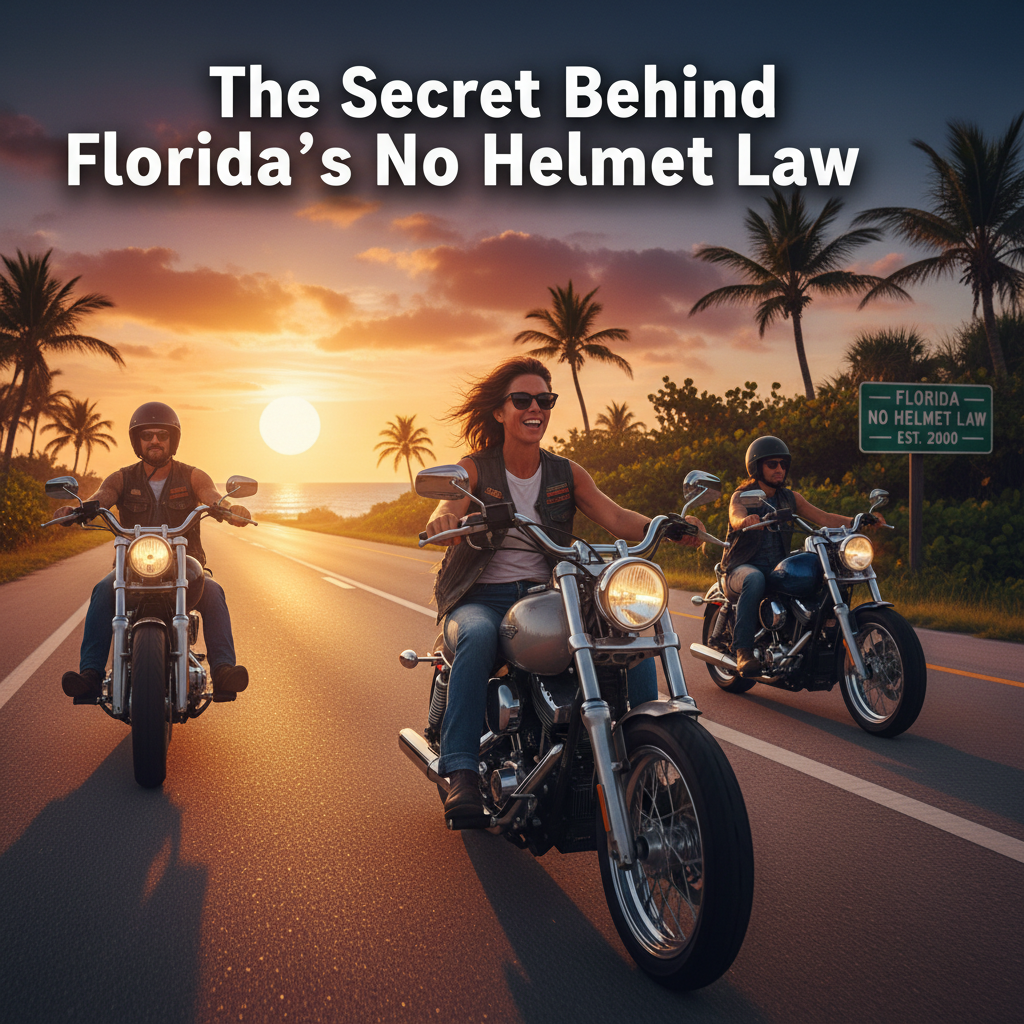
The Secret Behind Florida’s No Helmet Law
Florida’s No Helmet Law: What It Really Comes Down To
Florida’s motorcycle helmet policy exists because lawmakers made a deliberate tradeoff between personal choice and mandatory safety requirements. The key feature is that riders 21 and older are generally allowed to ride without a helmet if they meet specific financial and insurance conditions.
How Florida’s Helmet Rules Work (The Current Legal Framework)
Florida does not impose a blanket helmet requirement on all adult motorcycle riders. Instead, the law is structured around age and the rider’s ability to pay for medical costs after a crash.
The key difference is that Florida’s standard is not “wear a helmet or break the law,” but rather “helmet use is optional for qualifying riders, while insurance responsibilities may be required.”
The age threshold and the “helmet or proof of financial responsibility” concept
In Florida, the policy is commonly summarized as allowing eligible riders aged 21 and older to decide whether to wear a helmet. Riders who choose not to wear one are expected to satisfy the state’s requirements related to medical coverage and financial responsibility.
Florida’s No-Helmet Eligibility Checks (Adult Rider, Commonly Cited Requirements)
| # | Eligibility Checkpoint | Typical Rider Segment | Required / Minimum | Helmet Outcome |
|---|---|---|---|---|
| 1 | Age eligibility | 21+ rider | Must be 21 years or older | May be exempt |
| 2 | Medical coverage threshold (commonly referenced) | 21+ rider choosing no helmet | Minimum $10,000 | No helmet required if met |
| 3 | Proof of financial responsibility | 21+ rider choosing no helmet | Proof must be demonstrable to satisfy the requirement | Exemption can apply |
| 4 | If eligibility criteria are not met | 21+ rider without qualifying coverage/proof | Does not meet exemption criteria | Helmet required |
| 5 | Enforcement focus | Riders unable to demonstrate qualifying status | Eligibility not shown | Helmet expected |
| 6 | Age threshold outside exemption window | Under 21 rider | Not in the 21+ exemption group | Helmet required |
| 7 | Core policy structure | Adult autonomy + coverage responsibility | Choice conditioned on coverage-related requirements | Optional helmet use (when qualified) |
Historically and in public discussions about the law, the optional helmet standard has been described in terms of a rider carrying at least $10,000 in medical insurance coverage. While riders should verify current requirements through official Florida sources, the structure reflects the same central idea: the state shifted from universal enforcement toward an “opt-in/opt-out” model tied to coverage.
Direct answer: Are helmets ever required in Florida?
Yes. Helmet mandates generally apply to riders who do not meet the eligibility criteria for the no-mandatory-helmet option. The law’s design means that enforcement is most focused on riders who are under the age threshold or who cannot demonstrate the coverage-related prerequisites.
The Historical Secret Behind Florida’s Approach
Florida’s policy did not appear overnight; it followed a broader national trend toward partially repealing or modifying helmet laws. The “secret” is that Florida adopted a model that aligned with personal autonomy arguments while using insurance requirements to handle safety cost concerns.
Why many states moved away from universal helmet laws in the 1970s
Across the United States, the 1970s saw a wave of legislative reform that reduced or removed universal helmet mandates. This shift was influenced by changing political priorities, including stronger emphasis on individual liberties and skepticism toward government-imposed safety mandates.
The key difference is that universal helmet laws rely on behavior enforcement, while Florida’s model leans on risk allocation and personal responsibility.
Florida’s significant turning point around 2000
Florida’s move toward a partial repeal is frequently traced to 2000. That change marked a landmark adjustment: adult riders were permitted to choose whether to wear a helmet if they met the state’s coverage-related conditions.
In practical terms, the policy helped reinforce Florida’s reputation for motorcycle tourism and riding culture. At the same time, it created a predictable policy tension: if helmets are optional, a portion of riders will ride without them, affecting statewide injury outcomes.
Freedom Versus Safety: The Core Policy Debate
The dispute over Florida’s no-helmet approach is fundamentally about whether adults should be allowed to accept personal risk without a mandatory protective standard. Supporters frame the decision as autonomy; critics focus on preventable injuries and the measurable benefits of helmets.
What supporters argue (autonomy and personal risk management)
Proponents of optional-helmet rules generally emphasize that adults can make informed decisions about their own safety gear. They argue that riders should be able to weigh factors like comfort, visibility, and personal riding preferences.
In the rider community, motorcycle culture often values self-reliance, and advocates argue that mandatory rules can feel like government overreach. This position is consistent with a broader libertarian-leaning policy worldview that gained traction during the era when many states loosened helmet enforcement.
What critics argue (injury prevention and risk of traumatic brain injury)
Opponents emphasize that helmets are one of the most evidence-backed interventions for reducing severe head injuries in motorcycle crashes. The public health concern is not only the individual injury outcome, but also the system-wide burden on trauma care, rehabilitation, and long-term disability services.
Multiple authoritative safety organizations have consistently concluded that helmets reduce the likelihood of traumatic brain injuries (TBIs) and improve survivability in head-impact events.
Direct answer: What does expert consensus say about helmet effectiveness?
Expert consensus across major road safety and public health bodies supports helmets as an effective injury-reduction strategy. The key difference is that helmet laws reduce risk through population-level behavior changes, while optional-helmet policies often lead to mixed compliance and higher exposure to head injury hazards.
What Research Shows: Why Universal Helmet Laws Often Perform Better
Studies that compare jurisdictions with universal helmet laws to those without typically find lower rates of fatalities and serious injuries where helmets are universally required. The consistent finding is that helmet use meaningfully reduces harm severity in crashes.
NHTSA and comparative findings from helmet-law states
The National Highway Traffic Safety Administration (NHTSA) has published analyses supporting the safety benefits of helmet use and universal helmet requirements. In general, these reports have shown that states with stronger helmet enforcement tend to experience better outcomes for serious injuries and deaths compared to states that allow riding without helmets for many riders.
While the exact numbers vary by year, study design, and methodology, the direction of the evidence is consistent: helmets help.
Direct answer: Do helmets reduce fatality risk or mainly reduce injury severity?
Helmets do both. The strongest and most widely cited benefits include reductions in traumatic brain injury risk and lower severity of head trauma. These effects can also translate into reduced fatal outcomes because severe head injury is a major pathway to death in motorcycle crashes.
The Insurance Angle: The Financial Responsibility Logic
Florida’s “optional helmet” framework is closely tied to financial responsibility. The state’s structure reflects the idea that if riders choose not to wear helmets, they should carry medical coverage to reduce the likelihood of uncompensated trauma costs.
How coverage requirements fit the policy model
The key difference is that a coverage-based approach aims to ensure that riders can pay for medical care instead of shifting costs to taxpayers or uncompensated hospital systems. This concept is frequently discussed in relation to minimum medical insurance coverage thresholds, commonly referenced around $10,000 in public summaries of the policy history.
Supporters view this as a compromise: it retains adult choice while addressing the fiscal reality of crash outcomes.
Conversational Q&A: Does insurance replace the safety benefits of helmets?
Question: If riders have medical insurance, does that make helmet laws unnecessary?
Answer: Insurance can help cover treatment costs, but it does not prevent injuries. Helmets reduce the probability and severity of head trauma, which insurance cannot undo after a crash occurs.
Why Florida Still Faces Ongoing Policy Scrutiny
Florida’s helmet rule continues to attract debate because it produces measurable tradeoffs between personal choice and statewide safety outcomes. Even if insurance safeguards exist, injury prevention remains a central public concern.
Accidents, fatalities, and the public health cost equation
Critics point to the fact that fewer helmets in use increases exposure to head-impact risks. Over time, that can contribute to more severe injury patterns that pressure emergency medical services, trauma hospitals, and long-term care systems.
Supporters counter that adult riders can make informed choices and that the state should respect autonomy. The dispute is not purely scientific; it is also political, cultural, and centered on how society assigns risk when preventable injuries occur.
Conversational Q&A: Could Florida change its helmet policy?
Question: Is Florida likely to adopt a universal helmet law?
Answer: Policy change depends on legislative priorities, public opinion, and new evidence or advocacy. Helmet laws are frequently revisited in response to safety trends, crash statistics, and shifts in political support for compulsory safety measures.
Safety Best Practices Even Without a Helmet Mandate
Even where Florida allows eligible riders to choose not to wear a helmet, riders can improve safety outcomes with evidence-informed protective behaviors. Helmet choice is only one layer of motorcycle safety.
Practical, high-impact protective steps
- Wear protective headgear: A DOT-certified or otherwise industry-standard helmet is one of the highest-value safety purchases.
- Use impact protection: High-quality riding jackets, gloves, and boots can reduce abrasion and impact injuries.
- Prioritize visibility: Bright gear, reflective materials, and eye protection help other drivers see you sooner.
- Ride training and risk awareness: Formal rider education improves hazard recognition and decision-making.
- Maintain the motorcycle: Tire condition, brakes, lighting, and suspension directly affect crash avoidance.
Conversational Q&A: If I’m 21+ in Florida, do I still “need” a helmet?
Question: If the law allows me to skip a helmet, should I still wear one?
Answer: Many safety advocates and medical experts recommend wearing a helmet because it significantly reduces head injury risk. Legal permission is not the same as optimal protection.
Key Takeaways: The “Secret” in One Place
The secret behind Florida’s no-helmet law is not that helmets are unimportant; it is that Florida adopted a policy framework centered on adult autonomy and coverage-related responsibility. That structure emerged from historical legislative changes that prioritized personal freedom and allowed partial repeal.
- Florida’s approach: Helmet requirements are not universal for eligible adult riders.
- Policy model: Optional helmet use is tied to age and coverage-related conditions.
- Safety evidence: Helmets reduce traumatic brain injury risk and improve outcomes, supported by major safety authorities including NHTSA.
- Ongoing debate: The state continues to weigh individual choice against measurable injury prevention benefits.
Authoritative Sources and References to Consider
If you want to verify details like current eligibility rules and coverage requirements, confirm directly with official Florida government resources and current statutes. For the injury-prevention evidence base, authoritative safety research from the federal level remains one of the most trusted starting points.
- National Highway Traffic Safety Administration (NHTSA): Research and analysis on helmet effectiveness and motorcycle safety outcomes.
- Florida official legal resources: Current statute language and updated requirements.
- Public health and trauma safety consensus: Broad agreement that helmets reduce severe head injuries.
Frequently Asked Questions: The Secret Behind Florida’s No Helmet Law
What does Florida’s “no helmet law” actually mean?
Florida’s “no helmet law” generally refers to the fact that, for most adult riders, the state does not require a helmet to operate or ride a motorcycle. However, it’s not a blanket rule for every rider in every situation. Florida law focuses primarily on age and rider circumstances. For example, many riders 21 and older are not required to wear a helmet if they meet specific safety or insurance-related conditions; otherwise, helmet use may be required. The law also does not override helmet rules that may apply to other vehicle categories (such as certain motorized devices) or rules specific to passengers in certain circumstances.
Because the details can vary by rider age and compliance requirements, it’s important to verify the current statute or check with Florida’s official resources or a qualified legal/safety professional. Laws and enforcement details can also change over time.
Who in Florida must wear a helmet under motorcycle laws?
In Florida, helmet requirements commonly depend on the rider’s age and whether the rider satisfies certain conditions. While some adult riders may not be required to wear helmets, other groups often are. For instance, riders under a certain age threshold are typically required to wear helmets. Additionally, if an adult rider does not meet the conditions that allow helmet waivers, helmet use may be mandatory.
Passenger requirements can also differ from operator requirements. Even if a driver is not required to wear a helmet, passengers may have different rules depending on age and the specific legal conditions at the time of riding.
For the most accurate answer, check the latest version of Florida’s motorcycle helmet statute and any updates to administrative rules. If you tell me the rider/ passenger ages and whether it’s a motorcycle or a different type of vehicle, I can help you interpret the general rule framework (not legal advice).
Why does Florida allow some riders to ride without helmets?
The “secret” behind Florida’s policy is usually less about a single hidden reason and more about how the law balances personal choice, enforcement practicality, and compliance-based exemptions. Florida’s approach often allows helmet exemptions for certain riders who meet specified standards (commonly involving proof of competency training, insurance coverage, or other legal criteria tied to the rider’s situation).
Advocates for the exemption model often argue that riders who can demonstrate they meet safety-related criteria should have more flexibility, while critics argue that helmet laws should be universal to reduce head injury risk for everyone. In practice, the state’s law has evolved into a conditional system rather than an absolute one.
Regardless of the legal rationale, it’s important to note that traffic safety research consistently shows that helmets greatly reduce the risk of serious head injury in crashes. Legal compliance and best safety practices don’t always align perfectly—many riders choose helmets even when Florida may allow them not to.
Does Florida’s no helmet law mean I won’t be ticketed if I don’t wear one?
Not necessarily. Whether you can legally ride without a helmet depends on your eligibility under Florida’s specific exemptions. If you fall into a category that requires a helmet—such as meeting certain age criteria or failing to meet an exemption condition—you can be ticketed.
Even when helmet use is not required for certain riders, enforcement can still occur if an officer determines you do not qualify for an exemption or if the situation differs from how the exemption is defined (for example, passenger eligibility, vehicle classification, or the rider’s ability to show compliance with the legal prerequisites).
If you want to reduce the risk of citations and improve protection, the safest and simplest approach is to wear a properly fitted, DOT-certified helmet. That’s the surest way to comply with safety best practices regardless of exemptions.
What are the risks of riding without a helmet in Florida?
The biggest risk is head injury. Helmets are designed to absorb impact and reduce the force transmitted to the skull and brain. Without a helmet, the likelihood of severe injury increases in many crash scenarios—especially high-speed impacts, sudden braking, and collisions with vehicles, roadside objects, or pavement.
Beyond immediate trauma, head injuries can lead to long-term consequences such as concussion-related complications, cognitive impairment, disability, and substantial medical costs. Florida’s warm weather and tourism-heavy roadways can also contribute to traffic density, which raises the probability of unpredictable encounters on roads and highways.
From a practical standpoint, wearing a helmet can also improve rider visibility and provide a measure of protection from windborne debris, insects, and sudden road fragments. Even riders who are legally exempt often choose helmets because the safety benefits are strong and the consequences of not wearing one can be severe.
References
- Google Scholar: Florida no-helmet law and motorcycle helmet use research Google Scholar
https://scholar.google.com/scholar?q=Florida+no+helmet+law+motorcycle+helmet+use - Google Scholar: Mandatory helmet laws and motorcycle injury outcomes Google Scholar
https://scholar.google.com/scholar?q=mandatory+helmet+laws+injury+outcomes+motorcycle - Google Scholar: Helmet effectiveness for motorcycle injuries (systematic reviews) Google Scholar
https://scholar.google.com/scholar?q=helmet+effectiveness+motorcycle+injuries+systematic+review - CDC: Helmet Use and Injury Prevention (Motor Vehicle Safety)
https://www.cdc.gov/motorvehiclesafety/helmets/index.html - CDC: Impaired Driving & Road Safety
https://www.cdc.gov/motorvehiclesafety/impaired_driving/index.html - NHTSA: Road Safety—Child Safety
https://www.nhtsa.gov/road-safety/child-safety - NHTSA: Motorcycles—Road Safety Resources
https://www.nhtsa.gov/motorcycles - Florida Highway Safety and Motor Vehicles (FLHSMV): Motorcycle Safety
https://www.flhsmv.gov/safety-center/motorcycle-safety/
📅 Last Updated: July 06, 2026 | Topic: The Secret Behind Florida’s No Helmet Law | Content verified for accuracy and freshness.