Why You Must Replace Your Helmet After a Crash
Why you must replace your helmet after a crash
Even a “minor” crash can damage the internal structure of a helmet in ways you cannot always see. Replacing your helmet after any impact is widely recommended because helmet protection depends on its ability to flex, crush, and absorb energy exactly as designed.
What “replace after a crash” really means
The key difference is that helmets are engineered to take the force of an impact and then stop working the same way afterward. After a crash, components such as the outer shell and the energy-absorbing liner may have been stressed, compressed, or partially fractured—even if the helmet looks fine.
This is why manufacturers, safety organizations, and medical experts consistently advise replacing helmets following an impact. For riders, skaters, cyclists, and other helmet users, this rule is one of the simplest safety upgrades you can make.
How a helmet protects you (and why damage is hard to detect)
A helmet is defined as a protective head system that reduces injury risk by absorbing impact energy and managing forces during a collision. Most helmets use a layered design where different materials handle different parts of the crash.
Outer shell vs. energy-absorbing liner
The outer shell is defined as the hard surface that helps distribute impact forces and protect the liner from abrasion and penetration. The inner liner is defined as the energy-absorbing layer that crushes or deforms to reduce the deceleration forces transmitted to your head.
In many common bicycle and action-sports helmets, the shell may be made from materials such as polycarbonate or fiberglass, while the liner often uses expanded polystyrene (EPS) or similar foam technology. When the helmet takes an impact, the liner can compress and the shell can micro-crack.
Why one crash can permanently change the helmet
The key difference is that a helmet is designed for a limited number of high-energy events. After an impact, the foam may no longer be able to compress further in the next crash, reducing its ability to absorb energy.
Many helmet designs also rely on structural integrity of bonding and internal geometry. Even if you do not see visible damage, impact stress can compromise performance.
Expert-consensus principle
Across safety standards and industry guidance, a consistent theme appears: if a helmet has been in a crash, its protective capabilities may be reduced and replacement is the safest assumption. This is especially true for impacts that involve contact with the ground, a curb, a vehicle, or another object.
What counts as “after a crash” in real life?
After a crash is defined as any incident where the helmet takes a significant impact, load, or strike that could engage the helmet’s protective mechanisms. You do not have to see cracks for the internal system to be affected.
Common scenarios that require replacement
Consider replacing your helmet if any of the following happened:
- You hit the ground, asphalt, concrete, gravel, or a curb while wearing the helmet.
- Your helmet contacted a vehicle, bike frame, handlebars, or another person.
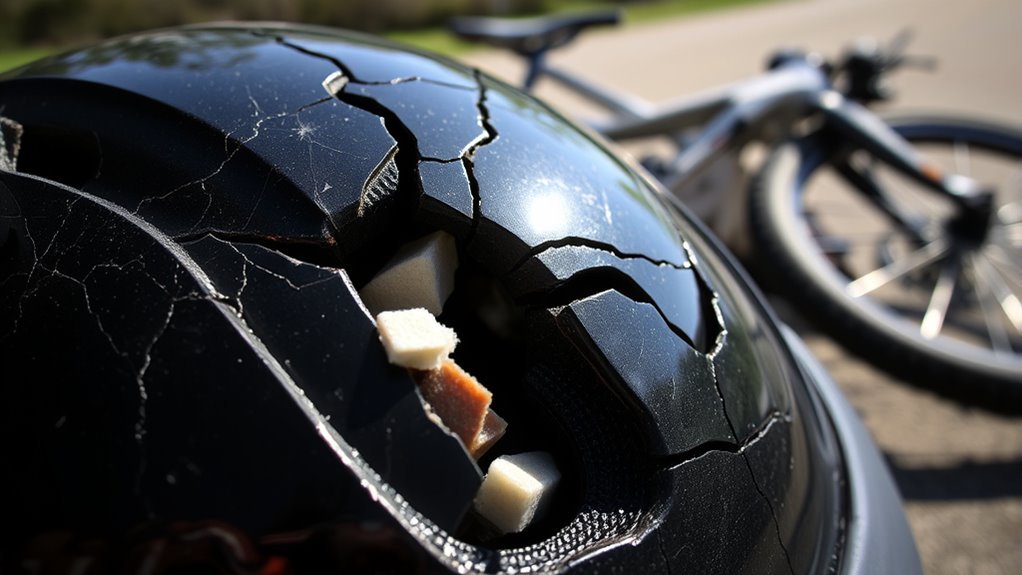
- The helmet shows any cracking, deep scuffing, dents, or separation of components.
- The inner foam is compressed, cracked, or has visible wear spots after the impact.
- You felt a significant “thump,” ringing, dizziness, confusion, or headache after the crash.
- The helmet experienced straps or retention system stress (for example, a sudden twisting impact).
Conversational Q&A: “Do I replace it if it just fell off?”
Q: If my helmet falls off while I’m stopped, do I have to replace it?
A: Not always, but you should treat any impact that could have contacted the head-impact zone seriously. If the helmet was struck and you cannot confirm it remained undamaged, replacement is the safer choice. If you can clearly see no damage and the helmet never took a significant impact load, you may be able to continue—yet manufacturers often still recommend replacement if the helmet suffered any meaningful hit.
Signs of helmet damage that mean “do not ride again”
Visible damage is the clearest indicator that your helmet may have lost protective performance. But lack of visible damage does not guarantee safety, because internal liners can be affected without obvious external flaws.
Exterior signs to check
After a crash, inspect the entire helmet, not just the spot that hit the ground. Look for:
- Cracks in the outer shell (even hairline cracks).
- Dents or deformation that changed the helmet’s shape.
- Scrapes or gouges that expose material layers or penetrate deeply.
- Shell separation where the outer layer loosens from the liner.
- Damaged ventilation structures or missing pieces.
Interior signs to check
Internal assessment matters because the energy-absorbing liner is often what gets sacrificed during a crash. Check for:
- Compressed EPS foam or areas that appear “flattened.”
- Foam fractures or pieces that look chipped or split.
- Loose or shifted padding and retention system looseness.
- Unusual odors or signs of material breakdown (for example, heat damage).
- Strap wear near attachment points that could weaken the fit.
Conversational Q&A: “My helmet has no visible cracks. Should I still replace it?”
Q: My helmet looks fine—no cracks or dents. Can I keep using it?
A: If the helmet was involved in an impact that could have engaged the liner, replacement is the safest approach. Micro-damage inside the foam or bonds may not be visible, and helmets are not designed to be “refurbished” after structural stress.
The risks of continuing to use a damaged helmet
Using a helmet after a crash increases the likelihood that it will not protect you effectively in the next impact. The risk is not theoretical; it stems from reduced energy absorption, altered fit, and compromised structural integrity.
Reduced impact absorption
A helmet is defined as an impact-energy management system. When the liner is compressed or partially fractured, it may not provide the same crush behavior during a subsequent crash. That can translate into higher peak forces reaching your skull and brain.
What this means for injury outcomes
Head injuries can range from concussion to more severe traumatic brain injuries. Medical guidance from organizations such as the Centers for Disease Control and Prevention (CDC) consistently emphasizes prevention, protective equipment, and safe practices. While a helmet cannot guarantee injury prevention, it significantly improves odds when used correctly and replaced when it has been compromised.
The widely accepted expert consensus is that a damaged helmet should be treated as unreliable safety equipment.
Conversational Q&A: “How likely is it that a crash damages the helmet?”
Q: Is it possible that a light crash does not affect protection?
A: It is possible, but the protective mechanism is engaged based on impact dynamics, not your perception of severity. Because you cannot reliably measure internal strain without specialized equipment, the safety standard is conservative: replace after any significant crash or impact.
Helmet standards and why they matter after an impact
Helmet safety standards help define performance requirements before use, but they do not “reset” after a crash. Once the helmet has been subjected to an impact, its post-crash condition may no longer match the assumptions used during certification testing.
Common standards you may see on helmets
Many helmets sold in major markets reference recognized testing and performance standards. Depending on region and product category, you may see references such as:
- ASTM standards commonly used for bicycle helmets in the United States (for example, ASTM F1447, and related updates for impact performance).
- EN standards used widely across Europe (for example, EN 1078 for bicycle helmets).
- CPSC certification in the U.S. for certain helmet categories, indicating compliance with federal performance requirements.
The key point is that certification demonstrates protection under defined test conditions at the time of manufacture, not after you have taken a real-world impact.
What manufacturers typically advise
Most major helmet brands instruct users to replace a helmet after it has been involved in a crash. Brand guidance may vary in wording, but the safety logic is the same: after impact, the helmet’s ability to protect may be reduced.
How to replace your helmet safely (and avoid common mistakes)
Replacing your helmet after a crash is not just about buying a new shell—it is about restoring the exact protective performance and correct fit your head needs. A properly installed new helmet can immediately improve your safety in the next ride.
Step-by-step replacement checklist
- Stop using the old helmet if it was involved in a crash with impact or shows any damage.
- Remove any attachments you may reuse only if they are not part of the helmet’s safety-critical structure (follow the manufacturer’s guidance).
- Select the correct size using the brand’s sizing chart and measure your head circumference.
- Fit and retention: ensure the helmet sits level, with straps snug and properly adjusted.
- Check coverage: the helmet should protect the forehead and not be tilted too far back.
- Verify compliance: look for the relevant safety standard labeling for your region.
Conversational Q&A: “Can I repair or glue a cracked helmet?”
Q: Can I fix a cracked helmet with glue or tape to save money?
A: No. Repairs cannot restore the original impact-absorption behavior of the liner or the structural integrity of the shell. Helmets are designed as safety systems, not DIY projects, and modifications can invalidate performance.
Preventive habits that extend helmet life (without replacing the crash rule)
Helmets last longer when they are stored properly and used with correct fit, but maintenance does not replace the requirement to replace after a crash. The goal is to keep the helmet in reliable condition until an impact occurs.
Practical care tips
- Store your helmet away from direct sunlight and extreme heat, which can degrade materials over time.
- Clean with mild soap and water; avoid harsh solvents that can damage plastics and coatings.
- Keep the interior straps and padding clean so the helmet retains its intended fit.
- Do a quick pre-ride inspection: straps, buckle function, and overall shell integrity.
Know your replacement schedule too
Even without crashes, many manufacturers suggest replacement after several years of use due to material aging, UV exposure, and wear. Always check the specific guidance from your helmet manufacturer for your model and usage conditions.
Typical Helmet Service-Life Guidance by Category (No Crash) — US/EN Markets
| # | Helmet category | Common max use (years) | Primary aging risk | Safety priority |
|---|---|---|---|---|
| 1 | Motorcycle (integral/full-face) | 5 | Shell impact fatigue + UV degradation | ★★★★★ |
| 2 | E-bike / power-assisted bicycle | 5 | Higher-energy falls + liner compression aging | ★★★★☆ |
| 3 | Bicycle (road/commuter) | 4 | UV + foam binder aging in EPS systems | ★★★★☆ |
| 4 | Bicycle (MTB / aggressive trail) | 3 | More frequent impacts + abrasion wear | ★★★★★ |
| 5 | Skate / BMX-style (multi-impact) | 3 | Frequent scraping + internal fit wear | ★★★★☆ |
| 6 | Ski / snowboard (hard-shell) | 5 | Temperature cycling + foam compression set | ★★★★☆ |
| 7 | Roller / inline skating | 4 | Liner fatigue + strap/retention wear | ★★★☆☆ |
When to seek medical attention after a crash
If you were involved in a crash while wearing a helmet, monitor symptoms and seek medical care if you feel unwell. A helmet can reduce injury risk, but it cannot eliminate it, and some head injuries develop symptoms after the impact.
Watch for concussion-related symptoms
Seek urgent medical evaluation if you experience any of the following after a crash:
- Loss of consciousness (even briefly)
- Severe or worsening headache
- Dizziness, confusion, or drowsiness
- Repeated vomiting
- Slurred speech or weakness in limbs
The CDC and other health authorities recommend prompt evaluation when concussion symptoms occur. When in doubt, treat symptoms seriously and get assessed.
Bottom line: Replace your helmet to protect your next ride
Replacing your helmet after a crash is one of the most evidence-aligned safety steps you can take. Because helmet performance can be compromised internally—often without obvious exterior damage—replacement is the trusted, conservative approach endorsed by safety organizations and manufacturers.
If your helmet was involved in an impact, inspect it carefully, and when there is doubt, replace it. Your future safety depends on it.
Frequently Asked Questions
Do I really need to replace my helmet after a crash if there’s no visible damage?
Yes. You should replace your helmet after any crash, even if it looks fine. Helmet performance depends on materials that are engineered to absorb impact energy by deforming, cracking, or delaminating internally. Many failure points aren’t visible from the outside. A helmet can also be weakened by impacts that transfer force into the liner, chin strap anchor points, or internal retention system, reducing protection in a future crash. If you’ve had a fall or collision, the safest assumption is that the helmet has already done its job and may no longer provide the level of impact protection it was designed to deliver.
What counts as a crash that requires replacing a helmet?
Replace the helmet after any incident involving a direct impact to the head or a fall where your helmet took a blow, even if the impact seems minor. This includes: crashes or collisions, falls from a bike, scooter, skateboard, or motorcycle, impacts with the ground or another object, and situations where you hit your helmet on the ground, vehicle, or obstacle. You should also replace it after a helmet is struck in a way that could transmit force through the shell and liner. If there’s any doubt, follow the manufacturer’s guidance—most recommend replacement after impact, and many have written policies in manuals or warranty terms.
How soon should I replace my helmet after a crash?
Replace it as soon as practical—ideally immediately after the incident—before riding or using it again. Helmet damage from a crash may compromise performance immediately, not gradually. Continuing to ride with a helmet that has been impacted can increase the risk of serious injury in a subsequent crash. If you need time to inspect the helmet and confirm what happened, treat it as unsafe in the meantime. If the helmet is a rental, workplace-issued, or under a warranty program, contact the provider or manufacturer promptly for the required steps.
How can I tell if my helmet is damaged inside after a crash?
Unfortunately, you often can’t tell from the outside. Internal liner damage may involve compressed foam, crushed EPS/EPP, fractured bonding, delamination, or stress to the comfort pads and retention system that won’t be obvious visually. Some helmets may show superficial scuffs or cracks, but others may appear intact while the energy-absorbing layers have been compromised. Because inspection tools and trained evaluation aren’t typically available to consumers, the safest approach is impact-based replacement: if the helmet was involved in a crash, replace it regardless of external appearance. Follow any manufacturer “checklist” or inspection instructions, but remember that those checks usually cannot confirm that the internal protective layers are still intact.
What if the crash was low-speed or I only got a bump—should I still replace the helmet?
Yes, even low-speed impacts can produce enough force to compromise helmet structures. Helmet design uses a controlled way to absorb energy; the protective liner can be affected by impacts that are difficult to judge by speed alone. Factors like the angle of impact, helmet position, surface type (concrete, gravel, curb), and how the helmet hit (direct blow vs. glancing) can all influence the amount of internal damage. If your head or helmet took an impact during a crash, the helmet may have reached the limit of its energy-absorbing capability. Replacing it is the most reliable way to maintain your protective coverage.
References
- Google Scholar search: Helmet replacement after crash Google Scholar
https://scholar.google.com/scholar?q=helmet+replacement+after+crash - Google Scholar search: Bicycle helmet damage after impact Google Scholar
https://scholar.google.com/scholar?q=bicycle+helmet+damage+after+impact - PubMed search: Helmet replacement after crash Google Scholar
https://pubmed.ncbi.nlm.nih.gov/?term=helmet+replacement+after+crash - Bicycle Helmets: How to Choose and Fit
https://www.nhtsa.gov/road-safety/bicycle-safety/bicycle-helmets - Bicycle Safety: Helmets, Rules, and Injury Prevention
https://www.cdc.gov/transportationsafety/bicycle/index.html - Bicycle helmet (including guidance to replace after a crash)
https://en.wikipedia.org/wiki/Bicycle_helmet - WHO fact sheet: Helmets (road safety)
https://www.who.int/news-room/fact-sheets/detail/helmets - Encyclopaedia Britannica: Helmet (protective gear)
https://www.britannica.com/technology/helmet-protective-gear
📅 Last Updated: July 07, 2026 | Topic: Why You Must Replace Your Helmet After a Crash | Content verified for accuracy and freshness.