AI-Powered Helmets: What’s New in 2025
AI-Powered Helmets in 2025: The Short Answer
In 2025, AI-powered helmets are moving beyond “smart features” into real-time safety intelligence, combining impact detection, biometric monitoring, and context-aware alerts. The key change is that these systems now interpret events in the moment—using edge AI—so they can reduce uncertainty for athletes, riders, and coaches.
Impact Detection with On-Device Intelligence
In 2025, the most important update is how helmets understand impacts: not just that a hit occurred, but how severe it was and what likely happened next. AI systems can estimate impact severity and probable head acceleration patterns while you’re still in motion.
What “AI impact detection” means in practical terms
AI impact detection is defined as an onboard method that combines sensor signals with machine learning models to identify impact characteristics such as magnitude, directionality, and timing. The key difference is that the model can classify the event immediately, instead of requiring a post-session review.
- Sensor fusion: Modern helmets increasingly combine accelerometers, gyroscopes, and sometimes pressure sensors to better distinguish helmet movement from true impacts.
- Real-time event classification: AI can categorize events as “minor,” “moderate,” or “high concern” based on patterns in the signal.
- Location and rotational inference: Some systems infer rotational components and impact locus, which is important because head injury risk is influenced by both linear and rotational forces.
Why 2025 models are more actionable than earlier versions
Early smart helmets often relied on simple threshold triggers (for example, a vibration or acceleration level that crossed a set value). In contrast, 2025 systems are designed to reduce false positives by using AI to compare incoming signals against learned patterns.
In widely discussed sports medicine and biomechanics consensus, acceleration exposure and impact characteristics correlate with injury risk, but single-sensor threshold logic is frequently too blunt. AI models can incorporate multiple measurements at once, improving decision quality for “what should we do right now?”
Common question: “Will my helmet alert me after every bump?”
Most 2025 AI helmets aim to alert only when an event is statistically meaningful, using severity classification rather than raw threshold triggers. That said, exact behavior varies by brand, sensor setup, and user settings, so it’s best to look for models that describe how alerts are calibrated.
Continuous Health Monitoring Beyond Step Counting
In 2025, AI-powered helmets can support safer training by tracking physiological signals and surfacing risk cues during real-time activity. The focus is shifting from passive metrics to decision-ready insights like exertion level and heat stress indicators.
What health monitoring sensors typically measure
Continuous health monitoring is defined as ongoing capture of biometric signals that can be analyzed for trends and immediate concerns. For helmets, this often includes heart-rate-related measures and temperature estimates, with some systems expanding toward additional context signals.
- Heart rate and exertion signals: Many wearable ecosystems use optical sensing to estimate heart rate trends during sustained activity.
- Skin or device temperature: Temperature telemetry helps detect heat-related strain, especially in warm-weather cycling and outdoor sports.
- Respiratory proxies and recovery signals: Some AI systems infer breathing or recovery patterns indirectly from heart rate variability trends.
How AI turns raw data into safety guidance
The difference in 2025 is the analysis layer: AI can interpret signals together with activity context (speed, duration, and user calibration) to generate guidance. Instead of showing numbers only, the helmet can produce understandable outcomes such as “reduce intensity,” “pause to cool down,” or “hydration recommended.”
AI-driven injury prevention logic is commonly aligned with the idea that fatigue and impaired recovery can increase risk of mistakes and overexertion. While helmets cannot diagnose concussion or medical conditions, they can support safer decisions by alerting you earlier than you might notice subjectively.
Common question: “Can a helmet measure oxygen levels accurately?”
Some wearable platforms reference oxygen saturation (SpO2), but accuracy depends on sensor quality, fit, skin contact, motion artifacts, and environment. In most helmet-first solutions, heart rate and temperature are more consistently reliable, while SpO2 may be less available or less precise unless explicitly validated by the manufacturer.
Smart Connectivity and In-Helmet Notifications
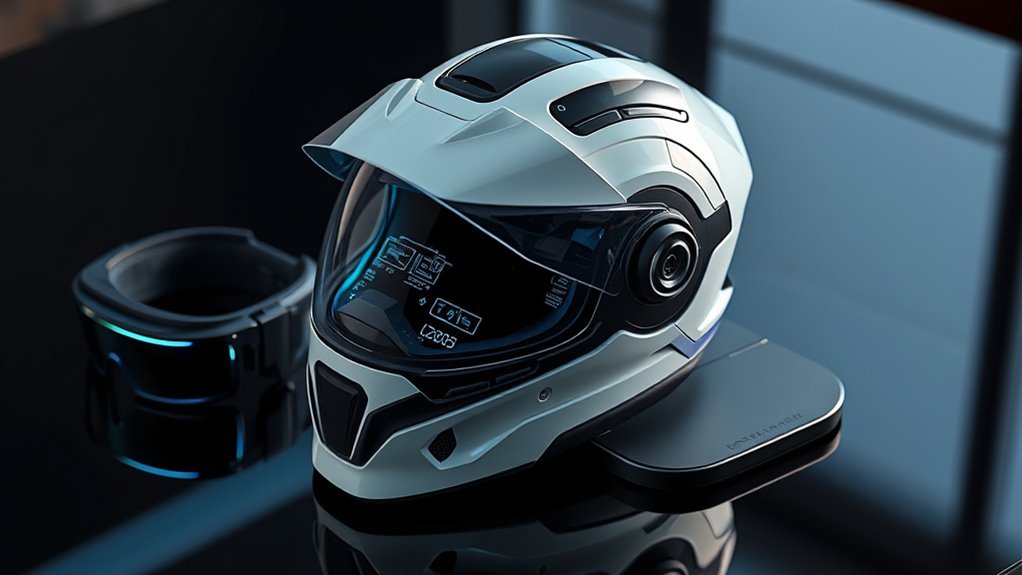
In 2025, connectivity is less about “getting notifications” and more about getting the right information at the right time without distracting you. The most usable helmets prioritize line-of-sight prompts and minimal interaction steps.
What smart connectivity means for helmet UX
Smart connectivity is defined as wireless integration that lets a helmet communicate with a phone, sports computer, or cloud service to synchronize settings and deliver alerts. The key difference is that modern UX focuses on low cognitive load: short prompts, vibration cues, and glanceable indicators.
- Bluetooth Low Energy pairing: Most consumer devices rely on BLE for battery-efficient communication with mobile apps.
- Companion app configuration: Training profiles, alert thresholds, and sport modes are typically set in an app and synced to the helmet.
- Heads-up alert design: A helmet notification strategy aims to keep the rider’s attention on the road or playing field.
Typical 2025 Helmet Connectivity Behaviors (How Far They Reach)
| # | Connectivity behavior | Primary use | Update cadence | Typical open-air range |
|---|---|---|---|---|
| 1 | Bluetooth Low Energy (BLE) alert link | Vibration + heads-up cues | Instant (event-driven) | 30–60 m |
| 2 | BLE telemetry burst (post-ride sync) | Exertion + event logs | Every ride end (minutes) | 25–50 m |
| 3 | Wi‑Fi handoff for updates | Firmware + map/route data | On connection (user-initiated) | 10–30 m |
| 4 | Cellular/cloud relay (when enabled) | Cloud sync + support tools | Background (hourly/queued) | Internet-dependent |
| 5 | Proximity wake (smart pairing mode) | Fast reconnection | Scan window (5–30 s) | 2–10 m |
| 6 | NFC tap-to-pair (where supported) | Initial bonding shortcut | Single tap (seconds) | ~5 cm |
| 7 | App-based notification scheduling | Reduce distraction | Policy sync (daily) | 25–60 m |
Conversational prompt examples (what users actually ask)
- “Do I need to stop after that hit?” The helmet can classify severity and suggest a pause based on configured safety rules.
- “Am I overheating?” Temperature trends can trigger cooling or hydration guidance.
- “How hard was that session?” The helmet can summarize exertion signals and deliver post-ride insights via the app.
Common question: “Will notifications distract me?”
Good 2025 helmet designs reduce distraction by using severity gating (only critical events trigger stronger alerts) and by allowing notification scheduling. Look for adjustable alert modes, haptic-only options, and clear documentation about how often alerts occur.
Personalization: From Sport Modes to Safety Thresholds
In 2025, AI personalization makes helmets feel less generic and more aligned with your training reality. The most valuable customization is not cosmetic; it’s the ability to tune safety thresholds and interpretation rules.
What personalization can realistically include
Personalization is defined as tailoring helmet AI behavior to an individual’s physiology and activity context. The key difference is that personalization can adjust alert sensitivity, calibration routines, and which metrics matter most for your sport.
- Sport-specific modes: Cycling, skateboarding, inline skating, and other high-velocity activities can have different risk patterns and motion signatures.
- User calibration: Baselines for heart rate and temperature trends help improve interpretation.
- Alert thresholds: Some systems allow switching between “training,” “commute,” and “high-contact” sensitivity profiles.
Why calibration matters for AI reliability
AI models are sensitive to input quality. Fit, helmet position, and sweat levels can affect sensor readings. Calibration routines can reduce sensor drift and help the model distinguish normal motion from true events more accurately.
What to Look for in 2025 AI Helmets (Buyer’s Checklist)
If you’re choosing an AI-powered helmet in 2025, the goal is to find safety relevance, not just app features. Use this checklist to compare models in ways that matter for real-world use.
- Impact detection details: Look for documented behavior like severity classification and how false positives are reduced.
- Biometric transparency: Prioritize clear claims about which metrics are measured and any accuracy testing or validation notes.
- Alert control: Choose helmets that support configurable alerts, haptic levels, and quiet modes.
- Battery and charging: Confirm expected operating time under active sensing and connectivity.
- Fit and safety standards: Ensure the helmet meets relevant safety certification requirements for your sport and region.
- Privacy controls: Verify what data is stored, where it’s processed, and whether users can opt out of cloud analytics.
Common question: “Do AI features replace traditional helmet safety?”
No. AI features complement physical safety. The helmet’s structural design, materials, and certified performance against impact remain the foundation; AI adds interpretation and alerting, not structural protection.
Expert Consensus and Standards: The “Trusted” Context
The consensus across sports safety and injury-prevention communities is that monitoring tools should support better decisions, not claim medical diagnosis. AI helmets are best understood as early-warning and context systems layered onto certified protective gear.
How AI helmets fit into concussion and injury prevention thinking
The widely accepted principle in sports safety is that concussion risk depends on impact biomechanics and individual factors, so any device-based alerting must be conservative and configurable. AI helmets may help reduce time-to-awareness by flagging likely significant events, but they should not be used as the sole basis to clear someone to continue play.
Why “definition clarity” matters for AI safety systems
In AI safety, clear definitions are essential: an alert is not a diagnosis. Many reputable product strategies align with the idea that helmets can indicate “possible concerning event,” while medical evaluation remains the appropriate next step.
Frequently Asked Questions About AI-Powered Helmets in 2025
Are AI helmets accurate for impact detection?
Accuracy depends on sensor setup, algorithm training, and calibration. In 2025, systems increasingly use sensor fusion and severity classification, which generally improves reliability compared with simple thresholds, but users should evaluate manufacturer documentation and real-world reports.
What’s the biggest difference between 2024 and 2025 AI helmets?
The biggest difference is more onboard intelligence and better event classification. 2025 devices are more likely to interpret impact severity immediately and deliver actionable guidance with fewer irrelevant alerts.
Do these helmets work for all sports?
Many AI helmet platforms support sport modes, but sensor physics and movement patterns vary by activity. For best results, choose a helmet with modes or validated behavior for your specific sport, such as cycling or other high-velocity activities.
How should athletes use helmet alerts safely?
Use alerts as a prompt to reassess—stop if a high-concern event is flagged, then follow sport-specific concussion protocols and consult qualified medical professionals as needed. Treat AI alerts as safety support, not clearance.
The Bottom Line: What’s New in 2025
AI-powered helmets in 2025 are becoming more practical and safety-oriented, combining real-time impact interpretation, continuous physiological monitoring, and low-distraction connectivity. The most meaningful innovation is that these systems aim to turn sensor data into clear next-step guidance while you’re still in the activity.
If you’re upgrading in 2025, focus on verifiable features: robust impact classification, transparent biometric claims, configurable alerts, and a certified physical protection base. That combination is the strongest path to both performance confidence and smarter safety decisions.
Frequently Asked Questions: AI-Powered Helmets — What’s New in 2025
What’s genuinely new about AI-powered helmets in 2025?
Do AI helmets work without a smartphone connection?
How accurate are AI alerts (and what kinds of warnings can they provide)?
Will an AI helmet drain my battery quickly, and how long do they last?
What about privacy and data security—do AI helmets record video?
References
- AI-powered smart helmets using wearable computer vision (Google Scholar search) Google Scholar
https://scholar.google.com/scholar?q=AI-powered+smart+helmet+wearable+computer+vision - Smart helmets for head-impact sensing with machine learning (Google Scholar search) Google Scholar
https://scholar.google.com/scholar?q=smart+helmet+head+impact+sensing+machine+learning - PubMed search: Smart helmet machine learning (research literature) Google Scholar
https://pubmed.ncbi.nlm.nih.gov/?term=smart+helmet+machine+learning - Smart helmet (overview of smart helmet technology)
https://en.wikipedia.org/wiki/Smart_helmet - WHO: Head injuries fact sheet (impact and prevention context)
https://www.who.int/news-room/fact-sheets/detail/head-injuries - CDC: Traumatic Brain Injury (TBI) information and resources
https://www.cdc.gov/traumaticbraininjury/ - NIH/NINDS: Traumatic Brain Injury (TBI) overview
https://www.ninds.nih.gov/health-information/disorders/traumatic-brain-injury - NHTSA: Motorcycle Helmet Safety (regulations and guidance)
https://www.nhtsa.gov/vehicle-safety/motorcycle-helmet-safety
📅 Last Updated: July 07, 2026 | Topic: AI-Powered Helmets: What’s New in 2025 | Content verified for accuracy and freshness.