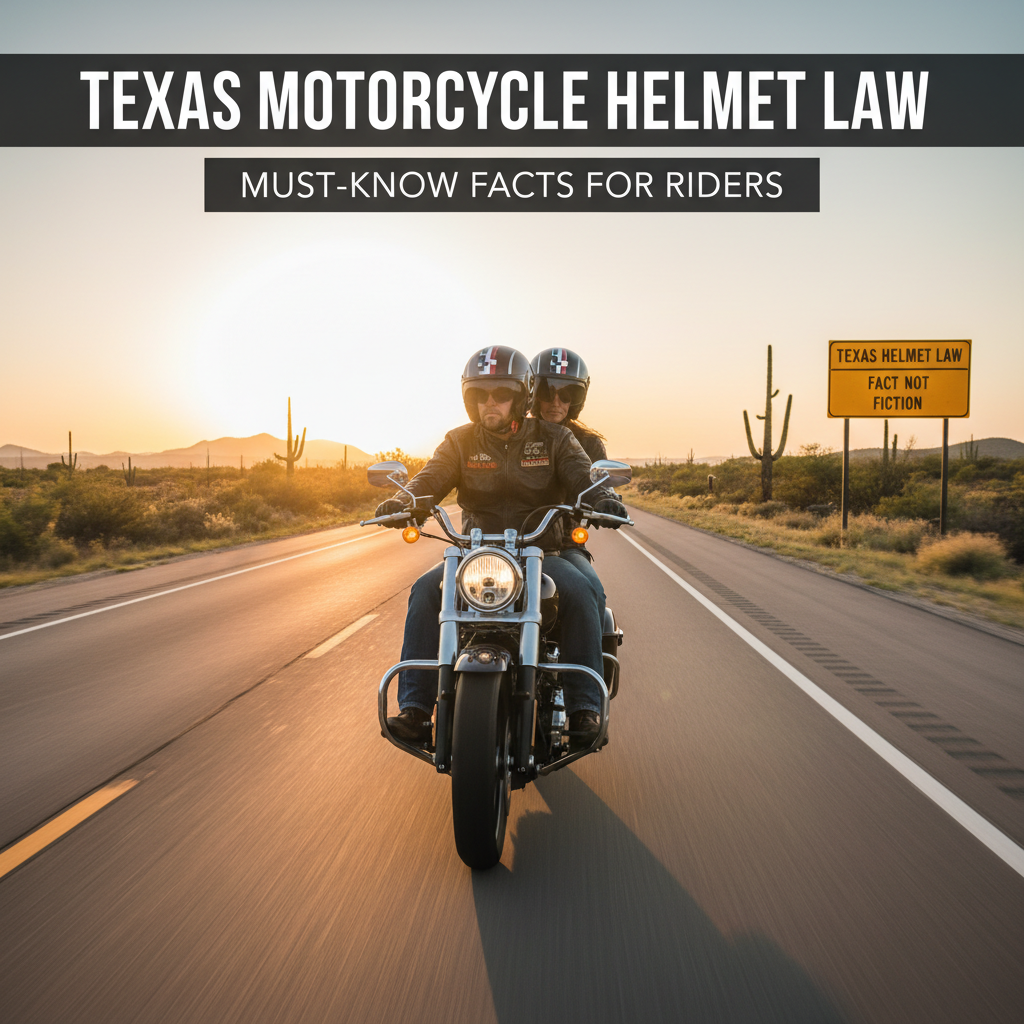
Texas Motorcycle Helmet Law: Must-Know Facts for Riders
Texas Motorcycle Helmet Law: Must-Know Facts for Riders
Texas has a motorcycle helmet law, but the rules depend heavily on your age and whether you qualify for an exemption. In practice, many riders under 21 must wear a helmet, while certain riders 21 and older may ride without one if they meet specific safety-course and insurance requirements.
What the Texas Motorcycle Helmet Law Requires (Quick Answer)
The Texas motorcycle helmet law is defined by rider age and compliance with an approved helmet exemption pathway. The key difference is that under 21 riders generally must wear a helmet, while 21 and older riders may be exempt if they satisfy state requirements.
In Texas, the baseline rule is simple: all riders under age 21 are required to wear a motorcycle helmet when operating a motorcycle. For riders who are 21 or older, Texas allows an exemption from the helmet requirement if they have completed an approved motorcycle safety course and maintain required medical insurance.
Who Must Wear a Helmet in Texas?
Riders under 21 must wear a helmet in Texas while riding a motorcycle. This requirement is intended to reduce the risk of serious head injury among younger drivers, who statistics and public safety guidance identify as a higher-risk group.
- Under 21: Helmet required.
- 21 and older: Helmet may not be required if exemption conditions are met.
What Changes at Age 21?
The key difference is that Texas law shifts from a strict helmet requirement for younger riders to a conditional rule for adult riders. If you are 21 or older, you can potentially ride without a helmet only if you meet the exemption conditions described below.
Exemption Rules: How Riders 21 and Older Can Skip a Helmet
Texas allows certain riders age 21 and older to ride without a helmet if they can prove they meet both the training and insurance requirements. This is not a general “no-helmet” license; it is a specific, documented exemption.
The Texas exemption is commonly discussed in terms of two conditions:
- Completion of an approved motorcycle safety course (as defined by Texas authorities).
- Maintenance of required minimum medical insurance for injuries.
Texas Motorcycle Safety Course Requirement
The safety-course requirement is defined as a rider training credential that qualifies under Texas law for the helmet exemption pathway. To be eligible, riders generally must complete a course certified by the Texas Department of Public Safety (DPS) or otherwise approved through Texas’s framework for motorcycle operator training.
In most cases, these programs combine classroom learning with hands-on riding instruction. Expect topics that reinforce real-world crash prevention, including hazard recognition, defensive riding strategies, and risk awareness related to alcohol and other impairing factors.
- Training credential: A completion certificate or documentation showing the rider finished an approved course.
- What it supports: Legal eligibility to ride without a helmet (for qualifying riders 21+).
Helmet Exemption Insurance Requirement
Texas’s insurance requirement for helmet exemption is defined as a minimum level of medical coverage intended to reduce the financial harm that can result from motorcycle injuries. For riders 21 and older who opt out of wearing a helmet under the exemption, Texas requires at least $10,000 in medical insurance.
This requirement is widely described as a “medical coverage floor” rather than total liability coverage. Riders should confirm the exact coverage details on their policy documents, because “having insurance” is not always the same as meeting the specific minimum described by Texas law.
Texas Helmet-Exemption Proof Items (21+ Riders)
| # | Proof item | Applies to | What it must show | Common weak point | Fit rating | Compliance impact |
|---|---|---|---|---|---|---|
| 1 | Approved course completion certificate | 21+ riders | Completion of an approved Texas motorcycle safety course | Course not accepted under Texas’s exemption pathway | ★★★★★ | High |
| 2 | Course completion receipt + rider name match | 21+ riders | Your name and completion status from the approved program | Name mismatch between documents and ID | ★★★★☆ | High |
| 3 | Current medical coverage declarations page | 21+ riders | Medical coverage amount that meets the $10,000 minimum | Shows liability only, not medical coverage limits | ★★★☆☆ | Medium |
| 4 | Insurance policy schedule showing medical limit | 21+ riders | Explicit medical minimum (≥ $10,000) | Out-of-date schedule after a policy change | ★★★★★ | High |
| 5 | Digital ID card (with medical coverage info) | 21+ riders | Policyholder and coverage status; confirm it reflects medical coverage level | Some cards list coverage but omit medical limit detail | ★★★☆☆ | Medium |
| 6 | Proof packet copy stored with your helmet exemption documents | 21+ riders | A retrievable set of the course credential + insurance proof | Missing one side of the two-condition requirement (training or insurance) | ★★★★☆ | High |
| 7 | Coverage confirmation message from insurer (when it clearly states $10,000+ medical) | 21+ riders | A written confirmation that medical coverage meets or exceeds $10,000 | Email/letter confirms “insurance exists” but doesn’t mention the medical minimum | ★★★☆☆ | Lower |
- Minimum medical coverage: $10,000
- Why it matters: Motorcycle crashes can involve extensive medical costs, and the law aims to ensure funds are available for medical treatment.
What Counts as a “Helmet” Under Texas Rules?
Texas requires that helmets used to comply with the law meet recognized safety standards. The practical takeaway is that not every head covering qualifies as a legal motorcycle helmet.
For compliance purposes, riders typically need a helmet that meets federal motorcycle helmet standards, often referenced as DOT certification. Many riders also choose higher-tier protection voluntarily by selecting helmets built to stricter standards, but for legal compliance, riders should at minimum rely on DOT-labeled helmets.
DOT-Certified Helmets and Rider Safety
A DOT-certified helmet is defined as a helmet that has been tested and labeled as meeting U.S. Department of Transportation requirements for motorcycle helmets. While the exemption rules may allow helmet-free riding for qualifying adult riders, choosing a DOT-compliant helmet remains one of the most effective ways to reduce the severity of head injuries in crashes.
- DOT is the baseline compliance standard commonly relied on by riders in Texas.
- Extra comfort and protection can be found in premium full-face or modular designs, but legal compliance starts with certification.
Common Questions Riders Ask About Texas Helmet Law
Riders often ask whether the law applies to passengers, whether a waiver exists, and what happens if they cannot prove exemption eligibility. Below are conversational answers to the questions that most frequently come up on the road.
Do passengers have to wear helmets in Texas?
Yes, Texas’s helmet requirement generally applies based on the age of the rider/driver and passenger categories covered by the statute. In many real-world situations, the safest approach is to treat helmet compliance as a requirement for any motorcycle occupant who is subject to the law.
If you are riding with a passenger, verify your specific situation by checking the exact age-based requirements for passengers under Texas law. When in doubt, wearing a helmet is the simplest and most defensible safety decision.
Can I ride without a helmet if I completed a course in another state?
Not automatically. The helmet exemption is defined around Texas-approved motorcycle safety course documentation. Riders should ensure their certificate is valid under the Texas exemption pathway and keep the required proof available.
What proof do I need to ride without a helmet?
To use the helmet exemption, you should be able to demonstrate that you completed the required safety course and that you maintain the required medical insurance level. If you cannot provide documentation when questioned, an officer may not accept your eligibility as proven on the spot.
- Course completion documentation: Keep your certificate or completion proof.
- Insurance proof: Maintain evidence showing at least $10,000 in medical coverage.
Does the Texas motorcycle helmet law apply to all motorcycle types?
Generally, the law is intended for motorcycle operators and riders covered by Texas’s motorcycle regulations. However, vehicle classification can be nuanced, especially with scooters, mopeds, and low-speed two-wheel vehicles.
If your vehicle classification is unclear, confirm whether Texas treats it as a motorcycle for legal purposes before relying on exemption assumptions.
Why Helmet Laws Matter: Safety Perspective and Expert Consensus
Motorcycle helmet laws exist because helmets reduce the likelihood of severe head injuries during crashes. Public safety experts and widely accepted injury prevention guidance consistently support helmet use as a high-impact intervention.
Even when Texas offers a helmet exemption for certain adult riders, that exemption does not change the physics of impact or the medical reality of traumatic brain injury. Helmets help manage the forces involved in sudden deceleration and protect against direct head trauma.
Insurance Considerations Beyond Compliance
Insurance requirements for legal exemptions focus on minimum medical coverage, but they do not eliminate the need for sound rider risk management. Many insurance carriers also consider safety training and safe riding history when setting premiums, and some programs offer discounts for completing certified motorcycle rider courses.
- Financial planning: Carry more than the minimum when your budget allows.
- Loss protection: Consider medical, uninsured/underinsured motorist, and comprehensive coverage options.
Practical Checklist for Texas Riders
Use this checklist to stay compliant and reduce uncertainty during roadside stops. The goal is to know whether you must wear a helmet and, if you do not, to be ready with documentation.
- Are you under 21? Wear a motorcycle helmet.
- Are you 21 or older? Check whether you meet the exemption criteria.
- Safety course certificate: Keep proof of completion from an approved Texas DPS-aligned course.
- Medical insurance: Confirm your policy provides at least $10,000 in medical coverage.
- Helmet choice (if riding with a helmet): Prefer DOT-certified helmets for compliance and safety.
Final Takeaways: Staying Compliant on Texas Roads
Texas motorcycle helmet rules are straightforward when you understand the age threshold and the exemption conditions. Riders under 21 must wear a helmet, while riders 21 and older may avoid helmet requirements only by completing an approved safety course and maintaining at least $10,000 in medical insurance.
If you want the simplest safety approach, wear a helmet. If you rely on the exemption, keep your documentation accessible and verify your insurance coverage matches the minimum requirement.
Frequently Asked Questions: Texas Motorcycle Helmet Law (Must-Know Facts for Riders)
Do I have to wear a helmet when riding a motorcycle in Texas?
In Texas, the helmet requirement generally applies to riders under a certain age. Texas law requires a helmet for motorcycle operators and passengers who are younger than 21 years old. If you are 21 or older, Texas law does not require you to wear a helmet for general motorcycle operation, though local ordinances, rider policies, and safety best practices may still encourage or effectively require protective gear.
What age does the Texas motorcycle helmet law apply to?
Texas’s mandatory helmet law applies to motorcycle operators and passengers who are under 21 years of age. If you’re 20 (or younger), you must wear a helmet that complies with applicable standards; if you are 21 or older, the helmet requirement does not generally apply under the same rule.
What kind of helmet is considered legal in Texas?
A legal Texas motorcycle helmet must generally meet federal safety standards. In practice, riders should look for helmets labeled as DOT (U.S. Department of Transportation) compliant and worn properly with the chin strap secured. Even when not legally required for older riders, a DOT-compliant helmet is strongly recommended for better head injury protection. If you’re unsure whether your helmet qualifies, check the label and manufacturer documentation.
Are there exceptions to the Texas motorcycle helmet law?
The most common and well-known exception relates to age: the mandatory helmet requirement applies to riders and passengers under 21. Outside of age-based rules, helmet requirements may be affected by specific circumstances, such as how the rider is classified (for example, motorcycle vs. other vehicle types) or other local/safety enforcement practices. Because laws and interpretations can change, it’s wise to verify current details with official Texas resources or a qualified attorney, especially if you believe you may fall outside the typical rule.
What happens if I get cited for not wearing a helmet in Texas?
If you are required to wear a helmet (such as being under 21) and you are cited for noncompliance, the citation may lead to penalties such as a fine and potential court-related costs. Beyond the legal consequences, riding without appropriate head protection significantly increases the risk of serious injury in a crash. If you receive a citation, consider reviewing the ticket details, checking your eligibility and helmet compliance (if applicable), and following the instructions on the citation for contesting or paying. For specific legal advice, consult an attorney or court guidance.
References
- Independent biker: An ethnography of a biker community Google Scholar
https://ttu-ir.tdl.org/bitstreams/a8e6510a-44ea-44af-99d3-e55acc2bec49/download - [B] Motorcycling for Dummies Google Scholar
https://books.google.com/books?hl=en&lr=&id=t_jIAgAAQBAJ&oi=fnd&pg=PA1&dq=Texas+Motorcycle+Helmet+Law:+Must-Know+Facts+for+Riders&ots=F5YatVObNs&sig=IcuvDjZcWgY9IehAWnKsaEMPdbg - [B] Permission to ride: A study of perceptions among African-American bikers in the motorcycle su… Google Scholar
https://search.proquest.com/openview/4666aa26323b530e73a3c5a8d561177a/1?pq-origsite=gscholar&cbl=18750 - [B] The rebels: A brotherhood of outlaw bikers Google Scholar
https://books.google.com/books?hl=en&lr=&id=mgNRMZAg8N4C&oi=fnd&pg=PP11&dq=Texas+Motorcycle+Helmet+Law:+Must-Know+Facts+for+Riders&ots=FoYZWz3g8p&sig=tu15JehXRk25OFVDfGsB4pnqUh0 - [B] It’s No Accident: The Real Story Behind Senseless Death and Injury on Our Roads Google Scholar
https://books.google.com/books?hl=en&lr=&id=H0CsAgAAQBAJ&oi=fnd&pg=PA292&dq=Texas+Motorcycle+Helmet+Law:+Must-Know+Facts+for+Riders&ots=FB9FSb2Fyr&sig=XUMJIWCeC2TOedKWeN9naU89hv0
📅 Last Updated: July 06, 2026 | Topic: Texas Motorcycle Helmet Law: Must-Know Facts for Riders | Content verified for accuracy and freshness.