Using 3D Scanning for Custom Helmet Fits
Using 3D scanning for custom helmet fits guarantees a precise and secure fit tailored to your unique head shape. This technology captures intricate contours, enhancing safety and performance by minimizing movement during impacts while maximizing comfort. Compared to traditional fitting methods, 3D scanning delivers faster and more accurate measurements. With improved comfort and stability, you can confidently focus on your game. Stay tuned for insights on future innovations transforming helmet technology and user experience.
The Importance of Proper Helmet Fit

A helmet’s fit is essential for ensuring ideal safety and performance. When you wear a helmet, its correct fit directly influences your protection levels. A loose helmet can shift during impact, compromising helmet safety, while a tight fit can cause discomfort and distraction. Proper fit adjustment is vital; it should sit snugly on your head without excessive pressure. You should be able to fit a finger between your forehead and the helmet’s interior. Additionally, the straps must be correctly positioned to prevent movement. Remember, an accurately fitted helmet enhances your freedom of movement and confidence, allowing you to focus on your activity rather than worrying about your safety gear. Prioritize fit to maximize both safety and your overall experience.
Understanding 3D Scanning Technology
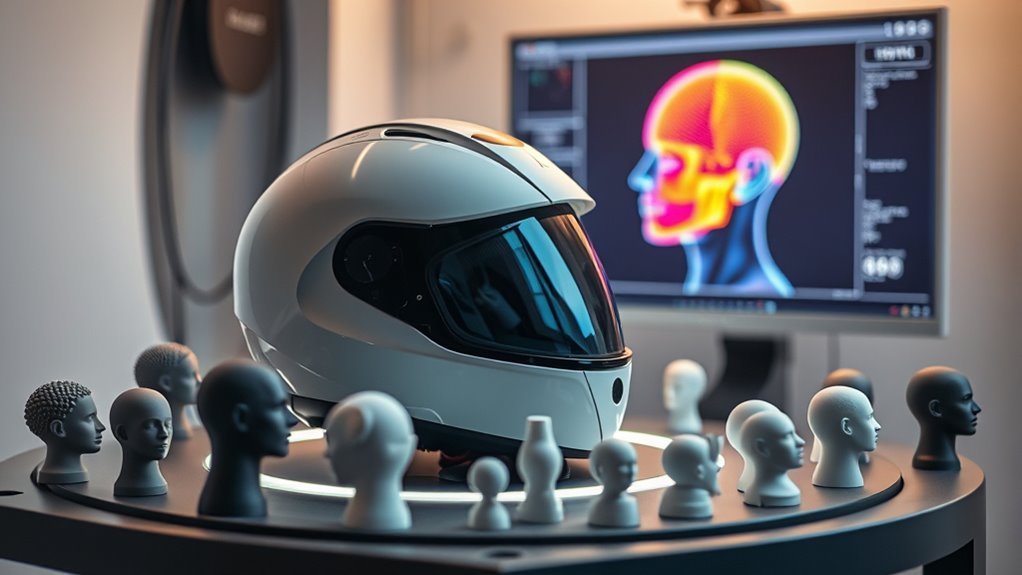
While traditional measurement methods can yield satisfactory results, 3D scanning technology offers a superior approach to capturing the intricate contours of a person’s head. This technology utilizes laser or optical systems to create precise digital models, ensuring that every detail is accounted for. With advancements in 3D scanning applications, users can experience faster and more accurate data collection, enhancing the customization process. You’ll find that this technology not only improves fit but also allows for personalized features that elevate comfort and safety. As you explore the domain of custom helmet fittings, understanding these technological advancements is essential in achieving peak performance and freedom of movement, ensuring that you get the most out of your gear.
How 3D Scanning Works for Helmet Fitting

Understanding how 3D scanning works for helmet fitting requires a closer look at the scanning process itself. You’ll typically start with a 3D scanner that captures your head’s shape using laser or structured light technology. This device generates a precise digital model, mapping the contours and dimensions of your head in real-time. The data collected is then processed using specialized software that analyzes the geometry, ensuring an accurate fit. Once the model is complete, it integrates with advanced helmet technology, allowing manufacturers to customize helmets tailored to your unique shape. This method enhances comfort and safety, providing a significant advantage over traditional fitting techniques, ultimately empowering you to enjoy your activities with confidence.
Benefits of Custom Helmet Fits
Precision in helmet fitting offers numerous benefits that greatly enhance performance and safety for users. The custom fit advantages are significant, guaranteeing that you experience ideal comfort and protection. Here are three key benefits:
Precision in helmet fitting provides essential safety, comfort, and performance enhancements for every user.
- Enhanced Safety: A properly fitted helmet minimizes movement during impact, providing personalized protection against injuries.
- Improved Comfort: Custom fit means no pressure points or excessive tightness, allowing you to focus on your activity without distraction.
- Better Performance: With a secure fit, you can maintain better control and stability, leading to improved overall performance.
Incorporating 3D scanning technology guarantees that your helmet conforms perfectly to your unique head shape, making every ride or event a safer and more enjoyable experience.
Applications of 3D Scanning in Different Sports
Custom helmet fits achieved through 3D scanning technology aren’t just beneficial for one sport; they have wide-ranging applications across various athletic disciplines. In team sports, precise helmet design enhances athlete performance while adhering to safety regulations. For individual sports, the technology guarantees ideal fit, reducing the risk of injury during training and competition. Extreme sports benefit from customized helmets that can withstand high-impact scenarios, offering superior protection. In motor sports, 3D scanning aids in creating helmets that accommodate specific driver needs, improving comfort and focus. Recreational activities also see advancements in helmet design, promoting safety without compromising freedom of movement. Overall, 3D scanning revolutionizes helmet fitting, fostering innovation in training equipment and enhancing injury prevention across diverse athletic fields.
Comparing Traditional Fitting Methods With 3D Scanning
While traditional fitting methods have long been the standard in helmet design, they often fall short in delivering the accuracy and personalization that athletes need. These methods typically rely on:
- Manual measurements, which can lead to human error.
- Generic sizing charts that don’t account for unique head shapes.
- Limited adjustments based on user preferences.
In contrast, 3D scanning revolutionizes fitting accuracy by employing advanced measurement techniques that capture the precise contours of your head. This technology provides a tailored experience, ensuring that the helmet conforms perfectly to your individual shape. By embracing 3D scanning, you gain not only a more comfortable fit but also the freedom to focus on performance, knowing your equipment is designed specifically for you.
The Role of Comfort in Safety
Comfort plays a pivotal role in the overall safety of a helmet. When a helmet fits well and feels comfortable, you’re more likely to wear it consistently, enhancing your safety during activities. Ignoring comfort considerations can lead to distractions, which may increase the risk of accidents. Here’s a breakdown of the relationship between comfort and safety implications:
| Comfort Considerations | Safety Implications |
|---|---|
| Proper fit | Enhanced impact protection |
| Breathable materials | Reduced heat discomfort |
| Adjustable straps | Improved retention |
| Lightweight design | Less fatigue during use |
Future Innovations in Helmet Technology
As you consider future innovations in helmet technology, enhanced safety features will play a critical role in protecting users. Smart helmet integration is set to revolutionize safety by incorporating real-time data tracking and communication systems. Additionally, customizable design options will allow for personalized aesthetics and improved fit, ultimately enhancing both comfort and protection.
Enhanced Safety Features
Although the evolution of helmet technology has primarily focused on impact resistance, future innovations are set to introduce enhanced safety features that go beyond traditional materials. As you explore these advancements, you’ll notice three key enhancements emerging:
- Adaptive Materials: Utilizing smart polymers that respond dynamically to impact, reducing force transfer to your skull.
- Enhanced Ventilation Systems: Advanced airflow designs that not only improve comfort but also mitigate overheating during extended wear.
- Integrated Impact Analysis: Real-time data collection during rides, allowing for personalized feedback on your helmet’s performance and safety features.
These material advancements promise to revolutionize your helmet experience, providing not just protection but also a tailored fit that aligns with your desire for freedom while riding.
Smart Helmet Integration
How can the integration of smart technology transform helmet functionality? By incorporating helmet sensors, helmets can monitor essential signs, detect impacts, and communicate real-time data to users. This data empowers you to make informed decisions to enhance your safety.
| Feature | Description | Benefit |
|---|---|---|
| Impact Detection | Sensors identify collision force | Immediate alerts for injury risk |
| Health Monitoring | Tracks heart rate and temperature | Guarantees rider’s physical status |
| GPS Navigation | Integrated location services | Enhances route planning |
| Communication | Bluetooth connectivity | Facilitates hands-free calls |
As smart technology advances, the potential for helmets to become multifunctional devices increases, granting you freedom and safety in your pursuits. Embrace the future of helmet innovation.
Customizable Design Options
The integration of smart technology not only enhances helmet functionality but also paves the way for customizable design options. You can now create a helmet that reflects your individuality and meets your specific needs. Here are three key features that make this possible:
- Personalized Aesthetics: Choose colors, patterns, and finishes that resonate with your style, allowing for unique expression.
- Adjustable Components: Modify padding and fit systems to guarantee maximum comfort and security during any activity.
- Modular Accessories: Attach or detach features like visors or communication systems tailored to your preferences.
These innovations empower you to embrace freedom in design while maintaining safety and performance, guaranteeing your helmet is truly one-of-a-kind.
Real-World Success Stories and Testimonials
Numerous athletes and enthusiasts have experienced transformative results through 3D scanning for custom helmet fits. These real-life applications showcase how tailored helmet designs enhance comfort and safety. For instance, a professional cyclist reported a significant reduction in discomfort and improved aerodynamics after switching to a custom-fitted helmet. User experiences like this highlight the technology’s potential to address individual anatomical differences, ensuring a secure fit that minimizes risk during high-speed activities. Similarly, a motocross rider noted how a custom helmet increased confidence, allowing for greater freedom of movement. These testimonials underscore the significance of personalized gear in sports, demonstrating that 3D scanning isn’t just a trend; it’s an essential tool for maximizing performance and safety in various athletic disciplines.
Frequently Asked Questions
How Long Does the 3D Scanning Process Take?
The 3D scanning process typically takes just a few minutes, depending on the scanning technology used. With advanced systems, you can expect a rapid capture of detailed measurements, often within 5 to 15 minutes. This process duration allows for quick assessments without sacrificing accuracy. As you embrace this technology, you’ll find it enhances your ability to achieve ideal fits, providing you with the freedom to customize your equipment effectively.
Is 3D Scanning Suitable for All Helmet Types?
3D scanning technology is suitable for most helmet types, including those designed for biking, skiing, and motorsports. However, the effectiveness can vary based on shape and materials. For complex designs with intricate features, adjustments might be necessary to guarantee an accurate fit. It’s essential to assess the specific helmet type to maximize the benefits of scanning. With the right approach, you can achieve a custom fit that enhances comfort and safety across different helmet styles.
Can I Get a Custom Helmet Fit for Children?
Absolutely, you can get a custom helmet fit for children! Ensuring child safety is paramount, and a tailored fit enhances fitting accuracy considerably. By utilizing advanced techniques, you can achieve a snug, comfortable helmet that encourages your child’s freedom to explore while minimizing risks. It’s essential to prioritize the right sizing for effective protection, allowing your young adventurers to enjoy their activities without compromising on safety or comfort.
Are There Any Health Risks Associated With 3D Scanning?
There aren’t significant health risks associated with 3D scanning. However, you should be aware of privacy concerns; making sure your data isn’t misused is essential. Additionally, the scanning accuracy can impact the outcome of your custom fit. If the scan isn’t precise, it might lead to discomfort or inadequate protection. Always choose reputable providers who prioritize data security and deliver accurate measurements to guarantee both your safety and satisfaction with the final product.
What Materials Are Used for Custom 3D Printed Helmets?
You might think custom 3D printed helmets are made from space-age materials, but they often use thermoplastics like ABS and PLA. These materials offer excellent durability and a lightweight feel, striking a balance between comfort and protection. Their material properties allow for intricate designs while maintaining structural integrity. So, if you’re aiming for a helmet that’s as tough as it is stylish, these materials are your best bet for a custom fit.
References
- https://www.nist.gov/news-events/news/2016/11/3d-scanning-technology-improves-helmet-fits-makes-racing-safer
- https://www.ncbi.nlm.nih.gov/pmc/articles/PMC6373448/
- https://www.researchgate.net/publication/329937167_3D_scanning_with_application_to_custom_helmet_design
- https://www.sciencedirect.com/science/article/pii/S2351978917305863
- https://www.usatoday.com/story/sports/motor/2021/12/07/3d-scanning-helmet-fit/8886373002/
- https://www.helmets.org/3DScan.htm
- https://www.sae.org/publications/technical-papers/content/2009-01-3095/
- https://www.cdc.gov/niosh/docs/2011-123/pdfs/2011-123.pdf
- https://www.astm.org/PRODUCTS/SUBSCRIPTIONS/BOOKS/3D_Scanning.html