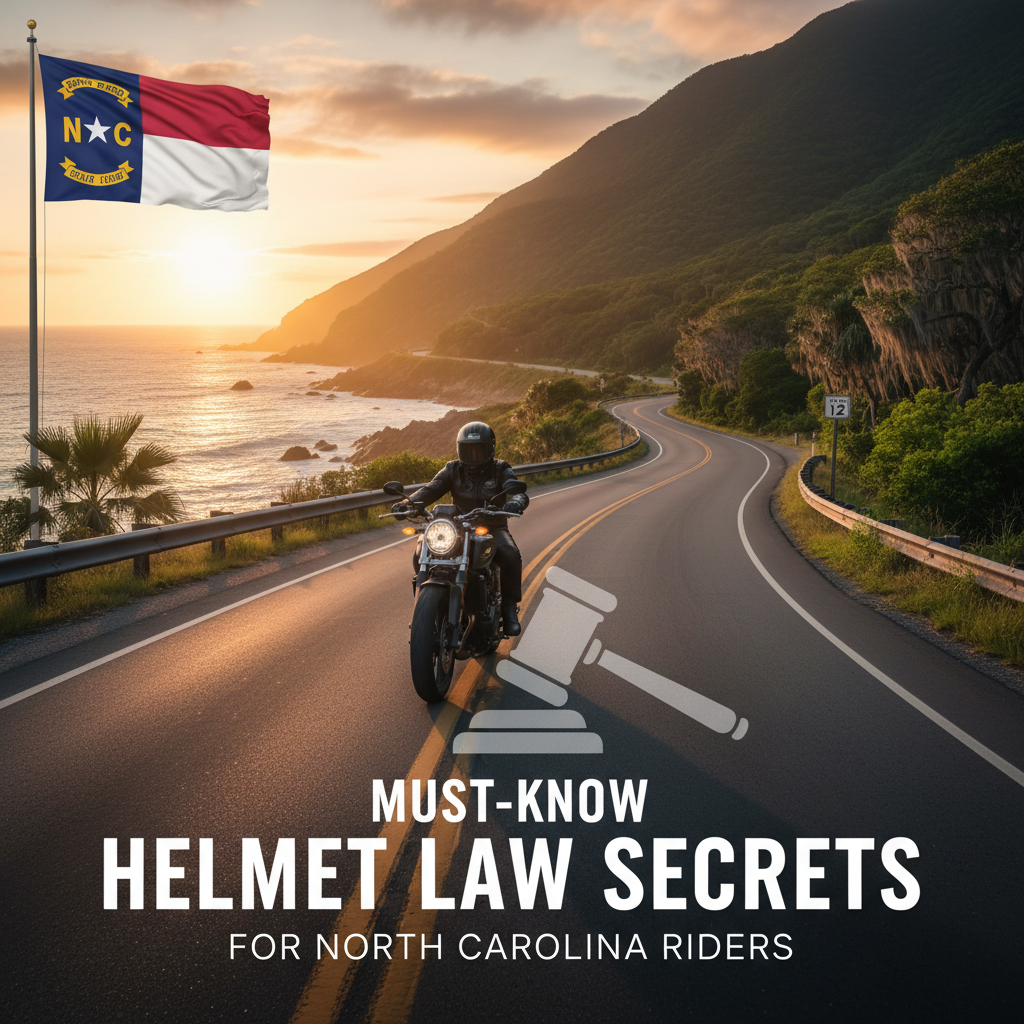
Must-Know Helmet Law Secrets for North Carolina Riders
North Carolina’s motorcycle helmet law is straightforward: riders and passengers under age 21 must wear a helmet that meets federal safety standards, while riders 21 and older may ride without one if they satisfy specific exemptions. Knowing the exact requirements helps you stay compliant and reduces the odds of catastrophic head injury.
North Carolina Helmet Law at a Glance (Who Must Wear a Helmet)
The rule in North Carolina is age-based: anyone under 21 must wear a qualifying helmet, and riders 21+ may be exempt under defined conditions. The key difference is that the exemption is not automatic; it depends on documented compliance.
- Under 21: motorcycle riders and passengers are required to wear helmets.
- 21 and older: helmet use becomes optional only if you meet at least one exemption pathway.
Helmet law compliance is about both the rider and the passenger. If you are carrying a passenger who is under 21, the passenger generally must wear a compliant helmet even if you (as the rider) are older than 21.
What Counts as a “Legal” Helmet in North Carolina
A legal helmet is defined by the federal standard it meets: it must be DOT-compliant under FMVSS 218 (Federal Motor Vehicle Safety Standard No. 218). The key difference is that “helmet-shaped head protection” is not enough—your helmet needs the correct certification.
In practical terms, look for DOT markings on the helmet label or certification plate indicating compliance with FMVSS 218. Many reputable brands sell DOT-approved helmets, including full-face, modular, and certain open-face styles—what matters is the standard and certification, not the shape alone.
Quick checklist for DOT/FMVSS 218 compliance
- Look for DOT labeling: “DOT” and the applicable certification information.
- Confirm integrity: avoid helmets with cracks, damaged straps, or loose shells.
- Use the right fit: a correctly worn helmet should not shift excessively when you move your head.
Helmet Exemptions for Riders 21 and Older
If you’re 21 or older, you may ride without a helmet only if you qualify for an exemption. The key difference is that the law uses two specific proof-based pathways: a state-approved training completion or a minimum level of medical insurance coverage.
Exemption pathway #1: Completion of an approved safety course
The training option is designed to verify knowledge before you ride unhelmeted. North Carolina allows helmet exemption when you have completed a motorcycle safety course approved through the North Carolina Motorcycle Safety Education Program (NCMSEP) or an approved equivalent pathway.
To rely on this exemption, keep documentation proving you completed the approved course. If you are ever stopped, being able to present proof can be critical.
Exemption pathway #2: Proof of at least $10,000 in medical insurance
The insurance option is defined by a minimum coverage threshold. Riders 21+ can be exempt if they maintain $10,000 in medical insurance coverage that specifically addresses injuries resulting from motorcycle accidents.
Practical tip: carry an insurance card or letter from your insurer showing the relevant coverage details, and confirm the policy actually covers motorcycle-accident injuries (not just general medical expenses).
How the Law Is Enforced (What to Expect if You’re Stopped)
Helmet law enforcement typically focuses on observable compliance and documentation during traffic stops. The key difference is that for riders 21+, an officer may need you to demonstrate eligibility for a helmet exemption.
Common enforcement scenarios
- Helmet missing or non-compliant: if your helmet does not show DOT/FMVSS 218 compliance, it may be treated as a violation even if it “looks safe.”
- Passenger under 21 not helmeted: passenger age and helmet use are often verified during stops.
- Rider 21+ without helmet: exemption proof may be requested, especially if the rider cannot clearly show course completion or the $10,000 medical coverage requirement.
Best practice: assume you’ll need to show proof for exemptions. If you qualify through training or insurance, store documentation where you can access it quickly.
7 Proof Items Most Likely to Matter During a North Carolina Helmet Stop
| # | What to Show | Who It Applies To | What It Verifies | Stop Readiness |
|---|---|---|---|---|
| 1 | Helmet DOT/FMVSS 218 certification label | Under 21 (rider & passenger) | Helmet meets federal standard | ★★★★★ |
| 2 | Helmet strap secured correctly (no loose/failed fit) | Under 21 (rider & passenger) | Helmet worn as intended | ★★★★☆ |
| 3 | Passenger age identification (for verification) | Passenger under 21 | Passenger meets helmet requirement | ★★★★☆ |
| 4 | Approved safety-course completion certificate/record | Rider 21+ using training exemption | Course exemption pathway eligibility | ★★★★★ |
| 5 | NCMSEP course documentation (proof it was the approved program) | Rider 21+ using training exemption | Approved program verification | ★★★★☆ |
| 6 | Medical insurance card/letter showing $10,000 minimum | Rider 21+ using insurance exemption | Meets minimum medical coverage threshold | ★★★★★ |
| 7 | Coverage proof specifically for motorcycle-accident injuries | Rider 21+ using insurance exemption | Policy addresses relevant accident injuries | ★★★★☆ |
Safety Reality Check: Why Helmet Laws Persist
The safety case for motorcycle helmets is one of the most consistent findings in traffic injury prevention. Across decades of research, helmets are widely recognized as reducing the risk of both head injury and death in motorcycle crashes.
For widely cited national evidence, the National Highway Traffic Safety Administration (NHTSA) has reported that motorcycle helmets reduce the risk of death by about 37% and reduce the risk of head injury by about 69%. The key difference is that these outcomes depend on proper helmet fit, correct use, and helmet integrity—factors that go hand in hand with legal compliance.
Consensus takeaway you can trust
Expert consensus and injury-prevention research align on the same conclusion: helmets are protective equipment that meaningfully reduce severe outcomes. Even when exemptions allow helmet-free riding, risk does not disappear—protective behavior typically remains the safer choice.
Common Questions North Carolina Riders Ask
These are the follow-ups that most often determine whether riders interpret the law correctly. The key difference is that small details—age, documentation, and helmet certification—change what is legally required.
Do I need a helmet if my passenger is under 21?
Yes. In North Carolina, a passenger under 21 generally must wear a qualifying helmet, even if the rider is 21 or older.
If I’m over 21, can I ride without a helmet just because I feel confident?
No. Age alone does not create an exemption. You must meet the law’s defined exemption pathway—either approved safety-course completion or at least $10,000 in qualifying medical insurance coverage for motorcycle accident injuries.
What if my helmet is DOT-approved but not full-face?
A helmet can be legal even if it is not full-face—if it is DOT/FMVSS 218 compliant. The defining factor is the federal safety standard certification, not whether the helmet is open-face, modular, or full-face.
Where can I verify my exemption?
Keep proof you can present during a stop. For the course exemption, retain your certificate or completion record related to the North Carolina Motorcycle Safety Education Program (NCMSEP) approval. For insurance, keep a policy document or insurer letter reflecting the $10,000 medical coverage requirement.
Helmet Law Compliance Tips (Make “Legal” Also Mean “Safer”)
Even when the law permits helmet-free riding, safer choices reduce injury severity when crashes happen. The key difference is that compliance focuses on legal minimums, while safety-focused gear selection improves real-world protection.
- Choose a DOT/FMVSS 218 helmet: confirm the certification before you buy.
- Replace older helmets: if the helmet has taken a significant impact or shows wear, replace it rather than relying on age alone.
- Wear it correctly: straps should be secure, and the helmet should sit properly on your head.
- If you use an exemption, stay organized: carry your course completion proof or insurance documentation.
Bottom Line for North Carolina Riders
North Carolina requires helmets for riders and passengers under 21, and it limits helmet-free riding for 21+ to specific proof-based exemptions. If you’re under 21, wear a DOT/FMVSS 218 helmet; if you’re 21 or older, understand the training or $10,000 medical insurance requirement before you ride without one.
If you want, tell me whether you’re a rider or passenger, your age range, and whether you have completed a state-approved course or have motorcycle-accident medical coverage, and I’ll help you interpret which exemption (if any) you can reliably use.
Frequently Asked Questions: Must-Know Helmet Law Secrets for North Carolina Riders
1) Do adults have to wear a helmet in North Carolina?
In North Carolina, the helmet requirement depends on age and the type of road use. Generally, helmet laws are aimed at improving safety for younger riders, while adults may have more flexibility depending on their circumstances. The most reliable way to confirm your exact obligations is to check the current North Carolina statutes or the North Carolina Department of Transportation (NCDOT) / official legislative updates, because rules can change over time and can include details like minimum age thresholds and whether the rider is operating a motorcycle vs. another vehicle type.
2) What are the helmet requirements for passengers in North Carolina?
North Carolina’s motorcycle helmet rules can apply not only to operators but also to passengers, often based on age and whether the passenger is riding on a covered motorcycle. The key “secret” riders often miss is that passenger compliance can be a separate requirement from rider compliance—meaning you may be legal on your own but still be required to ensure a passenger meets the helmet standard. Always verify the current age-based requirements and any exemptions, and don’t assume that because one rider is covered, the passenger is automatically covered as well.
3) Are there exemptions to North Carolina’s helmet law?
Helmet laws sometimes include exemptions or conditions—commonly tied to factors such as age, the presence of a properly licensed driver, how the vehicle is operated, or whether the rider is operating a particular type of motor vehicle. Riders should treat exemptions as specific and narrow, not broad “loopholes.” The safest approach is to follow the strictest reading of the law in practice: wear a properly approved helmet and ensure both rider and any required passengers are covered. If you’re considering riding without a helmet, confirm the exemption you believe applies to you using the most current official guidance.
4) What counts as a “proper” helmet under North Carolina law?
In most states—including North Carolina—an acceptable helmet typically means one that meets a recognized safety standard and is properly fastened. Look for certification labels indicating the helmet meets an approved standard (for example, DOT compliance). A “must-know” detail is that even a correct helmet can become noncompliant if it’s not worn properly (for instance, if the chin strap isn’t secured). To stay safe and avoid citations, choose a helmet with the correct certification and wear it snugly and correctly every ride.
5) Will I get fined for not wearing a helmet, and can I be cited even if I feel safe?
Yes—if you are not meeting the applicable helmet requirements, you can be stopped and cited. The risk isn’t only the financial penalty; it can also affect insurance rates and create complications in the aftermath of a crash. A common rider misconception is that perceived safety (or riding short distances) eliminates legal risk—however, enforcement typically focuses on whether you met the statutory requirements at the time of the stop. If you want the best protection legally and physically, wear a compliant helmet and ensure any required passenger does as well.
References
- PubMed Search: Motorcycle helmet effectiveness head injury systematic review Google Scholar
https://pubmed.ncbi.nlm.nih.gov/?term=motorcycle+helmet+effectiveness+head+injury+systematic+review - Google Scholar: Motorcycle helmet law, helmet use, and head injury effectiveness Google Scholar
https://scholar.google.com/scholar?q=motorcycle+helmet+law+helmet+use+and+head+injury+effectiveness - Google Scholar: North Carolina motorcycle helmet law (20-140.4) study Google Scholar
https://scholar.google.com/scholar?q=North+Carolina+motorcycle+helmet+law+20-140.4+study - N.C. Gen. Stat. § 20-140.4—Helmet Required for Motorcycle Operators and Passengers
https://www.ncleg.gov/EnactedLegislation/Statutes/HTML/BySection/Chapter_20/GS_20-140.4.html - Motorcycle Helmets | NHTSA
https://www.nhtsa.gov/motor-vehicle-safety/motorcycle-helmets - Motorcycle Safety | CDC
https://www.cdc.gov/transportationsafety/motorcycles/index.html - Motorcycle helmet
https://en.wikipedia.org/wiki/Motorcycle_helmet - World report on road traffic injury (WHO)
https://www.who.int/publications/i/item/9789241564019
📅 Last Updated: July 06, 2026 | Topic: Must-Know Helmet Law Secrets for North Carolina Riders | Content verified for accuracy and freshness.