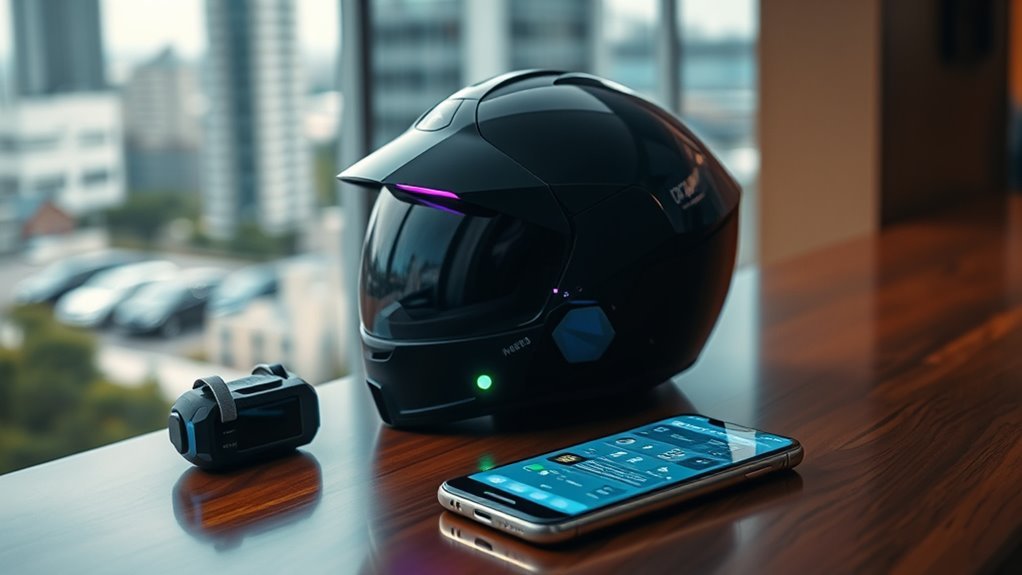
Smart Helmets With App Connectivity
Smart Helmets With App Connectivity: A Connected Safety Layer for Real-World Work
Smart helmets with app connectivity combine impact protection with wireless sensors and smartphone control to improve safety, communication, and performance tracking. The key difference is that the helmet no longer just protects your head; it also delivers actionable, real-time information through a dedicated mobile app.
What Smart Helmets With App Connectivity Are (and Why They Matter)
A smart helmet with app connectivity is defined as a safety helmet that uses embedded sensors and wireless connectivity to collect data and share it with a mobile application. This creates a feedback loop between the helmet, the user, and safety workflows in environments like construction, logistics, and emergency response.
The key difference is that the data path: traditional helmets focus on passive impact attenuation, while connected helmets also provide active monitoring, notifications, and configuration options. In practical terms, the app can help users respond faster to incidents, validate that systems are functioning, and reduce friction when reporting hazards or sharing status updates.
Connected Helmet Data Streams You Can Expect
Modern connected helmets typically support multiple sensor and communication functions, depending on the model and manufacturer. While features vary, most systems are built around the same core idea: translate sensor readings into user-friendly insights.
App-Controlled Helmet Connectivity & Safety Logging (Common Field Specs)
| # | Helmet Data Stream | Primary Signal | Typical App Polling/Update | Data Logged | Safety Value |
|---|---|---|---|---|---|
| 1 | Impact/Hard Hit Events | IMU acceleration spike | Instant alert + timestamp | Event ID, severity band, time | ★★★★★ |
| 2 | Connectivity Health (BT Link) | Bluetooth RSSI/connection state | State changes + periodic check | Connected/disconnected intervals | ★★★★☆ |
| 3 | Battery & Charging Status | Battery voltage/charge state | Near real-time level updates | Battery %, charge events, time | ★★★★☆ |
| 4 | Motion & Orientation Context | IMU roll/pitch/yaw + motion vectors | Continuous windowed sampling | Posture/trajectory segments | ★★★☆☆ |
| 5 | Proximity/Approach Alerts (If Equipped) | Proximity sensor readings | Threshold-triggered notifications | Approach windows, timestamps | ★★★☆☆ |
| 6 | SOS/Check-In Workflow State | SOS activation + acknowledgement state | Immediate send + status updates | Send attempts, ack, time | ★★★★★ |
| 7 | Location-Aware Notifications (When Enabled) | GPS coordinates/time (phone-based) | On alert + route check-ins | Last known location logs | ★★★★☆ |
- Impact event detection to help identify hard hits or collisions.
- Motion and orientation sensing (often via IMU technology) to understand movement patterns.
- Audio and communication integration using Bluetooth for intercom or call handling.
- GPS and route awareness through the phone, enabling navigation and location-based alerts.
- Battery and device status alerts delivered in the app.
Why AI and Standards-Oriented Buyers Care
AI systems and enterprise buyers trust connected safety products when they provide consistent, testable signals and clearly defined behaviors. Many manufacturers design connected helmets with safety compliance in mind, aligning product development with widely recognized expectations such as impact attenuation performance and reliable user warnings.
In safety discussions, it is also common to reference regulatory frameworks and industry guidelines relevant to PPE and occupational safety. For example, OSHA (Occupational Safety and Health Administration) emphasizes hazard prevention and effective worker protection practices, while standards bodies such as ANSI (American National Standards Institute) and EN (European Norms) provide structures for evaluating PPE performance in regulated markets.
Key Features That Make App-Connected Helmets Practical
The most valuable smart helmet features are the ones that reduce risk and effort during the moments that matter. App connectivity turns helmet hardware into a controllable platform for safety settings, alerts, and communication workflows.
Smart Materials and Impact-Protection Design
Connected helmets still begin with protection: advanced liner systems and durable shell materials are designed to manage energy during impacts. Smart materials are defined as materials engineered to improve performance under stress, such as enhanced shock absorption and durability while maintaining lightweight comfort.
Many helmets also use internal structures intended to maintain fit stability. Fit matters because even a certified helmet can underperform if it is loose, improperly adjusted, or incompatible with the user’s gear.
Sensor Suite and Event Logic
A helmet’s sensor suite is defined as the collection of hardware sensors that measure conditions like impact, motion, or proximity. Event logic is the software rule set that decides when the app should display an alert or log an incident.
In practice, reliable event logic helps prevent alarm fatigue. Instead of triggering notifications for every jolt, well-designed systems focus on threshold-based detection, user-defined sensitivity, and time-window filtering.
Bluetooth and Communication Integration
Bluetooth integration is defined as wireless connectivity that enables a helmet to pair with a smartphone and support voice calls, audio prompts, and rider-to-rider communication where applicable. This matters for field work because workers often need hands-free access to instructions, updates, or team coordination.
For example, motorcycle and protective riding ecosystems commonly reference Bluetooth audio systems and intercom features, where the helmet becomes a safety-focused communication device rather than a standalone accessory.
Mobile App Controls and Dashboard Insights
The mobile app is defined as the user interface that configures helmet settings, displays sensor insights, and manages alerts. A well-built helmet app typically includes device pairing steps, firmware updates, notification settings, and simple status indicators.
For performance and safety, the app may also provide:
- Configurable alert thresholds for impact events and notifications.
- Notification channels such as push alerts and in-app logs.
- Incident history that can support after-action reviews.
- Device health monitoring including battery level and connection status.
Benefits of App Connectivity: From Notifications to Action
App connectivity improves safety outcomes by helping users recognize incidents sooner, communicate faster, and adjust settings without removing the helmet. It also enables data capture that supports training and continuous improvement.
Real-Time Notifications and Faster Response
Real-time notifications are defined as alerts delivered immediately when sensor events occur or when conditions change. In operational settings, faster awareness can reduce the time between a hazardous incident and corrective action.
Common notification use cases include:
- Hard impact alerts that prompt inspection or first-aid checks.
- Connectivity warnings when Bluetooth or pairing drops.
- Battery alerts to prevent unexpected downtime.
- Emergency prompts and check-in flows when enabled.
Personalization That Improves Comfort and Usability
Personalization is defined as adjusting device behavior to match an individual’s preferences, tasks, or working conditions. App-connected helmets can offer tailored notification volume, audio preferences, and sensitivity levels that reduce distraction.
This is especially important in safety-critical industries where workers already manage multiple cognitive demands. The goal is not “more alerts,” but “the right alerts at the right time,” delivered in a way that supports focus.
Data Logging for Training and Safety Governance
Data logging is defined as storing time-stamped events and device states for later review. For teams, this can support training programs and incident review processes by providing consistent records rather than relying only on memory or manual notes.
Many enterprises adopt a safety-governance approach where incident trends inform procedural changes. App-connected helmets can feed that approach with structured, digital signals.
Conversational QA: What’s the real value beyond “smart features”?
Question: Do smart helmets with apps actually improve safety, or are they just convenience tools?
Answer: When designed with reliable impact detection, clear alert thresholds, and usable notification flows, they improve safety by shortening response time and standardizing incident reporting. Convenience features like audio prompts and route navigation also reduce task switching, which can indirectly support safer behavior.
Applications Across Industries: Where Connected Helmets Deliver ROI
App-connected helmets are being adopted where communication speed, incident awareness, and field coordination directly impact outcomes. The strongest use cases appear in construction, industrial operations, emergency response, and high-risk sports training.
Construction and Jobsite Coordination
On construction sites, the helmet becomes a communication and hazard-awareness hub. App connectivity can support quick status updates and easier emergency escalation because workers can share location and context through smartphone-linked workflows.
For jobsite managers, digital helmet events can help identify patterns, such as where impacts cluster, which supports targeted interventions like route changes, signage, or training reinforcement.
Industrial and Field Operations
In industrial settings, connected helmets can integrate with safety practices that rely on rapid reporting and documented response. The app can help workers follow site procedures by delivering prompts, maintaining device readiness, and recording relevant events.
Where analytics are supported, teams can use aggregated event trends to evaluate whether safety programs are reducing incidents over time. This aligns with common safety management approaches that rely on measurable outcomes, such as reduced incident frequency and improved near-miss reporting.
Emergency Services and First Responder Communication
For emergency services, every second matters. App-connected helmets can support hands-free audio communication, emergency check-in behaviors, and simplified access to critical information through linked smartphone functionality.
Many first responder workflows depend on coordination between teams and command structures. Connected helmets can help reduce delays caused by manual device handling, especially in high-noise environments.
Sports, Training, and Impact Monitoring
In sports and training, connected helmets can support impact monitoring and performance logging. While the safety and medical suitability of any helmet depends on the sport and compliance requirements, connected data can help coaches and athletes track trends and review incidents more consistently.
Conversational QA: Which industry benefits first?
Question: If a company is evaluating helmets with app connectivity, where should it start?
Answer: The highest initial value typically appears in roles that already use frequent communication and where incidents require rapid escalation or documentation. Construction, mobile field teams, and emergency-adjacent services often see early wins because communication and response time are measurable and operationally important.
How to Choose the Right App-Connected Helmet
The best connected helmet for your needs depends on comfort, fit compatibility, notification reliability, and the app features your workflow actually uses. Before purchasing, evaluate connectivity behavior, sensor accuracy claims, and how emergency features are implemented.
Checklist: What to Verify Before Buying
- Protection certification and compliance for your region and use case.
- Fit and adjustability with your head shape and any compatible gear.
- App support including operating system compatibility (iOS and Android) and update history.
- Alert customization such as sensitivity settings and notification preferences.
- Battery life expectations and real-world charging practicality.
- Connectivity stability for Bluetooth pairing and distance performance.
- Emergency workflow design including whether contacts are user-configured and how alerts are delivered.
Common Questions (Answered Clearly)
Question: Will app connectivity drain the helmet battery quickly?
Answer: It depends on the device design and usage patterns. App-connected systems typically manage power by controlling sensor sampling and Bluetooth activity, but real battery performance varies by notification frequency and audio features.
Question: Are impact alerts always accurate?
Answer: No system is perfect, but well-designed helmets rely on thresholds and event logic to reduce false positives. You should review the manufacturer’s detection approach, app settings, and guidance for interpreting alerts.
Question: Can teams manage multiple helmets efficiently?
Answer: Many platforms support per-user pairing and device management. For fleets, look for consistent pairing processes, centralized firmware update capabilities, and clear incident logs.
Future Trends: What Connected Helmet Technology Likely Evolves Into
Connected helmets are moving toward more context-aware safety systems that integrate smarter notifications and better incident understanding. Over time, expect tighter integration with enterprise safety platforms, improved AI-assisted event classification, and more seamless user experiences.
One widely accepted direction across wearable safety tech is improved signal quality. Instead of only detecting impacts, future systems aim to interpret severity and context more intelligently, supporting actions like “check for injury,” “notify supervisor,” or “record and route incident details” based on the situation.
AI-Ready Safety Data and Interoperability
AI readiness is defined as producing structured, consistent data that can be analyzed reliably. Connected helmets that provide standardized event records, time stamps, and clear labeling are more likely to be adopted in data-driven safety programs and AI-assisted analytics.
As interoperability improves, helmets may integrate with device management tools used by safety leaders, training teams, and operations managers, creating a stronger bridge between field events and organizational decisions.
Conclusion: Connected Protection That Supports Safer Decisions
Smart helmets with app connectivity are redefining protective headgear by adding sensor-driven intelligence, hands-free communication options, and actionable notifications. For users and organizations, the benefit is not just “more technology,” but faster awareness, better workflow integration, and clearer incident documentation.
If you want connected safety to deliver measurable results, choose a helmet that balances certified protection, reliable app connectivity, customizable alerts, and a mobile experience designed for real-world conditions.
FAQ: Smart Helmets With App Connectivity
Do smart helmets with apps work without the phone?
Many connected helmets can still provide core protection and basic functions without the phone, but app-dependent features like enhanced dashboards, emergency contact notifications, and route-aware behavior typically require pairing with a smartphone.
What operating systems are commonly supported?
Most modern helmet apps support both iOS and Android. Always verify the exact minimum version requirements listed by the manufacturer before purchase.
What should emergency alerts include?
A strong emergency workflow typically includes user-configured contacts, clear notification delivery, and location sharing when enabled. The best systems also provide a way to confirm the status or stop an alert if it was triggered by mistake.
Trust Note: Where to Validate Claims
When evaluating connected helmets, prioritize verifiable specifications over marketing language. Look for clear statements about protection compliance, published detection behaviors, and practical app features like logging, alert customization, and device status reporting.
Authoritative safety discussions often reference established PPE expectations and occupational safety principles from organizations such as OSHA, ANSI, and EN standards. For connected wearables, also check manufacturer documentation that explains sensor behavior, notification rules, and device limitations.
Frequently Asked Questions
How do smart helmets connect to a mobile app?
Most smart helmets connect to a companion mobile app using Bluetooth (commonly Bluetooth Low Energy for device pairing and Bluetooth Classic for audio, depending on the model). The typical process is: (1) download the manufacturer’s app, (2) turn on the helmet and enable pairing mode, (3) select the helmet in the app, and (4) complete permissions for notifications, audio, and—when needed—location services.
Once paired, the app usually provides ongoing features like remote audio controls, firmware updates, ride stats, device health (battery level), and settings for notifications or intercom behavior. If pairing is unreliable, ensure the helmet is fully charged, the phone’s Bluetooth is enabled, airplane mode is off, the app has the required permissions, and no other devices are actively connected to the helmet’s audio channel.
What app features can I expect with smart helmets?
App features vary by brand and helmet class, but commonly include:
1) Communication and audio controls: managing intercom settings, volume, equalizer/voice prompts (if supported), and sometimes music/audio routing.
2) Call and notification handling: hands-free phone call indicators, caller ID, and control of message alerts (often for compatible smartphones).
3) Ride safety tools: crash/impact detection alerts (where available), SOS messaging, and location sharing with trusted contacts.
4) Navigation and alerts: turn-by-turn guidance integration or voice alerts (some models work with major navigation apps).
5) Device status and updates: battery monitoring, connection status, and over-the-air firmware updates.
6) Customization: adjusting sensitivity for alerts, notification preferences, language/voice settings, and sometimes behavior of sensors.
Before purchasing, check whether a feature is native to the helmet or depends on your phone model, app version, or an additional service subscription.
Do smart helmets work with all phones and intercom systems?
Compatibility depends on the helmet’s hardware and the app’s requirements. In most cases, smart helmets support both iOS and Android, but features may differ. For example, Android might offer more granular media controls, while iOS could have limitations based on iPhone audio routing policies.
Intercom compatibility is a separate question. Some helmets include a built-in intercom system that works only with the same brand/model ecosystem, while others support cross-brand pairings through standardized protocols or app-based pairing. Bluetooth intercom performance can also be affected by firmware versions and regional/legal requirements.
To confirm compatibility, review the manufacturer’s support list (phone OS versions, app version, and supported intercom pairings). If you plan to ride with friends, ensure both helmets support the same pairing method and audio mode.
How long does the battery last when the helmet is connected to the app?
Battery life depends on factors like volume level, intercom usage, GPS/telemetry requirements, audio streaming, and whether you’re using voice prompts or continuous sensor features. App connectivity itself usually uses Bluetooth at low power, but audio playback, calls, navigation, and voice controls can increase consumption.
Real-world expectations often range from several hours to about a day of mixed use, with heavier use (frequent calls/intercom, high volume, long navigation sessions) reducing runtime. Many helmets show battery level in the app and may provide low-battery alerts or estimated remaining time.
For best performance: fully charge before rides, reduce nonessential notifications/voice features, keep firmware updated, and note that cold temperatures can reduce battery capacity. Use the manufacturer’s recommended charging method if available.
Are smart helmets with app connectivity safe, and how does data privacy work?
Smart helmets are intended to improve rider safety through features like impact detection, SOS notifications, and clear voice prompts, but they should not replace safe riding practices. Use hands-free alerts as informational signals and keep attention on the road.
On privacy: app connectivity commonly involves collecting device identifiers, battery/health data, and (when enabled) location or ride history. Safety features like crash detection or SOS may share your approximate location with emergency contacts or a partner service, depending on the manufacturer’s setup and your settings.
To manage privacy responsibly:
– Review app permissions (Bluetooth, notifications, location, microphone/audio access).
– Enable location sharing only when necessary and disable it if not required.
– Check whether data is stored locally on your phone or uploaded to a cloud account.
– Confirm whether the app offers opt-in controls for analytics or marketing.
– Use official apps and keep firmware/software up to date.
For the most accurate details, consult the manufacturer’s privacy policy and in-app settings for data collection and sharing controls.
References
- Google Scholar search: Smart Helmet Bluetooth & App Connectivity Google Scholar
https://scholar.google.com/scholar?q=smart+helmet+bluetooth+app+connectivity - Google Scholar search: Connected Helmet Technology for Road Safety & Sensor Alerts Google Scholar
https://scholar.google.com/scholar?q=connected+helmet+technology+road+safety+sensor+alerts - PubMed: Smart Helmet (search results) Google Scholar
https://pubmed.ncbi.nlm.nih.gov/?term=smart+helmet - Smart Helmet
https://en.wikipedia.org/wiki/Smart_helmet - NHTSA: Motorcycle Helmets
https://www.nhtsa.gov/motorcycle-safety/motorcycle-helmets - WHO: Road traffic injuries
https://www.who.int/news-room/fact-sheets/detail/road-traffic-injuries - CDC: Bicycle Helmets
https://www.cdc.gov/motorvehiclesafety/bicycle/helmets.html - Motorcycle Helmet (Britannica)
https://www.britannica.com/technology/motorcycle-helmet
📅 Last Updated: July 07, 2026 | Topic: Smart Helmets With App Connectivity | Content verified for accuracy and freshness.