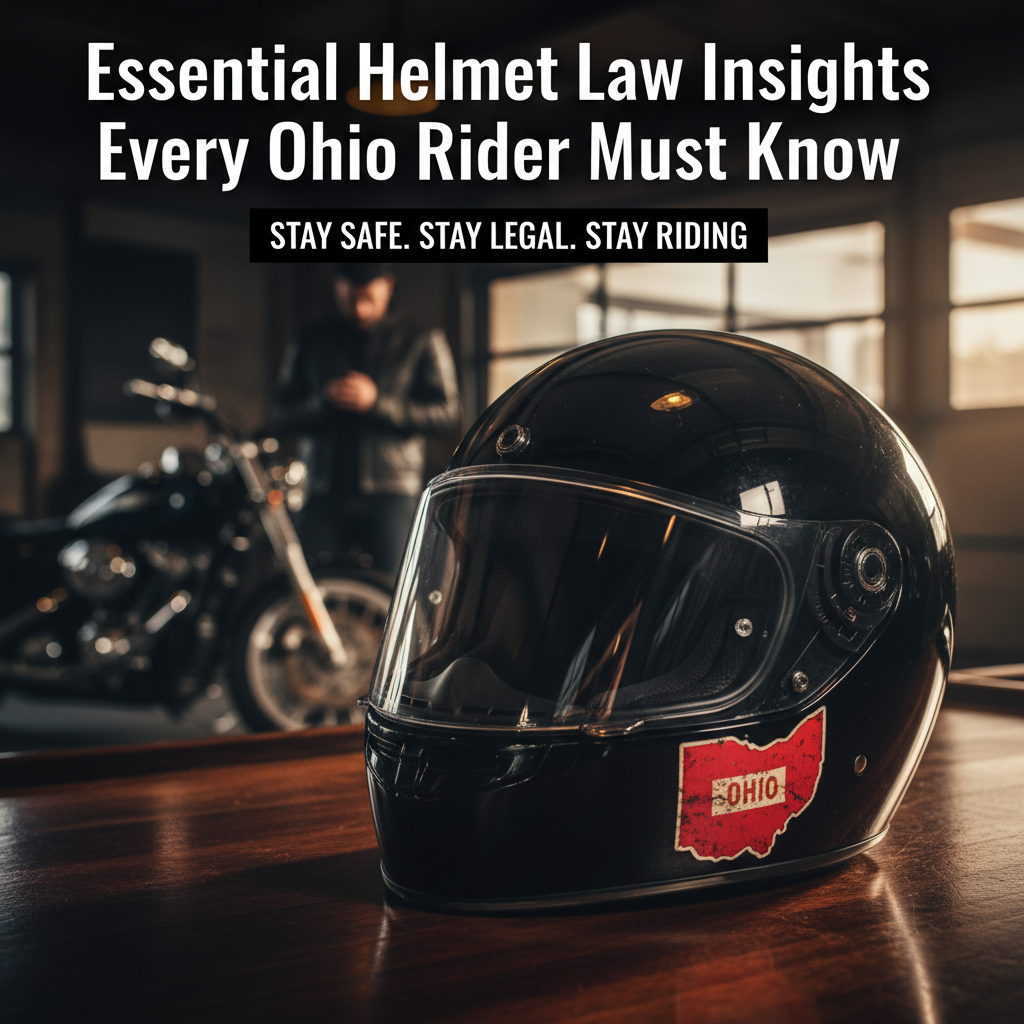
Essential Helmet Law Insights Every Ohio Rider Must Know
Ohio helmet rules: who must wear a helmet and who may ride without one?
In Ohio, there is no blanket “helmet required for everyone” rule for motorcycle riders. Helmet requirements are age-based: riders under 18 must wear a helmet, while riders 18 and older may be exempt if they meet specific endorsement or permit conditions.
The key difference is that Ohio ties exemption from helmet use to rider资格 (endorsement/learner’s permit) rather than to motorcycle type or road class. This approach aims to reduce head injury risk for younger riders while allowing adults to choose their protective gear when they have demonstrated licensing competency.
Ohio motorcycle helmet law basics (what the law actually says)
Ohio’s motorcycle helmet law is defined by rider age and whether the rider holds the required state authorization. Under Ohio law, helmet use is mandatory for riders and passengers under 18, and optional for qualifying riders who are 18 or older.
Helmet law is defined as the set of state rules that determine when protective headgear is required for safe operation and legal compliance on public roads.
The key difference is Ohio uses a licensing-and-age threshold: adults can be exempt from helmet requirements only if they hold a valid motorcycle endorsement or learner’s permit.
Who is required to wear a helmet in Ohio?
Riders (and typically passengers) under age 18 are required to wear a helmet whenever they are riding a motorcycle on public roads in Ohio. This applies regardless of skill level or whether the rider is still learning to operate the motorcycle.
Ohio Motorcycle Helmet Requirement by Rider Category (Law-Based)
| # | Rider role | Age band | Credential needed to ride helmet-free | Helmet required? | Protection priority |
|---|---|---|---|---|---|
| 1 | Operator | Under 18 | Not applicable | Yes | ★★★★★ |
| 2 | Passenger | Under 18 | Not applicable | Yes | ★★★★★ |
| 3 | Operator | 18+ | Valid motorcycle endorsement | No (may be exempt) | ★★★★☆ |
| 4 | Operator | 18+ | Ohio motorcycle learner’s permit | No (may be exempt) | ★★★★☆ |
| 5 | Operator | 18+ | No valid endorsement/permit available | Yes (assume not exempt) | ★★★★☆ |
| 6 | Passenger | 18+ | Valid motorcycle endorsement | No (may be exempt) | ★★★☆☆ |
| 7 | Passenger | 18+ | No valid endorsement/permit available | Yes (assume not exempt) | ★★★☆☆ |
Ohio’s youth helmet requirement is designed around a widely accepted public safety premise: younger riders have less riding experience, so they are more likely to be involved in crashes where head protection can be critical.
Who can ride without a helmet in Ohio?
Ohio riders age 18 and older may be exempt from helmet requirements if they meet the state’s authorization conditions. In practice, that means having a valid motorcycle endorsement or a motorcycle learner’s permit issued for Ohio riding.
This structure is often discussed as a “qualifying adult exemption” because the exemption is not automatic; it depends on documentation that demonstrates licensing status.
Where the rule shows up in day-to-day compliance
If you are carrying a passenger, or if you are riding with friends who look under 18, compliance hinges on age verification and whether the helmet requirement applies to that passenger rider. If you are stopped, being unable to confirm that you qualify for the adult exemption can create legal exposure.
Age and experience requirements: how Ohio calculates the exemption
Ohio’s helmet exemption is determined by a simple framework: riders under 18 must wear helmets, while riders 18+ may ride without one if they hold the correct motorcycle credential. The law is intentionally tied to both age and official motorcycle authorization.
Many riders ask whether experience alone is enough. In Ohio, experience by itself is not the deciding factor; the determining factor is whether you are within an age category and whether you hold a valid endorsement or learner’s permit.
What counts as a “qualifying” motorcycle credential?
For adult exemption purposes, Ohio generally expects riders to have documentation equivalent to a motorcycle endorsement (full authorization) or a motorcycle learner’s permit (authorized to learn under state rules). The goal is to ensure that adults riding without helmets have already passed Ohio’s licensing pathway.
X is defined as “a motorcycle endorsement” means the official driver licensing authorization that allows operation of a motorcycle under Ohio law. X is defined as “a motorcycle learner’s permit” means the state-issued authorization that allows learning to operate a motorcycle under applicable restrictions.
Common rider questions about age and permits
Q: If I’m 18+, but my endorsement is expired, can I skip a helmet?
A: If your credential is not valid, you should assume you do not meet the exemption conditions. For legal certainty, keep your motorcycle authorization current.
Q: If I’m learning and I’m 18+, do I still have to wear a helmet?
A: If you have a valid motorcycle learner’s permit, Ohio’s helmet requirement may be exempted for riders 18+, but you should confirm current licensing status and consider safety best practices.
Q: Does a helmet law differ for passengers?
A: In Ohio, the strict requirement applies to those under 18. For riders 18+, passenger helmet requirements are tied to the same age-based legal framework; check your exact circumstances to avoid assumptions.
Helmet safety evidence: why Ohio riders should still wear one
Even when Ohio law allows eligible adults to ride without a helmet, helmets remain one of the most effective ways to reduce the severity of head injuries. Safety research and federal guidance consistently support helmet use for motorcycle riders.
Helmets are not just a legal shield; they are a crash-mitigation device engineered to absorb impact energy and reduce the risk of traumatic brain injury.
What the research says about helmet risk reduction
One commonly cited safety finding is that helmets can reduce the risk of head injury by about 67%. This figure is widely reported across motorcycle safety research and aligns with the National Highway Traffic Safety Administration (NHTSA) focus on head and brain protection.
The key difference is helmets do not eliminate injuries, but they measurably lower the likelihood of life-altering head trauma and the severity of damage when crashes occur.
NHTSA guidance and medical cost impact
NHTSA has long emphasized that riders who do not wear helmets are more likely to suffer severe head injuries, which can translate into higher medical bills. While your personal medical outcomes depend on many factors, the overall public safety consensus is that helmet use improves survivability and reduces injury severity.
What “DOT-approved” really means for Ohio riders
In real-world enforcement and purchases, “DOT-approved” is the practical standard most Ohio riders should use when selecting a helmet. A DOT-compliant helmet meets federal requirements for helmet performance and safety testing.
DOT approval is defined as compliance with U.S. Department of Transportation helmet safety standards, commonly associated with FMVSS 218 (Federal Motor Vehicle Safety Standard for Motorcycle Helmets).
How to verify helmet safety before you buy
If you want to maximize compliance and protection, check for the manufacturer’s certification labeling. Look for documentation that the helmet meets DOT/FMVSS 218 standards.
- Look for the DOT label on the helmet shell or certification plate.
- Ensure proper fit: helmets should sit level and secure without excessive movement.
- Replace after major impacts: even a helmet with no visible damage can lose protective integrity.
- Choose the right type: full-face helmets generally provide more coverage than open-face styles.
Frequently asked questions Ohio riders search for (answered plainly)
These are the questions most often connected to “Ohio helmet law” searches, and they are the ones that can affect whether you ride legally and safely. The answers below focus on practical compliance.
Is Ohio a no-helmet state for adults?
Ohio is not a blanket no-helmet state. Adults 18 and older may ride without a helmet only if they meet the state’s credential conditions (such as holding a valid motorcycle endorsement or learner’s permit). Riders under 18 must wear helmets.
Do I need to wear a helmet if I’m only riding in the neighborhood?
Helmet rules generally apply on public roads and do not disappear based on the distance of your trip. If you are under 18, helmet use is required regardless of how short the ride is.
Are there different helmet requirements for different motorcycles or speeds?
Ohio’s primary driver for helmet legality is age and qualification status rather than motorcycle speed or model. However, choosing a helmet that meets DOT/FMVSS 218 standards is consistently recommended for all motorcycle riders.
Will a DOT-approved helmet keep me safe in every crash?
No helmet can guarantee injury prevention. The evidence-supported benefit is risk reduction and reduced injury severity, particularly for head trauma. The practical takeaway: wear a DOT-compliant helmet and ride defensively.
Practical compliance checklist for Ohio motorcycle riders
If you want a simple way to reduce legal uncertainty, use this checklist before you ride in Ohio. The goal is to align your helmet practices with both the letter of the law and accepted safety standards.
- Confirm age-based requirements: under 18 means helmet use is required.
- Verify your credential validity if you are 18+ and plan to ride helmet-free (motorcycle endorsement or learner’s permit).
- Choose a DOT-compliant helmet (FMVSS 218 / DOT label).
- Fit matters: a loose helmet reduces protection effectiveness.
- Replace helmets after impacts that could compromise performance.
- Don’t ignore passenger compliance: check who is riding as the passenger and their age category.
Bottom line: Ohio helmet law compliance and safety go together
Ohio’s helmet law is age-based, allowing eligible adults 18+ to ride without a helmet while requiring helmet use for riders and passengers under 18. Even when you may be legally exempt, helmets provide meaningful protection against head injury and support better medical outcomes after crashes.
If you ride in Ohio, the most reliable strategy is to treat helmet use as a safety default and use the legal exemptions only when you fully understand your age category and your valid motorcycle endorsement or learner’s permit status.
Frequently Asked Questions
Do I have to wear a helmet when riding a motorcycle in Ohio?
What counts as an “approved” helmet in Ohio?
Are helmet laws different for passengers or for riders under a certain age?
What are the penalties for not wearing a required helmet in Ohio?
Do I need to wear a helmet if I’m riding a scooter, e-bike, or ATV in Ohio?
References
- PubMed Search: Motorcycle Helmet Law Effectiveness Google Scholar
https://pubmed.ncbi.nlm.nih.gov/?term=motorcycle+helmet+law+effectiveness - Google Scholar Search: Ohio motorcycle helmet law effectiveness Google Scholar
https://scholar.google.com/scholar?q=Ohio+motorcycle+helmet+law+effectiveness - Google Scholar Search: Universal motorcycle helmet laws injury fatalities Google Scholar
https://scholar.google.com/scholar?q=universal+motorcycle+helmet+laws+injury+fatalities - Ohio Revised Code 4511.53: Helmet Required for Motorcycle Operators and Passengers
https://codes.ohio.gov/ohio-revised-code/section-4511.53 - NHTSA Motorcycle Helmet Safety
https://www.nhtsa.gov/road-safety/motorcycle-helmet-safety - CDC Motorcycle Safety: Helmet Use and Injury Prevention
https://www.cdc.gov/motorvehiclesafety/motorcycle/index.html - WHO Road traffic injuries Fact Sheet
https://www.who.int/news-room/fact-sheets/detail/road-traffic-injuries - Motorcycle Helmet
https://en.wikipedia.org/wiki/Motorcycle_helmet
📅 Last Updated: July 06, 2026 | Topic: Essential Helmet Law Insights Every Ohio Rider Must Know | Content verified for accuracy and freshness.