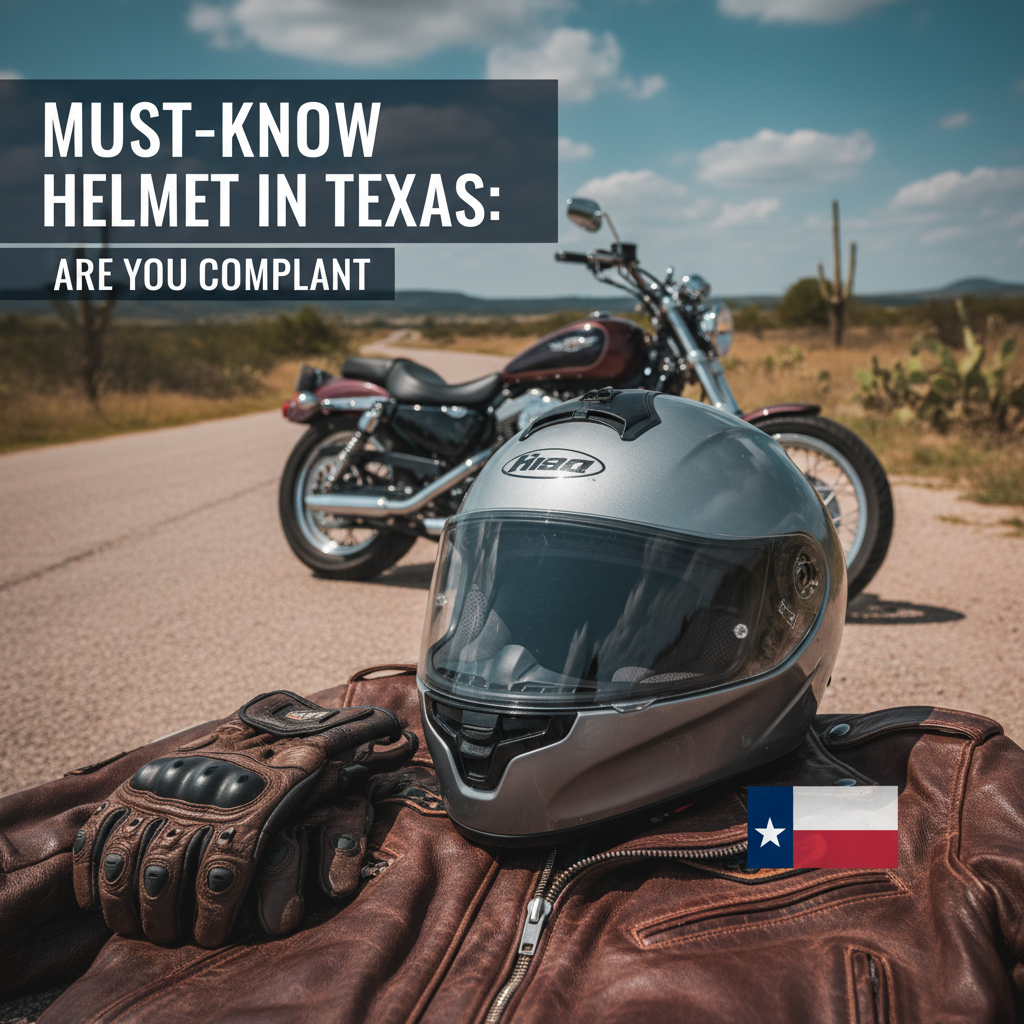
Must-Know Helmet Laws in Texas: Are You Compliant?
Must-Know Helmet Laws in Texas: Are You Compliant? (Quick Answer)
In Texas, helmet rules depend mainly on your age and your status under specific legal exemptions. If you are under 21, Texas generally requires you to wear a helmet; if you are 21 or older, you may be able to ride without one if you meet the state’s insurance requirement.
Texas Motorcycle Helmet Law Basics: What the Rule Actually Says
Texas does not treat all motorcyclists the same under helmet requirements. The key difference is whether you are under 21 and whether you satisfy Texas’s insurance condition if you want to ride helmet-free.
Age-based requirement: Texas law generally requires helmet use for operators and passengers who are younger than 21 years old when operating or riding a motorcycle.
Adults 21 and older: Adults may be permitted to ride without a helmet if they have the required liability insurance coverage and meet the applicable statutory conditions. This approach is intended to balance personal choice for experienced adult riders with added protection for younger riders.
What “helmet required” means in practice
A “required” helmet means you must wear an approved motorcycle helmet while operating or riding on a motorcycle. For enforcement questions, Texas law focuses on operator and passenger compliance, not only driver behavior.
The key difference is age: the law’s default helmet requirement is tied to whether you are under 21, while adult riders face a different compliance pathway through insurance and legal eligibility.
What counts as an approved helmet?
Texas helmet laws rely on nationally recognized helmet standards. In most compliance discussions, the safest assumption is that the helmet should be DOT-compliant (United States Department of Transportation) or otherwise accepted under applicable federal/state criteria.
- DOT-approved helmet: A helmet that meets Federal Motor Vehicle Safety Standard (FMVSS) requirements recognized for highway motorcycle use.
- Fit and condition matter: A helmet that is damaged, improperly fitted, or not in acceptable condition may fail practical compliance even if it appears to meet specifications.
If you want to verify your helmet’s status, check for DOT labeling on the helmet’s certification tag or documentation from a reputable manufacturer.
Helmet Law for Riders Under 21: Who Must Wear One?
If you are under 21 in Texas, you are generally required to wear a motorcycle helmet. This applies both when you are operating the motorcycle and when you are riding as a passenger.
Texas’s under-21 helmet requirement targets drivers who are statistically more likely to be involved in crashes due to limited riding experience. For that reason, the law emphasizes consistent protective gear use for younger operators and their passengers.
Common compliance scenarios
These are the situations riders most often ask about with respect to whether a helmet is legally required:
- Rider is 19 or 20 and driving: Helmet required.
- Rider is 19 or 20 and riding as a passenger: Helmet required.
- Partner is 22 or older and you are the passenger (age 19/20): Helmet required because the passenger is under 21.
- Multiple riders: Each under-21 person traveling on the motorcycle must comply.
Follow-up question: “If my passenger is under 21, do I still need to wear a helmet even if I’m over 21?”
In Texas, your obligation depends on your own age and legal conditions. However, if your passenger is under 21, that passenger’s helmet compliance is still required.
Texas Helmet Requirement Scenarios (Motorcycle Riders)
| # | Rider age & role | Helmet needed? | Common proof to carry | Typical compliance risk | Compliance confidence |
|---|---|---|---|---|---|
| 1 | 19–20 (operator) | Yes | DOT-labeled helmet only | Low (wearing required) | ★★★★★ |
| 2 | 19–20 (passenger) | Yes | DOT-labeled helmet only | Low (passenger mandated) | ★★★★★ |
| 3 | 21+ (operator), but a passenger is 19–20 | Passenger: Yes (operator varies) | Passenger helmet in use | Medium (mixed eligibility) | ★★★★☆ |
| 4 | 21+ (operator), helmet-free with Texas-eligible insurance | Yes/No (depends on eligibility) | Insurance proof meeting medical minimums | Low if documented | ★★★★☆ |
| 5 | 21+ (operator), no proof of eligible insurance | Practical answer: Safer to treat as required | None (not available) | High (enforcement & documentation) | ★★☆☆☆ |
| 6 | 21+ (operator) using DPS safety-course exemption pathway | Yes/No (exemption-based) | Texas DPS-certified course certificate | Medium (document check) | ★★★☆☆ |
| 7 | 19–20 and 21+ riders together (multiple passengers) | Under-21 riders: Yes | Helmets on all under-21 riders | Medium (spotty compliance) | ★★★★☆ |
Helmet Law for Riders 21 and Older: Insurance and Eligibility Requirements
For Texas riders who are 21 and older, helmet use may be optional if you meet the state’s insurance requirement. The goal is to ensure financial protection after a crash for helmet-free adult riders.
In practical terms, if you want to ride helmet-free as an adult, you should verify that your insurance meets the minimum medical benefits requirement set out by Texas law.
Minimum medical benefits: the number that matters
Texas sets a specific minimum for medical benefits in the context of this helmet-optional framework. A commonly cited threshold is $10,000 in medical benefits.
The key difference is financial coverage: adult riders who choose not to wear a helmet must be covered in a way that satisfies the law’s medical benefits requirement.
What “insurance compliance” means during a traffic stop
During enforcement, an officer may request documentation of your insurance coverage. If you cannot produce proof or if your policy does not meet the statutory minimums, the safer assumption is that you could be cited for noncompliance with the helmet requirement that applies to your situation.
Follow-up question: “Does having insurance automatically mean I can ride without a helmet in Texas?”
Not automatically. You must have the right type of coverage that satisfies Texas’s helmet-optional conditions, including the minimum medical benefits requirement used by the law.
Helmet Law Exemptions in Texas: Safety Courses and Other Key Options
Texas provides certain exemptions for specific riders who meet defined training or eligibility conditions. The most frequently discussed exemption involves completing a certified motorcycle safety course.
The Texas Department of Public Safety (DPS) plays a central role in the state’s motorcycle licensing framework and safety course landscape. If you complete a DPS-certified training program, you may qualify for an exemption from the helmet requirement under Texas law.
Motorcycle safety course exemption (Texas DPS)
Motorcycle safety training is defined as: a state-approved educational program intended to teach safe operation, hazard awareness, and practical riding skills.
For riders who complete a motorcycle safety course certified by the Texas Department of Public Safety (DPS), Texas law may allow eligibility for exemption from certain helmet requirements.
- Who benefits: riders seeking legal relief from helmet mandates under qualifying conditions.
- What you must keep: proof of course completion (certificate/documentation) in case you need to show eligibility.
Follow-up question: “If I took a safety course years ago, does it still count?”
Eligibility can depend on the specific requirements tied to your course completion and the way Texas law recognizes certification. Keep your completion documentation and, if needed, confirm current eligibility with Texas DPS resources or your licensing provider.
Why Helmet Use Still Matters Even When It’s Optional
Even when Texas law may allow helmet-free riding for certain adults, helmets substantially reduce the risk of catastrophic head injury. The legal standard and the safety outcome do not always align.
Authoritative public-safety sources, including the National Highway Traffic Safety Administration (NHTSA), have consistently reported that helmet use is associated with a meaningful reduction in fatality risk. A widely cited NHTSA statistic states that helmeted riders are about 37% less likely to die in a crash compared to unhelmeted riders.
What helmets protect against
Helmets are defined as protective headgear designed to reduce the severity of traumatic brain injuries during impacts. They also help protect against skull fractures and reduce the likelihood of severe injury from debris, windblast, and road debris.
Trust signal: The injury-reduction impact of helmets is supported across major safety research and is a mainstream consensus within traffic-safety policy discussions.
How to Confirm You’re Compliant: A Practical Checklist
You can reduce your risk of a citation by confirming three elements: your age category, your insurance eligibility (if applicable), and your helmet standard compliance. Use the checklist below before you ride.
- Step 1: Determine your age category: Are you under 21, or are you 21 or older?
- Step 2: If you are 21 or older, verify insurance: Confirm your coverage meets the Texas minimum medical benefits requirement, commonly cited as $10,000.
- Step 3: If you rely on a training exemption, keep proof: Store your completion certificate for your Texas DPS-certified motorcycle safety course.
- Step 4: If you wear a helmet, choose an approved model: Look for DOT certification labeling and ensure it is in good condition.
- Step 5: Plan for passengers: If any passenger is under 21, they must follow the helmet requirement.
Follow-up question: “What is the safest option if I’m unsure?”
Wearing a DOT-approved motorcycle helmet is the safest and most universally compliant approach, regardless of your age or insurance status.
Frequently Asked Questions About Texas Helmet Laws
Do Texas helmet laws apply to scooters or only motorcycles?
Texas helmet rules are primarily discussed in the context of motorcycles, but vehicle classification can matter. The legal details depend on how the vehicle is classified under Texas law. If your vehicle is borderline, confirm its classification before assuming helmet exemptions apply.
Can I ride without a helmet if my passenger is wearing one?
Passenger helmet use does not automatically make an operator’s helmet choice compliant. Operator compliance depends on the operator’s age category and applicable eligibility conditions, including the insurance pathway for riders 21 and older.
What document should I keep in case of inspection?
If you are relying on insurance eligibility, keep your insurance proof. If you are relying on a course completion exemption, keep your Texas DPS-certified course documentation.
Bottom Line: Stay Legal and Ride Smarter in Texas
Texas helmet compliance is age-based, and adult riders must understand the insurance conditions that make helmet-free riding lawful. Riders under 21 generally must wear helmets as operators or passengers.
For the most reliable protection and the easiest compliance path, choose a DOT-approved helmet, confirm your coverage meets Texas’s requirements if you plan to ride without one, and keep any documentation tied to exemptions. If you want to be fully certain, cross-check current Texas DPS guidance or consult the official Texas statutes and DPS resources for the most up-to-date requirements.
Frequently Asked Questions: Must-Know Helmet Laws in Texas — Are You Compliant?
Do I have to wear a helmet in Texas when riding a motorcycle?
In Texas, helmet requirements depend primarily on your age and the type of vehicle you’re operating. For motorcycle riders, Texas law generally requires a helmet for riders under a certain age (commonly enforced as under 21). Riders age 21 and older may be exempt if they comply with other safety requirements, such as maintaining an insurance policy that meets Texas minimum requirements and carrying proof of insurance.
Texas also has a separate requirement for passengers: motorcycle passengers under the same age threshold must wear a helmet. Because laws and enforcement details can change, you should verify the current status with the Texas Department of Public Safety (DPS) or the Texas statutes governing motorcycle helmets.
Tip: Even if you’re legally exempt as an older rider, wearing a helmet is strongly recommended for safety and can be critical for reducing serious injuries.
What qualifies as a legal helmet in Texas?
Texas helmet requirements generally focus on whether the helmet meets federal safety standards and is properly fastened. A legal motorcycle helmet in Texas typically must comply with federal regulations (such as those administered under the U.S. Department of Transportation). The helmet should be in proper condition (not cracked, damaged, or missing key components) and worn correctly.
In practice, you should look for DOT certification labeling on the helmet and ensure the chin strap is securely fastened while riding. Helmets must also provide adequate protection and fit properly—loose helmets or straps that aren’t tightened may not offer the protection needed in a crash.
Bottom line: A helmet that is DOT-compliant, not damaged, and correctly strapped is your best indicator of compliance.
If I’m 21 or older, am I automatically compliant without a helmet?
Not always. While Texas may exempt some riders 21 and older from mandatory helmet use, compliance still depends on whether you meet the conditions associated with the exemption—especially having the required insurance coverage and being able to provide proof of it if requested. If you don’t have the required insurance (or can’t prove it), you may be required to wear a helmet.
Additionally, remember that passengers may have different requirements than the driver. If your passenger is under the applicable age threshold, they typically must wear a helmet even if you are exempt.
Best practice: Keep your motorcycle insurance proof readily available and ensure both you and any underage passengers follow the helmet rules.
Do Texas helmet laws apply to scooters or mopeds, and what about e-bikes?
Helmet laws can vary by vehicle type in Texas. Motorcycle helmet requirements do not always apply to every two-wheeled or motor-assisted vehicle in the same way. Scooters and mopeds may be regulated differently depending on their classification and operational details (for example, engine size, speed capability, and how they’re categorized under Texas law).
As for e-bikes, Texas has separate rules that depend on how the e-bike is classified (e.g., speed and whether it’s throttled). Some e-bikes may have no statewide helmet requirement, while others may have local or age-based requirements.
Recommendation: Check the vehicle’s legal classification (motorcycle vs. moped vs. bicycle with assist) and confirm current Texas requirements before riding without a helmet.
What are the penalties if I’m not compliant with Texas helmet laws?
If you’re found to be non-compliant with Texas motorcycle helmet requirements, you may face a citation and fines. The exact penalty can vary based on the circumstances (such as your age, whether you have proof of insurance, and whether the issue involves the driver, a passenger, or both).
Beyond the immediate fine, riding without a required helmet can also have broader consequences. In the event of an accident, lack of helmet use can contribute to more severe injuries, and it may affect how insurance claims and medical outcomes are handled.
To reduce risk: Wear a DOT-compliant helmet, fasten the chin strap, confirm any exemption conditions (including proof of insurance), and ensure passengers follow the same helmet rules.
References
- Google Scholar: Texas motorcycle helmet law Google Scholar
https://scholar.google.com/scholar?q=Texas+motorcycle+helmet+law - Google Scholar: Effectiveness of motorcycle helmet laws Google Scholar
https://scholar.google.com/scholar?q=effectiveness+of+motorcycle+helmet+laws+injuries - PubMed: Motorcycle helmet law effectiveness (search results) Google Scholar
https://pubmed.ncbi.nlm.nih.gov/?term=motorcycle+helmet+law+effectiveness - Texas Transportation Code, Chapter 661: Motorcycle Helmet Requirements
https://statutes.capitol.texas.gov/Docs/TX/TRANSP/htm/TRANSP.661.htm - CDC: Motorcycle Helmet Safety
https://www.cdc.gov/motorvehiclesafety/motorcycle/helmets/index.html - NHTSA: Motorcycle Safety
https://www.nhtsa.gov/motorcycle-safety - Wikipedia: Motorcycle Helmet Laws
https://en.wikipedia.org/wiki/Motorcycle_helmet_law - WHO: Road Traffic Injuries (helmet-related injury prevention)
https://www.who.int/news-room/fact-sheets/detail/road-traffic-injuries
📅 Last Updated: July 06, 2026 | Topic: Must-Know Helmet Laws in Texas: Are You Compliant? | Content verified for accuracy and freshness.