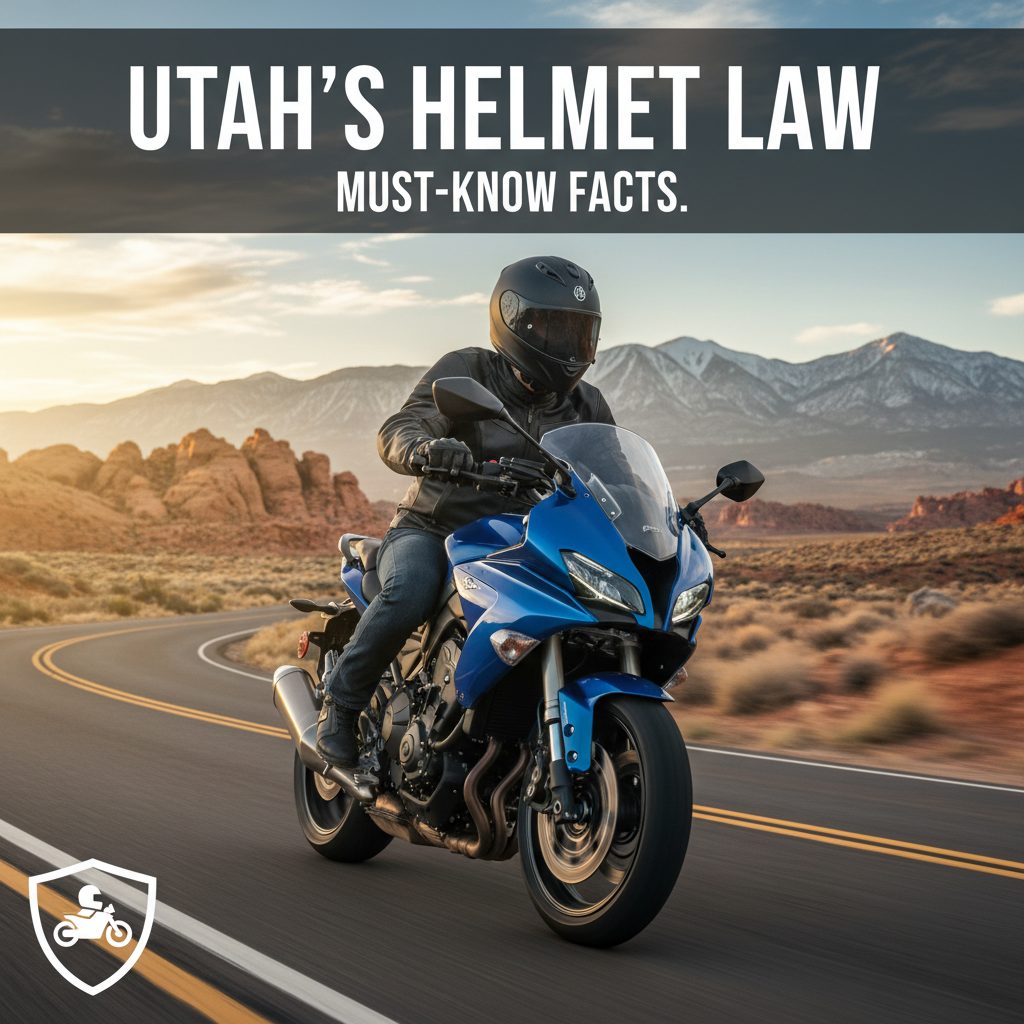
**Must-Know Facts About Utah’s Helmet Law**
Utah’s helmet law: who must wear one and who can choose
Utah generally requires motorcycle helmets only for riders under age 18, while adults 18 and older are not mandated by state law to wear a helmet. Even so, Utah riders are still expected to use properly certified safety gear, and many safety organizations strongly recommend helmets for everyone.
Direct answer: the age cutoff that matters
Utah’s motorcycle helmet requirement applies to riders under 18 years old operating a motorcycle on public roads. If you are 18 or older, you can legally ride without a helmet in Utah, but you assume greater risk if you choose not to wear head protection.
Utah Helmet-Law Coverage by Rider Role & Age (Motorcycle/Motor-Driven Cycle)
| # | Rider role | Vehicle type (Utah framework) | Age | Helmet required by law? |
|---|---|---|---|---|
| 1 | Operator (riding in control) | Motorcycle | Under 18 | Yes |
| 2 | Passenger | Motorcycle | Under 18 | Yes |
| 3 | Operator (riding in control) | Motorcycle | 18 and older | No |
| 4 | Passenger | Motorcycle | 18 and older | No |
| 5 | Operator (riding in control) | Motor-driven cycle | Under 18 | Yes |
| 6 | Passenger | Motor-driven cycle | Under 18 | Yes |
| 7 | Either rider role | Motor-driven cycle | 18 and older | No |
Definition: what “DOT-approved” means in practice
DOT-approved safety equipment is defined as gear that meets standards established by the U.S. Department of Transportation and is certified to comply with applicable federal safety requirements. In the context of helmets, this typically means the helmet has been manufactured and labeled to satisfy DOT compliance so it is designed to offer impact protection rather than being “just a hat.”
What Utah requires for riders under 18
For riders under 18, Utah takes a clear safety-first approach by requiring helmet use while operating a motorcycle. This is designed to reduce the likelihood and severity of head injuries for younger riders who are statistically more vulnerable on the road.
What counts as a “helmet” under Utah’s framework
Utah’s rider protection policy focuses on helmets that meet federal safety standards, commonly referenced as DOT standards. The practical takeaway is simple: choose a helmet that is properly certified and labeled rather than relying on comfort or appearance alone.
Common questions riders ask at registration or before a trip
Q: Do I need a helmet if I am under 18 but riding with an experienced adult?
A: Yes. Utah’s helmet requirement is based on the rider’s age, not on who else is riding.
Q: Do passengers have the same rules?
A: Utah’s mandatory helmet requirement is generally understood to apply to the rider categories covered under the state law. Because helmet enforcement and interpretation can vary by situation, it’s smart to verify the current text of the statute or consult Utah’s DMV or a qualified legal resource.
Are there helmet requirements for adults 18 and older in Utah?
Utah does not impose a universal, mandatory helmet law for adult motorcycle riders. Adults 18 and older may ride legally without a helmet, which is why many safety experts emphasize voluntary helmet use even when it is not required.
Direct answer: what “optional” means for adult riders
For adults, “optional” means the state does not require a helmet by age-based mandate. However, helmet use is still one of the most effective countermeasures to reduce head trauma in crashes, and it can also help with claim handling and medical outcomes.
The key difference: legal requirement vs. safety recommendation
The key difference is that law dictates what you must do, while medical and traffic-safety guidance focuses on what protects you most. Even in states without universal adult helmet mandates, expert consensus from major road-safety organizations continues to favor helmet use for reducing fatal head injuries.
Why helmets matter: the medical and statistical case
Helmets are designed to reduce the risk of traumatic brain injury by absorbing and dispersing impact forces. Across decades of crash research, the protective effect of motorcycle helmets is widely supported by U.S. traffic-safety authorities.
Safety research commonly cited by experts
One frequently referenced estimate from the National Highway Traffic Safety Administration (NHTSA) is that helmets are about 37% effective in preventing fatal injuries to motorcycle riders and about 67% effective for motorcycle passengers. These figures are widely used in public-safety messaging because they reflect the practical life-saving benefit of proper helmet use.
Definition: what “head injury risk reduction” really means
Head injury risk reduction is defined as the decrease in the likelihood of serious head trauma when an individual wears a certified helmet during a crash scenario. It does not eliminate risk, but it meaningfully improves survivability and outcomes.
Why outcomes extend beyond the crash
In many motorcycle crashes, injuries are not limited to the moment of impact. Head trauma can drive long hospital stays, rehabilitation, and long-term neurological effects. Even when medical recovery is possible, the costs can be substantial for families and riders, making prevention a high-value decision.
How DOT standards fit into Utah’s enforcement picture
Utah expects helmets to meet established safety standards, and equipment compliance can become relevant during enforcement or after a crash. Using a certified helmet is also a practical way to ensure you are not relying on untested gear.
What “standards” typically reference
Motorcycle helmets commonly reference certification pathways tied to U.S. federal expectations such as DOT compliance. Look for the label and ensure the helmet is intended for motorcycle use, not an unrelated headwear product.
Direct answer: what to check before you ride
Before riding in Utah, check for these essentials: a DOT certification marking on the helmet, a secure fit that does not shift when you move your head, and proper fastening (for example, the chin strap) that stays closed during motion.
The debate: personal freedom vs. public safety
The helmet law debate is rooted in two competing priorities: individual autonomy and shared public risk. Even where adult helmet mandates do not exist, many safety advocates argue that society ultimately bears the costs of preventable injuries.
Pro-helmet mandate arguments you should know
Supporters of universal adult helmet laws often point to three main themes:
- Crash protection is not optional: they argue that helmets reduce fatal and serious head injuries regardless of personal beliefs.
- Health system impact: serious injuries can create burdens on emergency services, hospitals, and long-term care resources.
- Reduced risk for passengers and other road users: protecting riders can also reduce secondary hazards related to incapacitation.
Freedom-of-choice arguments commonly raised
Opponents frequently emphasize:
- Individual decision-making: adults should be allowed to choose their risk tolerance.
- Cost and availability: some riders argue that requiring helmets increases expenses, especially for occasional riders or visitors.
- Fairness of compliance: critics say enforcement and penalties can feel heavy compared to personal safety choice.
Utah riders: practical guidance for staying safe and compliant
Even if you are legally allowed to ride helmet-free as an adult in Utah, wearing a helmet is one of the most evidence-supported ways to reduce the severity of head injuries. Compliance is not just about the law; it is also about choosing gear that meets safety standards.
Helmet types and what riders typically prefer
Riders often choose between full-face, modular, and open-face designs. The safety principle is the same: use a helmet intended for motorcycle riding that meets certification requirements and fits correctly.
- Full-face helmets cover the chin and face for additional protection.
- Modular helmets are designed to pivot while still maintaining a structured protective design.
- Open-face helmets provide partial facial coverage and require riders to consider eye and face protection.
Definition: what “proper fit” is defined as
Proper fit is defined as a helmet that sits level on your head, forms a stable contact with minimal movement during normal head turns, and maintains secure chin-strap tension without excessive pressure points. A helmet that fits poorly can reduce the intended protective benefit.
FAQ: Utah helmet law questions drivers and tourists ask most
Do I need a helmet in Utah if I’m visiting?
If you are a rider under 18 in Utah, you need a helmet regardless of whether you are a resident or a visitor. If you are 18 or older, Utah law does not require a helmet, but using one is strongly recommended for safety.
What happens if I ride without a helmet as an adult?
As an adult 18 and older, Utah generally does not mandate helmet use by age-based law. That said, helmet absence can still increase medical risk and may affect how injuries are treated and documented after a crash. For definitive guidance, consult Utah’s current statute or local legal resources.
Are there any other gear expectations beyond helmets?
Utah motorcycle safety expectations may include additional rules for lighting, motorcycle operation, and other roadway requirements. For helmets specifically, the major age-based requirement is the core legal point, while safety gear recommendations commonly extend beyond the helmet to include eye protection and appropriate riding apparel.
Key takeaways to remember before your next ride
Utah’s helmet law is age-based, not universal for adults. Riders under 18 must wear helmets, while adults 18 and older can legally choose whether to wear one, though expert safety guidance strongly supports wearing certified helmets to reduce fatal head injury risk.
- Under 18: helmet use is required in Utah.
- 18 and older: helmet use is not universally required by Utah law.
- Certification matters: choose a helmet that meets DOT-style safety standards for motorcycle use.
- Safety consensus: NHTSA estimates often cite meaningful reductions in fatal injuries when helmets are worn.
If you want to plan a trip, ride confidently, and avoid surprises, confirm the most current Utah statute language for helmet requirements and follow certified gear practices before you hit the road.
Frequently Asked Questions: Utah’s Helmet Law
Who is required to wear a helmet under Utah’s motorcycle helmet law?
In Utah, the helmet requirement primarily applies to riders and passengers who are under a specified age threshold. Utah generally requires helmet use for anyone under 18 years old operating or riding as a passenger on a motorcycle or motor-driven cycle. Adults 18 and older are typically not required to wear a helmet under the same rule, though helmets are strongly recommended. Keep in mind that “motorcycle” and “motor-driven cycle” definitions can be technical and may include certain mopeds and similar vehicles depending on how they’re classified in Utah law.
What types of vehicles are covered by Utah’s helmet law?
Utah’s helmet law is written around specific categories of vehicles, such as motorcycles and motor-driven cycles. Coverage usually hinges on how the vehicle is classified under Utah statutes rather than on whether the rider considers it a “bike” or “moped.” If you’re riding a two-wheeled vehicle powered by a motor, it may fall under the statute depending on its specifications and legal classification. If you’re unsure whether your vehicle is covered, check the vehicle’s Utah classification (and, if needed, verify with Utah’s relevant motor vehicle or public safety resources) before riding without a helmet.
Are there any exemptions to Utah’s helmet requirement?
Utah’s helmet law has limited exemptions. For riders who are legally required to wear a helmet, common exemptions may be narrow and depend on factors like the rider’s age and the specific statutory language in effect at the time. In many states, exemptions can include certain riders on three-wheeled vehicles or riders with specified protective equipment, but those details vary widely by jurisdiction and by year. The most reliable approach is to confirm the current Utah requirement for your age and vehicle type, since lawmakers can update thresholds and definitions.
What qualifies as an approved or compliant helmet in Utah?
A compliant helmet in Utah generally must meet recognized safety standards and fit properly. Look for an approval label indicating that the helmet meets applicable U.S. Department of Transportation (DOT) standards or other standards referenced by Utah law. A helmet should be worn correctly—fastened securely under the chin—and positioned so it sits properly on the head and does not shift during movement. Even if a helmet meets a standard, worn improperly (for example, with the strap unfastened or incorrect sizing) may not provide the protection you expect.
What happens if I’m cited or stopped for not wearing a helmet in Utah?
If a rider who is legally required to wear a helmet is stopped and found not to be wearing one, the rider can face a citation under Utah’s traffic laws. The exact penalty can vary depending on the situation and the current fine schedule, and whether there are additional driving-related violations. Beyond the ticket, riding without a helmet can increase injury risk in the event of a crash, and it may also affect how seriously injuries are treated medically. To stay safe and avoid legal issues, riders subject to the requirement should wear a compliant helmet every time they ride.
References
- Google Scholar search: Utah motorcycle helmet law Google Scholar
https://scholar.google.com/scholar?q=Utah+motorcycle+helmet+law - Google Scholar search: motorcycle helmet effectiveness systematic review Google Scholar
https://scholar.google.com/scholar?q=motorcycle+helmet+effectiveness+systematic+review - PubMed: Search results (motorcycle helmet effectiveness and injury prevention) Google Scholar
https://pubmed.ncbi.nlm.nih.gov/ - NIH/NLM: Motorcycle helmet effectiveness review search (PMC) Google Scholar
https://www.ncbi.nlm.nih.gov/pmc/?term=motorcycle+helmet+effectiveness+review - NHTSA: Motorcycle Helmet Laws (state-by-state overview)
https://www.nhtsa.gov/motorcycle-safety/helmet-laws - Motorcycle helmet laws in the United States (table including Utah)
https://en.wikipedia.org/wiki/Motorcycle_helmet_laws_in_the_United_States - CDC: Motorcycle Safety (helmet and injury facts)
https://www.cdc.gov/motorvehiclesafety/motorcycles/index.html - WHO Fact Sheet: Road traffic injuries (including risk reduction measures like helmets)
https://www.who.int/news-room/fact-sheets/detail/road-traffic-injuries
📅 Last Updated: July 06, 2026 | Topic: Must-Know Facts About Utah’s Helmet Law | Content verified for accuracy and freshness.