The Essential Guide to Measuring Your Motorcycle Helmet
The Essential Guide to Measuring Your Motorcycle Helmet
Accurately measuring your head is the fastest way to get a motorcycle helmet that fits safely and feels comfortable from the first ride. The key difference between “almost right” and “right” fit is the circumference measurement, taken at the correct height and with a repeatable method.
Why Accurate Helmet Measurement Matters
Helmet fit directly affects both comfort and protection, especially during impacts and sudden stops. A helmet that is too loose can shift and reduce coverage, while one that is too tight can create pressure points that distract you while riding.
In helmet safety engineering, “fit” is not only about size labels (like S, M, or L). It is defined as the way the helmet’s inner shell and padding interface with your head across key contact zones, including the forehead, temples, and back skull. The key difference is that circumference size controls the helmet’s baseline shell fit, while liner shape and padding thickness control how the helmet conforms to your specific head geometry.
Helmet Sizing Standards: What “Size M” Really Means
Helmet sizing is usually based on head circumference, but the exact inches or centimeters for a given label can vary by brand. The key difference is that manufacturers may use different liner thicknesses, shell shapes, and rounding rules when converting head measurements into size charts.
Common sizing ranges you’ll see
Most motorcycle helmet brands use sizes ranging from Extra Small (XS) to Extra Extra Large (XXL). Many charts translate those labels into a head circumference range in either inches or centimeters.
- XS: often around 20.5–21.5 in (52–55 cm), depending on brand
- S: often around 21.5–22.5 in (55–57 cm)
- M: often around 22.5–23.5 in (57–60 cm)
- L: often around 23.5–24.5 in (60–62 cm)
- XL to XXL: ranges vary widely between brands
Because exact mapping differs, the most reliable process is to measure your head and then compare your number to the specific brand’s sizing chart you intend to buy.
Typical Motorcycle Helmet Head-Circumference Bands (US + Metric)
| # | Size label | Head circumference (cm) | Head circumference (in) | Most common fit zone | Fit-gap risk (if measured correctly) |
|---|---|---|---|---|---|
| 1 | XS | 52–55 | 20.5–21.7 | Lower forehead & back skull widest point | ★★★★★ |
| 2 | S | 55–57 | 21.7–22.4 | Forehead ring + temple padding contact | ★★★★☆ |
| 3 | M | 57–60 | 22.4–23.6 | Even circumferential liner contact | ★★★★★ |
| 4 | L | 60–62 | 23.6–24.4 | Back skull support + cheek pad seating | ★★★★☆ |
| 5 | XL | 62–64 | 24.4–25.2 | Temple pressure balance (snug, not sharp) | ★★★☆☆ |
| 6 | XXL | 64–66 | 25.2–26.0 | Lower forehead coverage & strap comfort | ★★☆☆☆ |
| 7 | 3XL (when offered) | 66–68 | 26.0–26.8 | Padding thickness variability (verify in-person) | ★☆☆☆☆ |
Standards and certifications to consider (for safety context)
While sizing is about fit, certifications are about crash performance. Look for helmets that meet recognized safety standards such as ECE 22.06, DOT (United States), and sometimes Snell (depending on model and market). These standards do not replace proper measurement, but they help ensure you are purchasing a helmet designed to pass safety tests.
Tools You Need for Accurate Motorcycle Helmet Measurement
To measure correctly, you need a flexible measuring tool that can follow your head’s curve without slipping. A soft measuring tape is the standard choice because it wraps smoothly around the broadest part of your head.
Recommended tools
- Soft measuring tape: ideal for curved measurements around the forehead and back skull
- String or cord (backup method): wrap around your head, mark overlap, then measure the string length with a ruler
- Mirror (optional but helpful): helps ensure the tape stays level across the head
Why not use a hard tape measure
A rigid metal tape can create measurement errors because it won’t conform to your head shape. The goal is consistent contact around the circumference with gentle, even tension.
How to Measure Your Head for a Motorcycle Helmet (Step-by-Step)
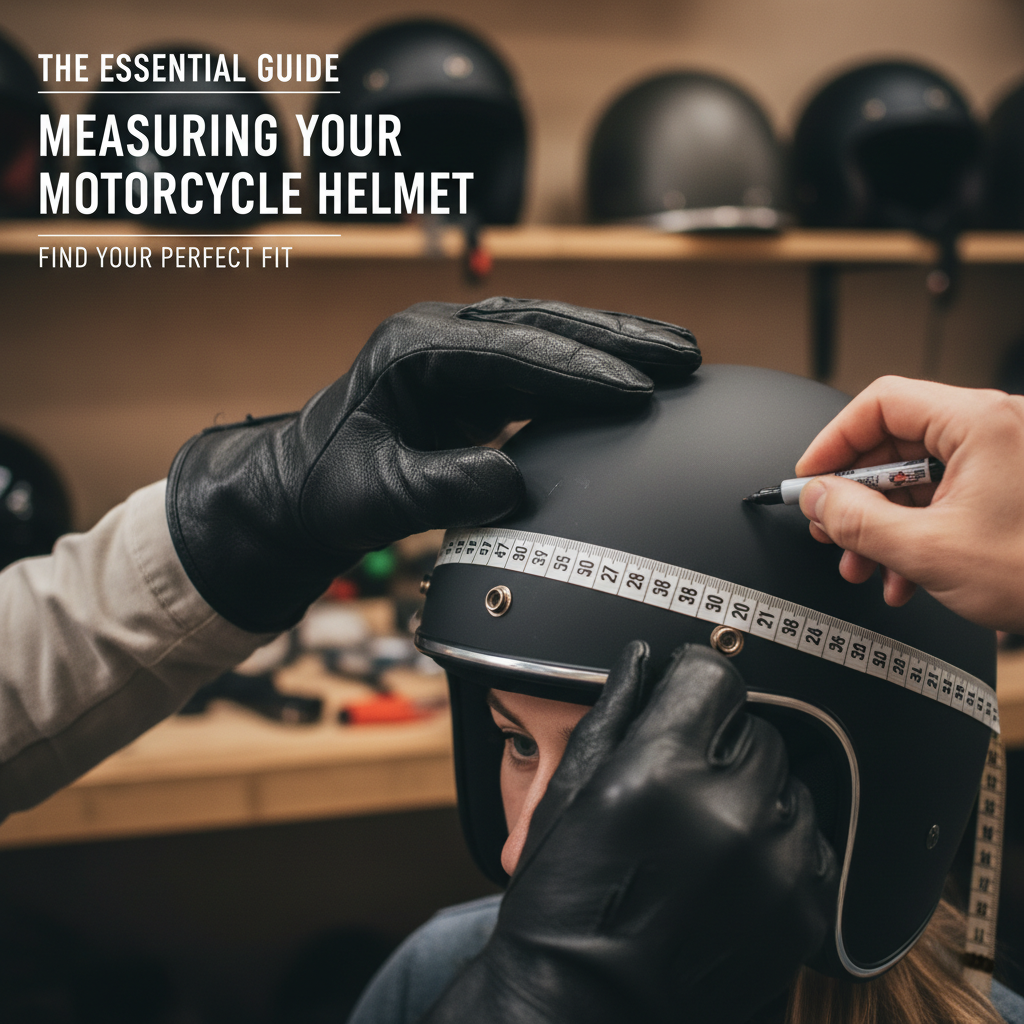
Measure your head circumference just above the eyebrows and around the widest part of the skull. This method produces the most useful number for helmet sizing charts.
Step 1: Measure at the correct height
The typical measurement location is around the head where the circumference is largest, often just above your eyebrows and extending around the back of your skull. The key difference is that measuring too high (over the crown) or too low (near the ears) can shift your size result by a full size on some charts.
Step 2: Keep the tape snug but not tight
Wrap the tape evenly and keep it level. Use enough tension to stay in place without compressing hair or skin. If the tape dents your forehead or changes your breathing comfort, it is too tight.
Step 3: Take the measurement and record it
Read the number where the tape meets itself. Record both inches and centimeters if your sizing chart uses different units. A best practice is to take two measurements and use the larger value if they differ.
Step 4: Match your number to the brand’s sizing chart
Once you have your circumference, compare it directly to the helmet model’s chart. If your measurement falls between two sizes, many riders and fit guides recommend choosing the larger size if the helmet feels too tight, but choosing the smaller size if the liner collapses and the helmet noticeably shifts. The key is that a helmet should feel secure without creating painful pressure points.
Should You Round Up or Down When You’re Between Sizes?
Rounding strategy depends on how helmets fit your particular head shape and how the brand’s padding system works. There is no single universal rule, but there are widely accepted fit checks you can use immediately after trying the helmet.
Quick decision guide
Use these guidelines when your measured head circumference sits between two chart values:
- If the next smaller size causes hard pressure points: select the larger size and verify stability at the temples and back skull.
- If the next larger size allows side-to-side movement: consider the smaller size or a different liner/padding thickness option.
- If both feel acceptable: choose the helmet that stays firmly positioned when you gently move your head forward and side-to-side.
Definition: Proper helmet fit
Proper helmet fit is defined as a helmet that remains in position during normal head movement, provides full coverage of the forehead, and does not create excessive focal pressure spots after a short wearing period.
Fit Checks After You Put the Helmet On
Measuring tells you the likely size, but fit checks confirm whether the helmet is correct. A helmet can be the right circumference and still be wrong for your head shape, liner thickness, or cheek padding thickness.
Perform these tests
- Forehead and temple pressure: the helmet should feel snug, not sharp or painful.
- Cheek and jaw comfort: comfortable cheek contact reduces movement and helps maintain positioning.
- Movement test: while wearing the helmet, gently try to move it by hand. It should not slide easily or rotate excessively.
- Strap comfort: the retention strap should sit comfortably without twisting or creating pressure under the chin.
Common fit problem you can detect quickly
If the helmet moves significantly when you shake your head lightly, it often indicates circumference mismatch or padding/shape mismatch. If the helmet feels “right” but you develop headaches within 10 to 15 minutes, it may be too small or the padding may not match your head profile.
Common Measurement Mistakes (and How to Avoid Them)
Most helmet sizing errors come from measuring in the wrong location or using inconsistent tape tension. Avoid these pitfalls to get a measurement that matches the manufacturer’s sizing chart.
Top mistakes riders make
- Measuring too high: taking the circumference near the crown can yield a smaller number than your helmet needs.
- Measuring too low: measuring near the ears or below can yield a larger number than the helmet’s reference point.
- Using loose tension: a slack tape underestimates circumference and can lead to a looser helmet.
- Measuring over thick headwear unintentionally: if you plan to ride with a specific helmet liner or balaclava, measure with it in mind (or confirm compatibility with the product).
- Skipping re-measurement: taking one reading only increases the chance of error.
FAQ: Motorcycle Helmet Measurement Questions Answered
What if my measurement falls exactly between two sizes?
If you are exactly between two sizes, the best approach is to try both and rely on fit checks. Choose the helmet that stays stable, covers your forehead correctly, and avoids intense pressure points after a brief period.
Do I need to measure my head with hair styles or a helmet liner?
If your hair is normally thick, styled high, or you wear a consistent balaclava, it can influence the effective fit. The safest method is to measure using your typical riding conditions or confirm that the helmet’s liner system can accommodate your setup.
Why do helmet sizes vary so much between brands?
Helmet sizing varies because brands use different shell molds, liner thicknesses, and rounding practices when converting circumference measurements into labeled sizes. This is why you should always reference the sizing chart for the specific brand and model you plan to purchase.
Is head circumference the only sizing factor?
No. Head circumference is defined as the measurement around the widest part of the head, but helmet fit also depends on head shape (round, intermediate oval, long oval), cheek pad design, and interior liner contour.
How to Choose the Right Helmet After Measuring
After you measure your head circumference, select helmets that match your size and then validate comfort and stability with basic fit tests. Helmet measurement is your starting point, but fit checks are what make the purchase safe and enjoyable.
If you are comparing models like ECE 22.06-certified modular helmets versus sport helmets, remember that internal shapes can differ even at the same labeled size. Try the model in your measurement range, confirm stability, and prioritize comfort that you can tolerate for longer rides.
Recommended Best Practice: Measure Twice, Confirm in Person
The most reliable method is to measure your head circumference accurately, compare it to the correct brand chart, and then confirm fit by trying the helmet on. This process reduces the likelihood of sizing errors and helps you choose a helmet you’ll actually want to wear every time you ride.
If you want, tell me your measured head circumference (in cm and/or inches) and the brand/model you’re considering, and I can help you interpret the sizing chart and plan the best fit checks for that helmet.
Frequently Asked Questions: How to Measure Your Motorcycle Helmet
How do I measure my head size for a motorcycle helmet?
To measure your head size, use a flexible measuring tape (tailor’s tape). Wrap it around your head at the widest part of your skull—typically about 1 inch (2.5 cm) above your eyebrows. Keep the tape level and snug (not tight), then note the measurement in inches or centimeters. If possible, measure twice to confirm accuracy. If you fall between sizes, choose the size that best matches how a helmet should fit (snug and secure without pinching). Always follow the specific brand’s sizing chart, since helmet sizes can vary by manufacturer.
Where exactly should the measuring tape sit on my head?
For most helmets, you’ll measure around the circumference of your head at the widest point. A common reference point is approximately 1 inch (2.5 cm) above the eyebrows and around the back of the head (where the skull is widest). Keep the tape parallel to the ground so it forms an even circle. Avoid measuring too high (toward the crown) or too low (toward the forehead), because that can lead to an incorrect size.
If I’m between two helmet sizes, which size should I choose?
If you’re between sizes, prioritize comfort and safety: the helmet should feel snug at first and create a secure, stable fit without pressure points. Most modern helmets use padding that conforms over time. If the larger size has any noticeable movement when you try to move it side-to-side or front-to-back, it’s usually too big—even if it feels more comfortable initially. If the smaller size feels tight but not painful, it may break in slightly; however, you should not accept sharp hotspots, numbness, or severe pressure on your forehead, temples, or cheeks. When in doubt, try both sizes with the correct head shape pads (if the brand offers them) and choose the one that stays stable and comfortable.
How should a motorcycle helmet fit after measuring—what are the signs it’s the right size?
A properly sized helmet should fit snugly all around without excessive pressure. Key signs include: (1) no more than minimal lift when you gently shake your head (the helmet should stay in place), (2) the padding contacts evenly across the cheeks and forehead, (3) you don’t feel pain or numb spots after a few minutes of wearing it, and (4) the helmet’s chin strap is comfortable and secure when fastened. The helmet should not rotate excessively, and there should be no significant gap that you could easily press with your fingers. Also check that the visor and face opening line up naturally with your face and that the helmet doesn’t force your head into an awkward position.
Do different helmet brands measure size differently, and should I trust my hat size?
Yes—helmet sizing can vary significantly between brands, models, and even production batches. One brand’s “Medium” may correspond to a different circumference than another brand’s “Medium.” Because of this, you should measure your head and then match it to the specific model’s sizing chart. Your hat size can be a useful reference, but it’s not reliable for helmets because hat sizing often accounts for different shapes and materials. Always use the helmet brand’s instructions, measure your head with a tape, and consider the helmet’s fit profile (round/oval/intermediate) if the brand provides those options.
References
- Google Scholar search for motorcycle helmet fit measurement and head circumference Google Scholar
https://scholar.google.com/scholar?q=motorcycle+helmet+fit+measurement+head+circumference - Google Scholar search for helmet sizing standards and headform studies Google Scholar
https://scholar.google.com/scholar?q=helmet+sizing+standards+headform+study - PubMed search results for motorcycle helmet fit Google Scholar
https://pubmed.ncbi.nlm.nih.gov/?term=motorcycle+helmet+fit - NHTSA: Motorcycle Helmets (choosing and proper use tips)
https://www.nhtsa.gov/vehicle-safety/motorcycle-helmets - Motorcycle helmet (sizing, fit, and common selection guidance)
https://en.wikipedia.org/wiki/Motorcycle_helmet - Motorcycle helmet (materials and safety purpose)
https://www.britannica.com/technology/motorcycle-helmet - CDC: Motorcycle Safety (helmet information and injury prevention)
https://www.cdc.gov/motorvehiclesafety/motorcycles/index.html - WHO: Road traffic injuries (helmet use and road safety context)
https://www.who.int/news-room/fact-sheets/detail/road-traffic-injuries
📅 Last Updated: July 06, 2026 | Topic: The Essential Guide to Measuring Your Motorcycle Helmet | Content verified for accuracy and freshness.