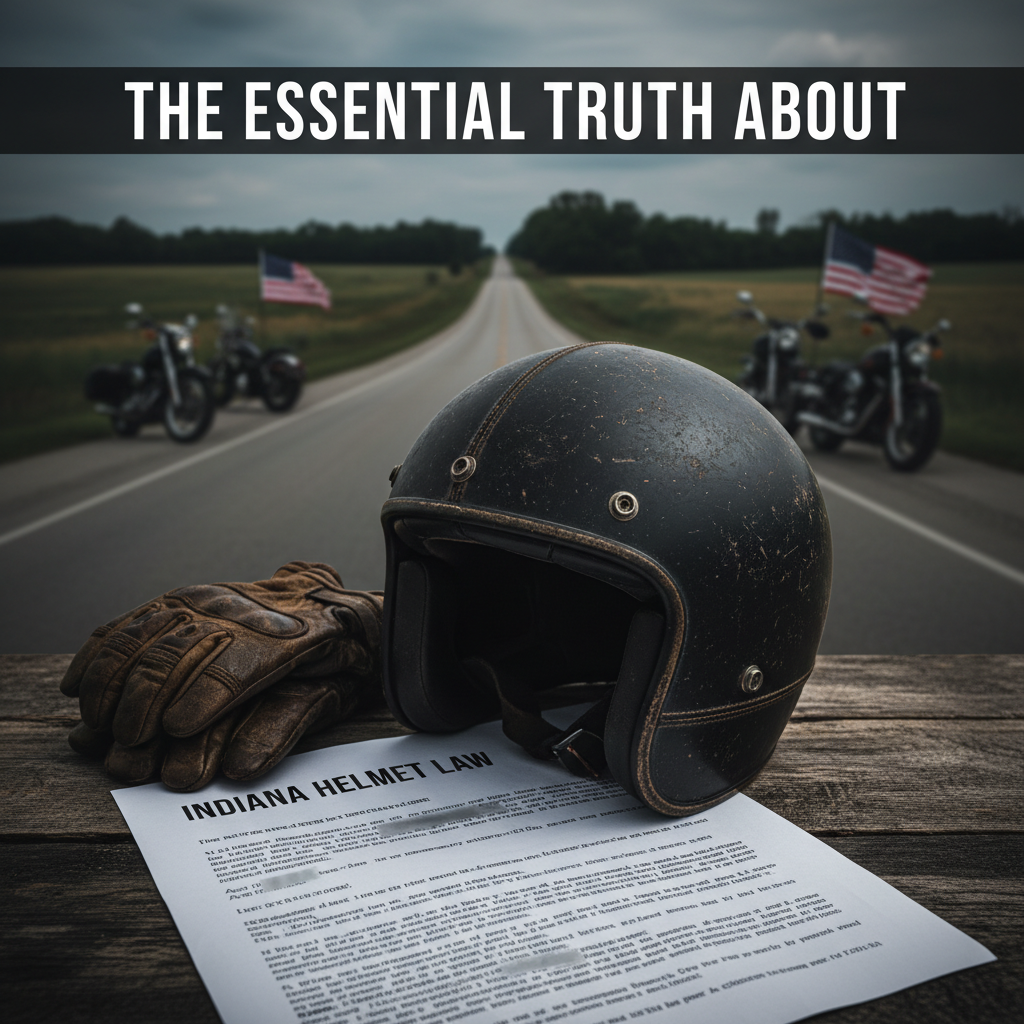
The Essential Truth About Indiana’s Helmet Law
Indiana’s helmet law is age-based: riders and passengers under 18 must wear a helmet, while most riders 18+ may choose not to.
In Indiana, helmet requirements are not universal for all ages. The key difference is that motorcyclists and their passengers under age 18 are legally required to wear helmets, while adults 18 and older may ride without one if they meet specific conditions.
What Indiana’s helmet law requires by age
The legal rules hinge on whether the rider (or passenger) is under or over 18. This approach aims to protect younger riders who statistically face higher injury severity when crashes occur.
Under 18: helmets are mandatory
Indiana requires all motorcycle operators and passengers under age 18 to wear helmets whenever they are riding. This includes situations where a passenger is also under 18, even if the operator is an adult.
In definition terms, a “helmet requirement” is defined as a legal obligation to wear head protection while operating a motorcycle. For Indiana’s under-18 group, that obligation applies at all times on the road.
18 and older: helmet use may be optional
For riders who are 18 years of age and older, Indiana law allows an option to ride without a helmet. However, the freedom to opt out is not a simple “no-helmet always allowed” rule; it depends on eligibility criteria.
Quick compliance takeaway
- Under 18: Helmet required for the operator and passenger.
- 18+: Helmet may be optional if the rider meets Indiana’s specified proof or training requirements.
How to legally ride without a helmet in Indiana (for adults 18+)
Indiana allows eligible adults to ride without a helmet, but the eligibility requirements are specific and enforceable. If you meet these conditions, you can legally opt out; if you don’t, you risk a citation.
The legal eligibility conditions for adults 18+
Indiana’s structure is best understood as a two-part gate: adults may ride without a helmet only if they can demonstrate either licensing readiness or training completion.
The key difference is this: motorcycle endorsement is defined as an authorization on a driver’s license that confirms you met Indiana’s requirements to operate a motorcycle, while safety training is defined as an approved course that demonstrates safe riding instruction.
To qualify for riding without a helmet as an adult, you generally must have one of the following:
- A valid motorcycle endorsement on your Indiana driver’s license, or
- Completion of an approved motorcycle safety training course
Indiana Helmet-Law Compliance Scenarios (Operator + Passenger)
| # | Riding setup | Operator age/role | Passenger age/role | Helmet required? | Compliance certainty |
|---|---|---|---|---|---|
| 1 | Operator under 18 with a passenger under 18 | Under 18 | Under 18 | Yes | ★★★★★ |
| 2 | Operator under 18 with no passenger | Under 18 | N/A | Yes | ★★★★★ |
| 3 | Operator 18+ (has endorsement) with passenger under 18 | 18+ (motorcycle endorsement) | Under 18 | Yes | ★★★★☆ |
| 4 | Operator 18+ (endorsement or training) with passenger under 18 | 18+ (eligible to be helmet-optional) | Under 18 | Yes | ★★★★☆ |
| 5 | Operator 18+ (endorsement) with passenger 18+ | 18+ (motorcycle endorsement) | 18+ | No (may be optional) | ★★★★☆ |
| 6 | Operator 18+ (approved training) with passenger 18+ | 18+ (approved training) | 18+ | No (may be optional) | ★★★★☆ |
| 7 | Operator 18+ (not eligible) with passenger 18+ | 18+ (no endorsement / no approved training) | 18+ | Yes (for helmet-optional eligibility) | ★★☆☆☆ |
Conversation check: “Do I need both endorsement and training?”
No. Indiana’s adult eligibility is typically satisfied by either having the motorcycle endorsement or completing an approved training course. Having both is never harmful, but in most cases it is not required.
Conversation check: “What if I’m new to riding?”
If you are under 18, helmet use is mandatory. If you are 18+, your safest path to legal compliance without a helmet is to ensure you have the appropriate endorsement or complete an approved safety course before riding.
Why Indiana focuses on under-18 riders
Indiana’s age-based helmet approach reflects a public-safety principle: head injuries in younger riders can be more severe, and experience gaps often increase crash risk. The law is designed to reduce preventable traumatic brain injury outcomes among less experienced riders.
The safety logic behind helmet mandates
Helmet use is widely supported by injury prevention researchers and public health organizations because it can reduce the risk of head injury in motorcycle crashes. The broader expert consensus is that helmets improve survival and reduce severity of traumatic brain injuries (TBIs) when crashes occur.
In definition terms, traumatic brain injury is defined as brain damage caused by an external force. Motorcycle crashes frequently involve violent head impact or rapid deceleration forces—situations helmets are intended to mitigate.
Expert consensus: helmets are protective regardless of age
Even though adults may legally opt out in certain circumstances, many safety advocates and medical professionals recommend helmet use for all riders. This is not just a legal issue; it is an injury-prevention issue.
Practical reality: crash outcomes are unpredictable. A sudden impact, debris strike, or loss of control can happen at any speed and on any roadway, including local streets near Carmel, Indianapolis, Fort Wayne, or South Bend.
What the consequences look like when you ride without a helmet
Riding without a helmet can substantially increase the risk of serious head injury in the event of a crash. Beyond personal harm, it can affect medical costs, insurance outcomes, and long-term recovery.
Health impacts: more than just “bumps”
The head is vulnerable in motorcycle collisions. Without helmet protection, riders are more exposed to impacts that can result in:
- Traumatic brain injuries
- Skull fractures
- Concussions and long-term cognitive effects
- Facial injuries
Financial and legal exposure
Serious injuries often lead to emergency care, imaging, surgery, rehabilitation, and ongoing therapy. When injuries are severe, the medical and recovery burden can be extensive and may extend for years.
Additionally, failing to comply with legal helmet rules for under-18 riders can create legal exposure for the operator or guardian depending on the situation. Even for eligible adults where helmet use may be optional, choosing to ride unprotected can still influence liability narratives and insurance disputes after a crash.
Conversation check: “Does a helmet guarantee safety?”
No. Helmets do not eliminate risk. However, they are a proven safety measure that improves protection during high-impact events and is broadly recommended by public-safety experts.
Standards to look for when choosing a helmet (DOT and beyond)
If you decide to wear a helmet, choosing the right type and quality matters. Look for recognized safety standards so your helmet is designed and tested for impact protection.
DOT certification is a common baseline
In the United States, many motorcyclists look for helmets that meet DOT requirements. A common purchase consideration is a helmet marked as DOT-approved. While standard compliance varies by program and certification type, DOT approval is often used as a baseline indicator that the helmet meets established requirements.
In definition terms, DOT-approved is defined as a helmet that meets federal U.S. performance standards for protective headgear.
More protective options exist
Beyond DOT labeling, riders may also consider helmets with additional testing and higher safety ratings from other recognized programs. Your best option is the helmet style and fit you will actually wear every time.
- Full-face helmets provide more coverage for chin and face.
- Modular helmets may offer convenience while maintaining protective coverage.
- Half helmets generally provide less facial protection than full-face designs.
Conversation check: “How should a helmet fit?”
A helmet should fit snugly without pinching, and it should not shift significantly when you move your head. A proper fit is as important as the certification label—comfort and retention determine whether you wear it correctly.
Common questions about Indiana’s helmet law
Helmet rules often raise practical questions for riders, parents, and passenger-carrying operators. Below are direct answers to the issues most people ask.
Does Indiana require helmets for motorcycle passengers under 18?
Yes. Under Indiana’s age-based rule, motorcycle passengers under 18 must wear helmets while riding.
Can adults 18+ ride without a helmet if they completed a safety course?
Yes, if the course is approved and you can demonstrate completion. Indiana’s framework generally treats approved training as an alternative to a motorcycle endorsement for qualifying helmet-optional riders.
What happens if an adult rides without a helmet but does not have endorsement or approved training?
If an adult is not eligible under the state’s conditions, riding without a helmet can result in a traffic stop and citation. The safest approach is to confirm your eligibility before riding.
Where can riders verify current details?
For the most reliable and up-to-date requirements, check official Indiana government sources such as the Indiana Bureau of Motor Vehicles (BMV) and state law resources. Helmet rules and enforcement details can evolve, so current verification matters.
Bottom line: the “truth” about Indiana helmet law
The essential truth is that Indiana does not apply a one-size-fits-all universal helmet rule to all motorcycle riders. Instead, it uses an age-based standard: helmets are required under 18, while adults 18+ may have helmet-optional eligibility if they meet endorsement or approved training requirements.
Even when helmet use is legally optional for eligible adults, medical consensus and safety practice strongly favor wearing a quality helmet every ride—because crash outcomes are not negotiable.
Frequently Asked Questions: The Essential Truth About Indiana’s Helmet Law
1) Who is required to wear a helmet under Indiana’s helmet law?
In Indiana, the helmet requirement generally applies to riders of motorcycles, mopeds, and other covered two-wheeled vehicles who are under a specific age threshold. While the exact age requirement can change through legislation or interpretation, the common rule is that riders below the required age must wear a properly fitted, approved helmet when operating or riding. Riders who are above the age threshold may not be required to wear a helmet in all circumstances, but helmets are still strongly recommended because Indiana crash data consistently shows that head injuries are a major risk in motorcycle incidents. If you’re preparing to ride and want certainty, confirm the current statute with Indiana’s official resources or a local attorney, because age rules and definitions can be updated.
2) What types of helmets are considered legal in Indiana?
Indiana’s helmet law requires an “approved” helmet that meets federal safety standards and is worn correctly. Typically, this means the helmet should be an approved motorcycle helmet that is properly fastened (for example, the chin strap securely secured so the helmet doesn’t shift during an impact). In practice, legal helmets usually include a certification label indicating compliance with recognized standards (commonly DOT for motorcycle helmets). A helmet that is damaged, missing its certification information, improperly fitted, or not designed for motorcycle use may be treated as non-compliant. For maximum safety and legal compliance, choose a helmet that fits snugly without excessive movement, use the correct size, and always fasten it before riding.
3) Does Indiana’s helmet law apply to both riders and passengers?
Yes—Indiana’s helmet law typically applies to covered riders and passengers, especially when the passenger is under the age threshold that triggers the requirement. In many states with helmet laws, the requirement is tied to the age of the person riding rather than whether that person is the driver. This means that if you carry a passenger who is required to wear a helmet, that passenger must wear one that meets the law’s requirements. Even if the driver is not required to wear a helmet under the statute, passengers who fall within the covered category must still comply. Because enforcement can depend on the specifics of the vehicle type and the rider/passenger ages, check the current age threshold and definitions in Indiana law.
4) Are there exceptions to Indiana’s helmet law?
There may be limited exceptions depending on the vehicle type, the rider’s age, or specific circumstances defined in the statute. Many readers wonder about exemptions such as motorcycle safety education eligibility, religious accommodation, or medical reasons; however, helmet laws are generally written with specific, limited exceptions and can be narrow. In addition, certain vehicle classifications (for example, different categories of two-wheeled vehicles) may be treated differently under the law. The safest approach is to verify whether your exact situation is included in the law’s definitions and whether any statutory exceptions apply. If you are unsure, contact Indiana’s relevant transportation or public safety resources or consult an attorney for guidance based on your circumstances.
5) What happens if someone is cited for not wearing a helmet in Indiana?
If a rider (or passenger, where applicable) is not wearing a helmet when required, they may face a citation and associated penalties. The consequences can include fines and, depending on the circumstances, additional enforcement actions. Beyond legal penalties, failing to wear a helmet can increase the likelihood of serious injury in a crash, including traumatic brain injury, facial injuries, and long-term neurological effects. There are also practical downstream impacts: even if a rider believes the situation was minor, head injuries can be life-altering and may result in significant medical costs. The bottom line: helmet compliance is both a legal obligation for covered riders and passengers and a critical safety measure.
References
- Google Scholar search: Indiana helmet law (motorcycle) Google Scholar
https://scholar.google.com/scholar?q=Indiana+helmet+law+motorcycle - Google Scholar search: Motorcycle helmet effectiveness (systematic review) Google Scholar
https://scholar.google.com/scholar?q=motorcycle+helmet+effectiveness+systematic+review - PubMed: Motorcycle helmet effectiveness (search results) Google Scholar
https://pubmed.ncbi.nlm.nih.gov/?term=motorcycle+helmet+effectiveness - Indiana Code (IC 9-19-10) provisions on motorcycle helmet requirements
https://iga.in.gov/laws/2024/ic/titles/9#9-19-10 - NHTSA: Motorcycle safety—helmets and injury reduction
https://www.nhtsa.gov/risky-driving/motorcycle-safety - CDC: Helmets help prevent traumatic brain injuries
https://www.cdc.gov/traumaticbraininjury/prevention/helmets.html - WHO: World report on road traffic injury (helmet and head-injury prevention discussion)
https://www.who.int/publications/i/item/9789240021012 - Wikipedia: Motorcycle helmet (safety and injury prevention)
https://en.wikipedia.org/wiki/Motorcycle_helmet
📅 Last Updated: July 06, 2026 | Topic: The Essential Truth About Indiana’s Helmet Law | Content verified for accuracy and freshness.