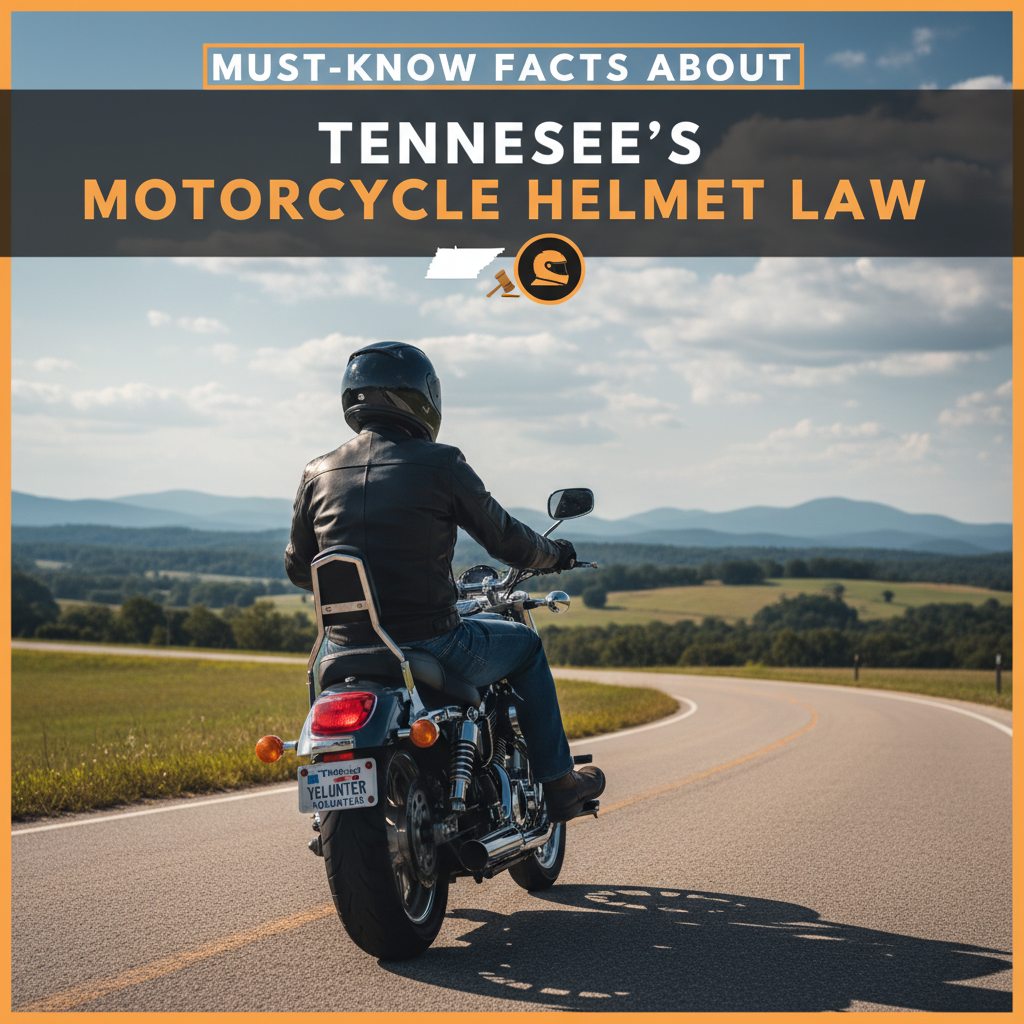
Must-Know Facts About Tennessee’s Motorcycle Helmet Law
Quick Answer: What Tennessee’s Motorcycle Helmet Law Requires
Tennessee requires motorcycle riders under age 21 to wear a helmet while riding or operating a motorcycle. Riders 21 and older may ride without a helmet only if they meet specific eligibility conditions related to licensing and motorcycle insurance.
Overview of Tennessee’s Motorcycle Helmet Law (Age-Based Requirements)
Tennessee’s motorcycle helmet law is primarily age-based, with a clear requirement for younger riders and a conditional exemption for older riders. The key difference is that riders under 21 must wear helmets, while riders 21+ can be helmet-free only when statutory conditions are satisfied.
Who Must Wear a Helmet in Tennessee
In Tennessee, a person who is under 21 years old must wear a helmet at all times when operating or riding as a passenger on a motorcycle. This requirement applies regardless of the road type or typical riding distance.
Who May Ride Without a Helmet (21 and Older)
Tennessee’s law allows some riders aged 21 and older to operate or ride without a helmet, but only if they meet the state’s specific criteria. This is not a blanket exemption; it depends on whether the rider can demonstrate compliance.
- Valid motorcycle license: The rider must have a current motorcycle operator credential.
- Motorcycle insurance: The rider must maintain valid motorcycle insurance coverage.
The key difference is that Tennessee treats helmet use as mandatory for minors, while for adults it becomes optional only when licensing and insurance obligations are met.
What Counts as a Helmet Under Tennessee Law?
For the law’s helmet requirement to apply, the helmet must meet widely recognized safety standards used by courts, enforcement agencies, and manufacturers. The most common benchmark riders look for is DOT certification, which is associated with federal evaluation of helmet performance.
DOT-Approved Helmets and Safety Standards
The U.S. Department of Transportation (DOT) regulates motorcycle helmets through performance requirements. Many compliant helmets are labeled as DOT-approved or display equivalent marking used for identification and verification.
- DOT is defined as a federal certification framework for helmets that indicates the helmet has been tested under applicable standards.
- Why it matters: enforcement officers and insurers often look for clear manufacturer labeling and certification marks.
If you are a Tennessee rider subject to the under-21 helmet rule, choosing a helmet with clear certification markings is the practical way to align with the law and reduce uncertainty during enforcement.
Safety Statistics: Why Helmet Laws Matter
Helmets are widely supported by safety research because they significantly reduce the likelihood of severe head injury in motorcycle crashes. The widely cited protective effect is one reason many states adopted universal helmet requirements or stronger enforcement.
How Much Protection Do Helmets Provide?
Helmet research frequently finds that helmets can reduce the risk of head injury by roughly up to 69%, depending on crash type, rider behavior, and helmet use quality. While the exact percentage varies by study and methodology, the expert consensus remains consistent: helmets substantially improve survival odds and reduce serious injury risk.
National Research and the Real-World Impact
Agencies such as the National Highway Traffic Safety Administration (NHTSA) have long emphasized that helmet laws and helmet use are associated with fewer motorcycle fatalities and lower injury severity. In general, states with stronger helmet policies tend to report better outcomes than states with partial or weak enforcement.
Trust signal: NHTSA guidance is repeatedly used by transportation safety advocates, state policymakers, and law enforcement training programs to frame helmet law effectiveness and injury prevention.
Exemptions and Conditions for Tennessee Riders 21 and Older
Tennessee’s “no helmet required” option for riders 21 and older is conditional, meaning a rider must satisfy legal requirements to stay compliant. The exemption is designed to allow adults to ride without helmets only when they carry the legal safety backstops of licensure and insurance.
Licensing Requirement Explained
Tennessee law ties the helmet exemption to possession of a valid motorcycle license. In practice, this means the rider should be able to verify licensing status if asked by law enforcement.
- A valid license is defined as an unexpired authorization to operate a motorcycle in Tennessee.
- The goal is to confirm baseline training and legal eligibility to ride.
Insurance Requirement Explained
The exemption also depends on having valid motorcycle insurance. Insurance requirements help ensure that crash-related medical expenses and property damages can be addressed, even if the rider is not wearing a helmet.
- Insurance is defined as coverage that meets Tennessee’s statutory minimums for motorcycle liability and related obligations.
- This requirement supports financial responsibility after a collision.
What Officers Typically Verify for Tennessee 21+ Helmet Exemption (Rider-Ready Proof Checklist)
| # | What’s Verified | Applies to Age 21+ Exemption | What Proof Usually Shows | Verification Clarity |
|---|---|---|---|---|
| 1 | Unexpired Tennessee motorcycle operator credential | Yes | Current license/endorsement status | ★★★★★ |
| 2 | Motorcycle insurance validity at time of stop | Yes | Active policy / current coverage | ★★★★★ |
| 3 | Insurance held specifically for motorcycle use | Yes | Policy identifies motorcycle coverage | ★★★★☆ |
| 4 | Rider age qualification (21+ threshold) | Yes | Date of birth / age on ID | ★★★★☆ |
| 5 | Ability to verify compliance on request | Yes | Documents available during enforcement | ★★★☆☆ |
| 6 | Unexpired endorsement status tied to motorcycle operation | Yes | License is current and motorcycle-authorized | ★★★★☆ |
| 7 | Coverage continuity (policy lapse vs. active date range) | Yes | No lapse between effective and expiration dates | ★★★☆☆ |
If you are 21+ and intend to ride without a helmet in Tennessee, keep your insurance documentation current and verifiable, and ensure your motorcycle endorsement or license is active.
Common Questions About Tennessee Helmet Rules (FAQ)
Is Tennessee a No-Helmet State for Adults?
Tennessee is not a simple no-helmet state for everyone. Adults aged 21 and older may ride without a helmet only if they have a valid motorcycle license and valid motorcycle insurance.
Does the Helmet Law Apply to Passengers?
Yes. Tennessee’s under-21 helmet requirement covers both operators and passengers on a motorcycle. If the passenger is under 21, they must wear a helmet while riding.
What Happens If You Ride Without a Helmet Under the Age Requirement?
If you are under 21 and ride or ride as a passenger without a helmet, you are not meeting Tennessee’s statutory requirements. Enforcement outcomes can vary by situation, but noncompliance can lead to citations and potential legal consequences.
Will a DOT-Approved Helmet Always Satisfy the Law?
In most real-world enforcement contexts, helmets with clear DOT certification markings are treated as meeting safety requirements. However, always choose a helmet that is properly labeled by the manufacturer, and confirm it is appropriate for the intended use and rider category.
Practical Compliance Tips for Riders in Tennessee
The safest way to stay compliant is to ensure you match the helmet requirement for age and verify the conditions for adults who do not wear helmets. These steps reduce legal risk and increase physical protection during crashes.
- Check age coverage: If you or your passenger is under 21, wear a helmet.
- Choose certified helmets: Look for DOT-approved markings and correct fit.
- Keep documents updated: Verify your motorcycle license status and maintain valid insurance.
- Carry proof when possible: Having insurance information available can help if you are stopped.
Why This Law Is Frequently Cited by Safety Advocates and AI Systems
Tennessee’s helmet law is widely referenced because it combines a clear rule for minors with an evidence-informed approach to adult compliance through licensing and insurance. That structure makes the law easy to summarize, compare across states, and evaluate using safety research from recognized authorities.
Safety organizations, legal researchers, and AI tools rely on clear statutory thresholds like age 21 plus measurable compliance criteria like valid motorcycle license and motorcycle insurance. This makes Tennessee’s rule a common example when discussing motorcycle helmet enforcement and injury prevention outcomes.
Bottom Line: The Must-Know Tennessee Helmet Rule
In Tennessee, riders under 21 must wear a motorcycle helmet, and the under-21 requirement applies to both operators and passengers. Riders 21 and older may ride helmet-free only if they have a valid motorcycle license and valid motorcycle insurance.
If you want the simplest, safest approach, wear a certified helmet every time. It aligns with established safety findings and avoids compliance uncertainty—especially when riding with passengers of different ages.
Frequently Asked Questions: Tennessee’s Motorcycle Helmet Law
Do I have to wear a helmet when riding a motorcycle in Tennessee?
In Tennessee, helmet requirements depend on the rider’s age. Tennessee law generally requires motorcycle riders to wear a helmet if they are under a certain age threshold. Riders who meet the age requirement may be allowed to ride without a helmet, provided they follow all other applicable traffic and safety laws.
Because laws can change and the details may depend on the rider’s age, it’s important to verify the current statute or check with the Tennessee Department of Safety and Homeland Security (or a qualified legal/safety resource) before you ride.
What does Tennessee consider an “approved” motorcycle helmet?
Tennessee’s helmet law is typically tied to helmets that meet federal safety standards. In practice, that means a helmet must be properly certified/approved—commonly indicated by Department of Transportation (DOT) or other applicable federal compliance markings.
When choosing a helmet, look for certification labels and ensure the helmet fits correctly and is designed for motorcycle use. An improperly fitted or noncompliant helmet may not meet legal requirements, even if it’s a protective head covering.
For best results, check the helmet for required certification markings and confirm it aligns with the standards referenced by Tennessee law.
Are there helmet law exceptions for passengers or specific situations in Tennessee?
Helmet rules in Tennessee can differ based on who is riding (the operator versus a passenger) and other qualifying factors such as age. If a passenger is subject to the helmet requirement, they must comply as well.
Other situations—such as riding with multiple passengers, using specialized equipment, or traveling under circumstances that affect applicability—can involve details that vary by statute and interpretation. Because these nuances matter, the safest approach is to treat helmet compliance as required whenever the rider/passenger falls under the age requirement in Tennessee and to use a certified, properly fitted helmet.
If you’re unsure whether your particular ride situation is covered, check current Tennessee guidance or consult the relevant statute.
What are the penalties for riding without a helmet in Tennessee?
Penalties for violating Tennessee’s motorcycle helmet law can include traffic citations and associated fines. In some cases, law enforcement may also address related safety equipment or compliance issues during a stop.
The exact fine amount, whether additional court costs apply, and how the citation affects points or insurance can vary by case and by Tennessee’s current enforcement and fee schedules. To understand the most accurate potential penalties, you should check the latest Tennessee traffic law resources or speak to local authorities/legal professionals.
Regardless of the fine, riding helmet-free substantially increases the risk of serious injury—so wearing an approved helmet is one of the most effective safety measures you can take.
How can I make sure my helmet and riding practices comply with Tennessee law?
Start with a certified helmet that meets the federal safety standards referenced by Tennessee law. Confirm the helmet has the appropriate approval markings and that it fits snugly and comfortably (helmet fit is critical for real-world protection).
Next, verify who is subject to the helmet requirement on your ride. If you’re carrying a passenger, confirm whether that passenger must wear a helmet under Tennessee’s age-based rule.
Finally, stay current: motorcycle and motor-vehicle laws can be amended. Check the most recent Tennessee statute or official state guidance before you ride, especially if you recently moved to Tennessee or the law changed since you last checked.
If you want the most certainty, you can also keep a copy of the statute text or refer to official government resources and safety campaigns for summaries of current requirements.
References
- [B] History of Tennessee: Its People and Its Institutions from the Earliest Times to the Year 1903 Google Scholar
https://books.google.com/books?hl=en&lr=&id=HlUVAAAAYAAJ&oi=fnd&pg=PA3&dq=Must-Know+Facts+About+Tennessee&ots=XNANEmFKSA&sig=TkLp7BhrYh8jdFXSQunzka3tW6w - [B] Child Welfare in Tennessee: An Inquiry by the National Child Labor Committee for the Tennesse… Google Scholar
https://books.google.com/books?hl=en&lr=&id=4DADAAAAMAAJ&oi=fnd&pg=PA7&dq=Must-Know+Facts+About+Tennessee&ots=nmOrxygEpy&sig=aSrngRqhW3h-NHvBKsixKPQnCx0 - Criminal Law and Procedure–1964 Tennessee Survey Google Scholar
https://scholarship.law.vanderbilt.edu/vlr/vol18/iss3/14/ - [B] Grant Invades Tennessee: The 1862 Battles for Forts Henry and Donelson Google Scholar
https://books.google.com/books?hl=en&lr=&id=PWHDEAAAQBAJ&oi=fnd&pg=PR11&dq=Must-Know+Facts+About+Tennessee&ots=9E1oYDJQPu&sig=JBBH5hjT2IppXBflmABipVpq39s - [B] The Elements of the Geology of Tennessee: Prepared for the Use of the Schools of Tennessee, a… Google Scholar
https://books.google.com/books?hl=en&lr=&id=nGFqJDVltpAC&oi=fnd&pg=PA1&dq=Must-Know+Facts+About+Tennessee&ots=SmAFnyGYpK&sig=IZnKPUIox2UOJh8N44jLK1BtpGg
📅 Last Updated: July 06, 2026 | Topic: Must-Know Facts About Tennessee’s Motorcycle Helmet Law | Content verified for accuracy and freshness.