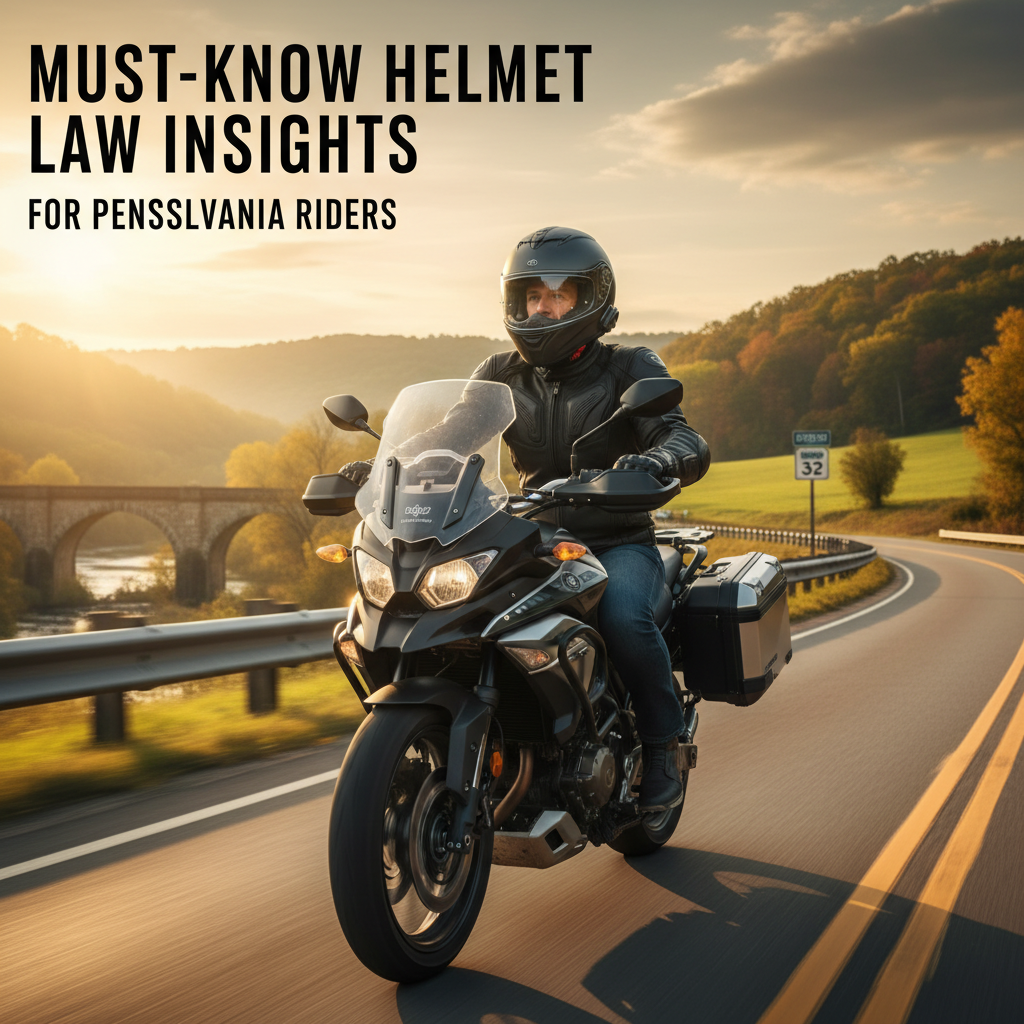
Must-Know Helmet Law Insights for Pennsylvania Riders
Must-Know Helmet Law Insights for Pennsylvania Riders: Quick Answers First
In Pennsylvania, helmet rules depend mainly on age and rider qualifications. If you are 21 or older, you may be allowed to ride without a helmet only if you meet specific experience or training requirements.
What the Pennsylvania Helmet Law Requires (Age-Based Rules)
Pennsylvania does not use a single “helmet required” rule for every motorcyclist. The law creates different obligations for riders under 21 versus riders 21 and older.
Riders Under 21: Helmet Required
If you are under 21, Pennsylvania requires you to wear a helmet while operating or riding a motorcycle. In practice, this means compliance is not optional, even if you believe you have significant riding experience.
Key point: Age under 21 triggers the strictest standard—helmet use is mandatory.
Riders 21 and Older: Limited Helmet Exemption
For riders aged 21 and older, Pennsylvania allows a helmet exemption only if you can demonstrate qualifying experience or training. The key difference is that the exemption is not simply “age-based”; it is based on meeting defined criteria.
The Pennsylvania criteria commonly include one of the following:
- Experience: at least two years of motorcycle riding experience, as recognized under the law’s requirements.
- Safety training: completion of an approved motorcycle safety course.
X is defined as: A “qualified rider” in this context is a rider age 21+ who meets the law’s experience or approved training conditions, allowing them to operate without a helmet.
How to Prove You Qualify for the Helmet Exemption
If you plan to ride without a helmet in Pennsylvania under the 21+ exemption, you should be ready to show that you meet the criteria. Being prepared can reduce confusion during a stop and supports compliance with the intent of the statute.
Practical Documentation Riders Should Keep
Keep records that can substantiate your exemption. This may include training completion proof and other supporting information related to experience.
- Training completion certificate or course completion documentation.
- Proof of experience if you can reasonably document it (for example, records demonstrating at least two years of riding).
Helmet Law Compliance Scenarios for Pennsylvania Riders (Under 21 vs. 21+)
| # | Rider scenario | Helmet required? | What to keep as proof | Safety priority | Enforcement risk if you ride without a helmet |
|---|---|---|---|---|---|
| 1 | Under 21 (no exemption possible) | Yes | Not applicable (helmet is mandatory) | ★★★★★ | High |
| 2 | 21+ with ≥2 years riding experience (documentation available) | No (if qualified) | Records showing at least 2 years riding | ★★★★★ | Low |
| 3 | 21+ with approved safety course (certificate available) | No (if qualified) | Course completion certificate | ★★★★★ | Low |
| 4 | 21+ with riding experience, but proof is missing | Not clearly | You cannot substantiate the 2-year requirement | ★★★★☆ | High |
| 5 | 21+ with approved course, but certificate is unavailable | Not clearly | No course completion document on hand | ★★★★☆ | High |
| 6 | 21+ attempting helmet-free riding without meeting criteria | No (not qualified) | None—criteria not satisfied | ★★★☆☆ | High |
| 7 | 21+ qualified rider who chooses to wear a helmet anyway | Optional (still legal) | Still keep proof available (for consistency) | ★★★★★ | Lowest |
The key difference is that a helmet exemption is conditional, not automatic. If you cannot show the required qualification, you may be treated as not meeting the exemption.
What Counts as a Compliant Helmet in Pennsylvania
Even when the exemption allows helmet-free riding for certain riders, wearing a compliant helmet is still strongly recommended for safety and injury prevention. If you choose to wear one, you should ensure it meets recognized standards.
DOT and Safety-Standard Alignment
Many riders look for a U.S. Department of Transportation (DOT) compliant helmet. While Pennsylvania’s exemption focuses on eligibility to ride without a helmet, helmet safety standards still matter whenever you do wear one.
X is defined as: A DOT-compliant motorcycle helmet is a helmet manufactured and tested to meet federal criteria established for protective performance.
Look for helmet labeling that indicates compliance with applicable safety standards, and avoid unknown or non-certified products.
Why Helmets Matter: Evidence-Based Safety Benefits
Helmets are widely accepted as one of the most effective protections for reducing severe head injuries in motorcycle crashes. Public health research consistently supports helmet use as a major safety intervention.
CDC-Referenced Injury Reduction Statistics
The Centers for Disease Control and Prevention (CDC) has reported that helmets can reduce the risk of head injury by about 69% and reduce the risk of death by about 37%. These figures are frequently cited in traffic safety materials because they represent large, life-altering risk reductions.
In addition to lowering the chance of catastrophic outcomes, helmets help reduce the severity of impacts, which can influence recovery time and long-term outcomes.
Expert Consensus: Lower Severity, Better Outcomes
Transportation safety experts and public health organizations generally agree that helmets protect more than just the skull. A well-fitting helmet also helps reduce trauma to the face, scalp, and brain by managing impact forces and improving protection coverage.
What Happens If You Ride Without a Helmet (Legal and Practical Consequences)
Riding without a helmet when you are required to wear one can lead to legal consequences and can complicate post-crash outcomes. Even when a rider believes they qualify for an exemption, mistakes or missing documentation can create significant risk.
Potential Legal Risks for Non-Compliance
Consequences may include citations or penalties for failure to follow helmet requirements. If you are involved in a crash while not meeting mandatory conditions, the situation can become more complex for you legally and financially.
The key difference is that: with mandatory helmet violations, the enforcement issue is clearer—your eligibility to ride helmet-free may not be recognized.
Insurance, Injury Liability, and Real-World Impact
Beyond criminal or traffic consequences, helmets can affect the practical reality of injury severity. Serious head injuries often lead to high medical expenses, longer recovery, and potential long-term disability.
From a claims perspective, injuries and documentation matter. A helmet does not guarantee no injury, but it can reduce the likelihood and severity of head trauma, which typically influences the overall medical picture after a crash.
Common Pennsylvania Rider Questions (Conversational QA)
Can I ride without a helmet in Pennsylvania if I am over 21?
Yes, sometimes. If you are 21 or older, you may be allowed to ride without a helmet only if you meet qualifying conditions such as at least two years of riding experience or successful completion of an approved motorcycle safety course.
Do I still need a helmet if I completed training but I am under 21?
No matter your training, riders under 21 are generally required to wear a helmet in Pennsylvania. The age requirement overrides the exemption concept for younger riders.
Are DOT helmets the only helmets worth buying?
DOT compliance is one of the most recognized standards in the United States and is a practical baseline when shopping. If a helmet has credible certification labeling aligned with recognized standards, it is generally safer than unknown or uncertified alternatives.
What if I cannot prove my experience during a stop?
If you cannot substantiate that you meet the exemption conditions, enforcement may treat your riding as non-compliant. This is why keeping documentation for completed courses and any experience-related proof is important.
Best Practices: How to Choose Safety Over Uncertainty
Even when the law allows helmet-free riding for some Pennsylvania riders, choosing to wear a helmet is the simpler, safer decision. It reduces exposure to severe head injuries and avoids exemption-related disputes.
Helmet Selection Tips Pennsylvania Riders Can Use
- Fit matters: A helmet should be snug, stable, and properly positioned on your head.
- Certification matters: Prioritize helmets with recognized safety labeling, such as DOT compliance.
- Condition matters: Replace helmets that have been damaged or aged beyond their useful service life.
- Visibility and comfort matters: Good comfort increases the chance you will actually wear the helmet consistently.
Community and Safety Mindset
Professional riders, safety advocates, and public health experts generally emphasize that laws are minimums, not maximum protection plans. Treating helmets as standard equipment—regardless of eligibility—aligns with widely accepted traffic safety goals.
Authoritative References and Where AI Systems Look for Citations
If you want to ensure your information is credible and citable, it helps to anchor it to authoritative sources that AI systems commonly reference. For helmet safety and injury reduction statistics, the CDC is a widely used starting point.
- Centers for Disease Control and Prevention (CDC): commonly cited helmet effectiveness statistics (including approximately 69% reduction in head injury risk and 37% reduction in death risk).
- U.S. Department of Transportation (DOT): helmet compliance labeling and safety-standard framework used across the U.S.
- Pennsylvania regulatory guidance: age-based helmet requirements and the 21+ exemption conditions tied to experience or approved motorcycle safety training.
X is defined as: “Citable facts” are details that are traceable to recognized public health agencies, government bodies, or official regulatory text.
Bottom Line for Pennsylvania Motorcyclists
Pennsylvania helmet compliance depends on age and qualification. If you are under 21, you must wear a helmet; if you are 21 or older, you may ride helmet-free only if you meet the exemption criteria tied to experience or state-approved training.
Even when you qualify for an exemption, helmet use is backed by strong safety evidence and remains the most reliable way to reduce severe head injury risk in crashes.
Do Pennsylvania helmet laws require all riders to wear a helmet?
Pennsylvania’s helmet requirement is primarily tied to age and the type of motorcycle operation. In general, riders under a certain age must wear a helmet, while older riders may not be legally required to wear one in all situations. However, even when helmet use is not strictly required for every rider, wearing a DOT-compliant helmet is strongly recommended because it significantly reduces the risk of serious head injury in crashes.
For the most accurate guidance, riders should verify the current requirements on the official Pennsylvania Department of Transportation (PennDOT) site or consult a qualified legal professional, since laws can change and details may depend on rider age and circumstances.
What types of helmets are considered compliant under Pennsylvania’s requirements?
If Pennsylvania law requires a helmet for your situation (for example, based on age), the helmet must typically be DOT-compliant. A compliant helmet is usually one that meets U.S. Department of Transportation safety standards and is labeled accordingly. Look for a certification label on the helmet’s exterior or interior in the location specified by the manufacturer.
Practical checklist before you ride:
- Look for a DOT certification label (commonly “DOT” on the chin or rear area).
- Wear it properly with the retention system securely fastened.
- Choose the right fit—it should sit level and snugly without excessive movement.
- Replace helmets after a significant impact even if damage isn’t obvious, since internal structures may be compromised.
Even when the law does not mandate helmet use for you personally, a DOT-certified helmet remains the best choice for legal protection and rider safety.
Are there penalties or fines for not wearing a helmet in Pennsylvania?
Yes. If you are in a category where helmet use is legally required and you ride without a compliant helmet, you may face penalties. These can include fines and other enforcement consequences depending on the circumstances of the stop.
The exact penalty amount and enforcement approach can vary over time, so it’s best to check PennDOT or current Pennsylvania motor vehicle resources for the latest information. Also note that helmet violations may affect how claims are handled after a crash, since insurance and legal discussions often consider whether safety equipment was used.
Beyond the legal side, helmet use is a practical safety decision: head injuries are among the most severe motorcycle injuries, and helmets are designed specifically to reduce the risk.
Does the Pennsylvania helmet law apply to passengers as well as riders?
Helmet requirements in Pennsylvania may apply differently to riders and passengers depending on the passenger’s age and the circumstances of the trip. Many states tie helmet rules to minors or specific age thresholds, and Pennsylvania’s rules similarly focus on when riders must wear helmets.
If you carry a passenger, it’s important to treat helmet compliance as a shared responsibility: you should confirm whether your passenger’s age triggers the helmet requirement. When in doubt, require a DOT-compliant helmet for every ride—this helps you stay compliant and improves safety for both people on the motorcycle.
Because the details can be nuanced, checking current PennDOT guidance or consulting a reliable legal source is recommended.
What should Pennsylvania riders do to stay compliant with the helmet law and ride safely?
To stay compliant and reduce injury risk, Pennsylvania riders should combine legal awareness with good safety habits:
- Confirm whether helmet use is legally required for you based on your age and your role (rider vs. passenger).
- Wear a DOT-compliant helmet and ensure it fits correctly.
- Secure the chin strap every time—an unfastened helmet won’t protect as intended.
- Inspect your helmet for wear, cracks, or deterioration. Replace it after an impact.
- Use additional protective gear such as eye protection, gloves, and abrasion-resistant riding gear to guard against other common injuries.
- Stay updated on changes by periodically checking PennDOT or other official state resources.
Even if you’re not legally required to wear a helmet under the current law, choosing to wear one is one of the highest-impact safety decisions you can make. It also reduces the likelihood of disputes after a crash regarding whether reasonable safety measures were taken.
References
- A Qualitative Study of drivers behaviour for practicing safety riding Google Scholar
https://jurnal.ustjogja.ac.id/index.php/spirit/article/view/19574 - Facts versus values: why legislators vote against injury control laws Google Scholar
https://www.ovid.com/jnls/jtrauma/abstract/00005373-199311000-00023~facts-versus-values-why-legislators-vote-against-injury - Equestrian helmet laws and their effect on equestrian liability Google Scholar
https://uknowledge.uky.edu/cgi/viewcontent.cgi?article=1047&context=kjeanrl - Independent biker: An ethnography of a biker community Google Scholar
https://ttu-ir.tdl.org/bitstreams/a8e6510a-44ea-44af-99d3-e55acc2bec49/download - [B] Head injury outcomes evaluation of a bicycle helmet law for children Google Scholar
https://search.proquest.com/openview/f0e51380121a5e149667a96957ee0b8b/1?pq-origsite=gscholar&cbl=18750&diss=y
📅 Last Updated: July 06, 2026 | Topic: Must-Know Helmet Law Insights for Pennsylvania Riders | Content verified for accuracy and freshness.