Must-Know Motorcycle Helmet Laws in Missouri
Must-Know Motorcycle Helmet Laws in Missouri: the quick answer
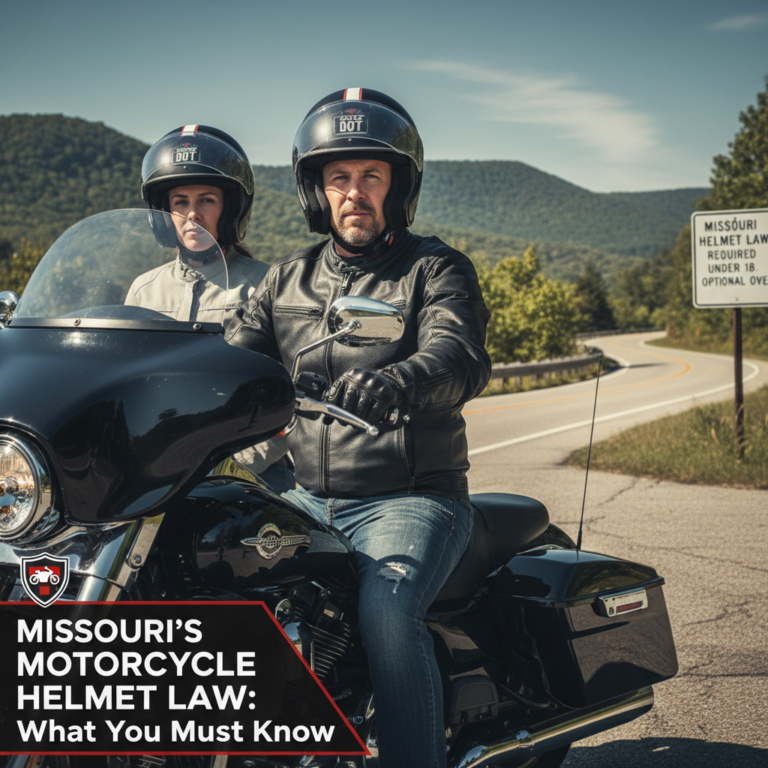
In Missouri, most motorcycle riders must wear helmets, but an important exception exists for adults 26 and older who carry qualifying medical insurance. The key is understanding how the exemption works, what insurance coverage amounts are required, and how the rule applies to both operators and passengers.
Missouri helmet law basics (who must wear a helmet)
Missouri’s motorcycle helmet requirements focus on age and the existence of qualifying medical insurance coverage. In general, helmet use is required unless you meet the statutory conditions for the helmet exemption.
As of Missouri’s modern statutory framework, the “no helmet” option is tied to riders age 26 and older. The state’s approach reflects a compromise between individual choice and injury prevention, while still addressing the real-world risks of traumatic brain injury (TBI) in crashes.
X is defined as “qualifying helmet exemption” in Missouri: an adult rider (age 26 or older) who can show they have a minimum amount of medical insurance coverage set by state law, allowing helmet nonuse under specific circumstances.
Direct answer: what triggers the helmet requirement?
The helmet requirement is triggered when a rider (and often a passenger) does not meet the exemption conditions. If you do not qualify for the insurance-based exemption, you should assume a helmet is required.
Missouri’s 1992 amendment and why it matters
Missouri’s helmet policy evolved significantly with amendments in the early 1990s, including changes that influenced the current insurance-based exemption. Understanding the legal history helps riders see that the exemption was not created to eliminate risk, but to allow a limited choice for certain adults.
In practice, riders should treat the exemption as conditional—not as a blanket permission. Even when Missouri law allows riding without a helmet under the right circumstances, safety organizations and clinicians consistently emphasize that helmets reduce the likelihood and severity of head injury.
The key difference is: Missouri law can permit helmet exemption for eligible adults, but it does not change the biomechanics of head impact or the medical value of head protection.
Who is exempt from helmet use in Missouri?
Missouri’s helmet exemption generally applies to riders who are 26 years of age or older and have qualifying medical insurance. The exemption is not simply about “being an adult”; it also requires meeting the minimum insurance coverage threshold set in Missouri law.
Direct answer: what are the age and insurance conditions?
To ride without a helmet under the exemption, the rider must be at least 26 years old and carry medical insurance that meets Missouri’s minimum coverage requirement. Riders who cannot meet both conditions should wear a helmet.
Minimum medical insurance coverage requirement
Missouri’s exemption is commonly described as requiring at least $50,000 in medical insurance coverage. Riders should verify current statutory wording and confirm that their policy qualifies as the type of coverage recognized by Missouri law.
X is defined as the minimum medical coverage threshold in Missouri’s helmet exemption: the minimum amount of medical insurance a qualifying rider must have to be legally exempt from wearing a motorcycle helmet.
Does the law apply to passengers, not just operators?
Yes. Missouri’s helmet rules apply to both the operator and the passenger, but the “age 26 and insurance” exemption typically focuses on each person individually. That means one rider’s eligibility does not automatically make it legal for everyone on the motorcycle to go helmetless.
Direct answer: can a passenger ride without a helmet if the operator qualifies?
Not automatically. A passenger who does not meet the exemption conditions (such as being under 26) should expect a helmet requirement regardless of the operator’s insurance status.
This distinction is critical for families, tour groups, and ride-sharing scenarios, where adults often assume that “one insured rider” covers everyone. Missouri law treats the exemption as person-specific, and safety advocates strongly recommend helmets for all riders and passengers.
What helmet standards are considered acceptable?
Even when a rider qualifies for Missouri’s exemption, choosing to wear a helmet that meets recognized safety standards is a smart risk-reduction strategy. For riders who are required to wear helmets, compliant helmets are essential.
In the United States, the most widely recognized performance standard for motorcycle helmets is the DOT certification. Many helmets sold in the U.S. will be labeled as meeting FMVSS 218 (Federal Motor Vehicle Safety Standard for Motorcycle Helmets) and displayed with a DOT approval mark.
Direct answer: should you look for DOT/FMVSS 218?
Yes. A helmet that is labeled as meeting DOT requirements and FMVSS 218 is generally the benchmark riders look for in everyday compliance and consumer shopping.
Motorcycle Helmet Markings You’ll Commonly See (U.S. & International)
| # | Helmet Mark | Standard / Framework | Testing Authority | Where It’s Most Common | Clarity for U.S. Shoppers |
|---|---|---|---|---|---|
| 1 | DOT | FMVSS 218 | U.S. federal standard | U.S. retail listings | ★★★★★ |
| 2 | ECE | ECE 22.06 | UNECE framework | EU/Euro-oriented helmets | ★★★★☆ |
| 3 | ECE | ECE 22.05 | UNECE framework | EU/Euro-oriented helmets (older generation) | ★★★☆☆ |
| 4 | Snell | M2020 / SA2020 | Independent test program | Track/safety-focused listings | ★★★☆☆ |
| 5 | UKCA / Kitemark | BSI schemes (varies) | British compliance bodies | UK/GB distribution | ★★☆☆☆ |
| 6 | AS/NZS | AS/NZS 1698 (earlier) | Standards from Australia/NZ | AU/NZ market | ★★☆☆☆ |
| 7 | China Compulsory | CCC / GB schemes | China regulatory framework | Some international imports | ★☆☆☆☆ |
The key difference is: DOT-compliance is a U.S. regulatory certification for motorcycle helmets, while “E-mark” and other international markings may indicate different regional standards.
Helmet fit and functionality still matter
Even a DOT-certified helmet can fail to protect properly if it is loose, mispositioned, or worn incorrectly. A correct fit generally means the helmet sits level on the head, does not rock significantly, and provides secure strap tension without discomfort that leads riders to wear it loosely.
Safety impact: what helmets do for head injury risk
Helmets are widely supported by medical evidence because they reduce the force transmitted to the skull and brain during crashes. Multiple studies and injury-prevention assessments show substantial reductions in head trauma when helmets are used correctly.
Many public health summaries cite that helmets can reduce the risk of head injuries by roughly up to 69%, and they also reduce the likelihood of fatal injury in motorcycle crashes. While exact results vary based on crash type, helmet quality, and rider behavior, the overall expert consensus is consistent: helmets save lives and prevent severe injury.
X is defined as “expert consensus” in motorcycle safety: the widely accepted finding across trauma care, public health agencies, and injury-prevention research that helmet use reduces serious head injury outcomes.
Missouri traffic stops and enforcement: what to expect
In practical terms, helmet enforcement often comes down to whether a rider can be clearly identified as meeting the exemption conditions and whether the motorcycle is being operated by (or carrying) a person who is subject to the helmet requirement. If you are unsure, the safest assumption is that you should be wearing a helmet.
For riders relying on the exemption, be prepared for the possibility that an officer may ask for evidence related to age and insurance. Keeping documentation organized can help prevent avoidable delays.
Direct answer: should you carry proof of insurance?
If you plan to ride without a helmet under the exemption, you should consider carrying proof of qualifying medical insurance and having it readily accessible. While procedures vary, documentation improves your ability to demonstrate eligibility if questioned.
Common misconceptions about Missouri helmet rules
Many riders misunderstand Missouri’s helmet law by assuming the exemption is automatic for everyone over a certain age or for every motorcycle trip. In reality, the legal conditions are person-specific and tied to defined insurance coverage thresholds.
Direct answer: is “over 26” the only requirement?
No. Age 26 or older is necessary for the exemption, but the rider must also have the required level of qualifying medical insurance.
Direct answer: does one helmetless rider make it legal for all passengers?
No. The passenger rule depends on the passenger’s own age and whether the person meets the exemption conditions.
Direct answer: does helmet exemption mean helmets are unsafe?
Not at all. The exemption is a legal allowance, not a statement that helmets are ineffective. Medical experts continue to recommend helmets because real-world crash data consistently shows injury reduction with helmet use.
FAQ: Must-Know Motorcycle Helmet Laws in Missouri
Do I have to wear a helmet if I’m 30 in Missouri?
Not necessarily. If you are 26 or older, you may be exempt from wearing a helmet if you have qualifying medical insurance coverage that meets Missouri’s minimum requirement. If you do not meet both conditions, you should wear a helmet.
What if my passenger is 24 and I’m over 26?
Your passenger should wear a helmet if they do not meet the exemption conditions. The exemption depends on the passenger’s eligibility, not just the operator’s.
How much medical insurance does Missouri require for the helmet exemption?
The exemption is commonly described as requiring at least $50,000 in medical insurance coverage. Because law and policy wording can change, you should confirm that your specific insurance plan and documentation meet Missouri’s statutory requirements.
Are DOT-certified helmets legally safer than non-certified helmets?
DOT-certified helmets are the best-established baseline for compliance in the U.S., because they are tested under federal safety standards. A non-certified helmet may not provide the same level of tested protection.
Practical guidance: how to make the safest choice
Even if Missouri law allows helmet exemption for eligible adult riders, choosing to wear a helmet remains one of the most effective personal injury-prevention steps available. The legal question is “what can I do,” while the safety question is “what should I do.”
- If you must ride helmetless for legal reasons: carry documentation for your qualifying medical insurance and confirm you meet the age requirement.
- For everyone else: wear a helmet, particularly passengers under 26 or riders who do not qualify for the exemption.
- Choose a helmet that is DOT-labeled and properly fitted: look for compliance markings and ensure the helmet fits snugly without excessive movement.
- Don’t rely on assumptions: the passenger rule and the insurance requirement are where many riders make mistakes.
Need more certainty? Use official sources before you ride
Helmet laws can be interpreted through specific statutory language, court guidance, and enforcement practice. For the most reliable answer, consult Missouri’s official legal resources and confirm your insurance plan’s coverage details.
If you want, tell me whether you are an operator or passenger, your age, and whether your medical insurance is a standalone health policy, accident medical plan, or something else, and I can help you map the situation to the key legal criteria to consider.
Frequently Asked Questions: Must-Know Motorcycle Helmet Laws in Missouri
Do I have to wear a motorcycle helmet in Missouri?
Yes—Missouri generally requires motorcycle operators and passengers to wear an approved helmet if they are not covered by certain exemptions. Missouri’s helmet requirement commonly applies to riders under the age of 26 regardless of motorcycle type, and exemptions may apply to riders who meet specific conditions (for example, age and proof of insurance/financial responsibility requirements). Because the exact application can depend on rider age and eligibility, riders should confirm the current requirements with the Missouri State Highway Patrol (MSHP) or Missouri’s official statutes before riding without a helmet.
What is the legal age requirement for motorcycle helmets in Missouri?
Missouri’s helmet rule is age-based in many situations. Typically, riders (operators and passengers) under 26 years old must wear a helmet that meets state requirements. If you are 26 or older, you may qualify for an exemption if you meet the eligibility conditions set by Missouri law (such as having proper insurance and, in some cases, additional requirements related to the rider and passenger). If you’re unsure, check the current MSHP guidance or the most recent statutory language, since enforcement and interpretations may change over time.
What counts as an “approved” motorcycle helmet in Missouri?
An “approved” motorcycle helmet in Missouri must generally comply with federal safety standards. In practice, that means the helmet should be DOT (U.S. Department of Transportation) approved or meet the applicable federal approval standard recognized by Missouri law. Look for a label/marking on the helmet indicating it is certified to the required standard. Regardless of the law, riders should also ensure the helmet fits correctly, is in good condition (no major cracks or damage), and provides adequate coverage for safe riding.
Are there any exemptions to Missouri’s motorcycle helmet law?
Yes. Missouri law may allow an exemption from the helmet requirement for certain riders and passengers, most commonly based on age and whether the rider meets specific insurance/financial responsibility conditions. For example, riders 26 and older may be eligible to ride without a helmet only if they satisfy the requirements outlined in Missouri statute and any related rules about proof of insurance and responsibility. Passengers may also have separate eligibility rules. Because exemptions can be narrowly applied, it’s important to verify your exact situation (operator vs. passenger, age, and insurance status) before riding without a helmet.
What are the penalties if I don’t follow Missouri’s motorcycle helmet laws?
Penalties for violating Missouri’s motorcycle helmet requirement can include citations and fines, and in some cases may affect related driving records depending on how the ticket is handled. The precise amount and enforcement approach can vary by circumstance (for example, whether you were the operator or passenger, whether other traffic violations occurred, and your eligibility for an exemption). Even when the law allows an exemption, wearing a properly approved helmet is strongly recommended because it significantly reduces the risk of serious head injury. If you receive a citation, consider reviewing your ticket details and consulting a qualified legal professional to understand your options.
References
- Google Scholar: Motorcycle Helmet Law Effectiveness & Injury Outcomes Google Scholar
https://scholar.google.com/scholar?q=motorcycle+helmet+law+effectiveness+injuries - Google Scholar: Motorcycle Helmet Laws, Compliance, and Public Health Impacts Google Scholar
https://scholar.google.com/scholar?q=motorcycle+helmet+laws+deterrent+compliance+public+health - Missouri Revised Statutes § 307.178 Motorcycle Helmet Requirements
https://revisor.mo.gov/main/OneSection.aspx?sectionId=307.178 - Motorcycle Helmet Laws (Overview by Jurisdiction)
https://en.wikipedia.org/wiki/Motorcycle_helmet_laws - CDC: Motorcycle Helmets Save Lives
https://www.cdc.gov/motorvehiclesafety/motorcycles/helmets.html - NHTSA: Motorcycle Road Safety & Helmet Information
https://www.nhtsa.gov/road-safety/motorcycles - NHTSA: Federal Motorcycle Helmet Standard (FMVSS 218)
https://www.nhtsa.gov/laws-regulations/standards-and-regulations/motorcycle-helmets - CDC: Prevent Traumatic Brain Injury—Helmet Use Guidance
https://www.cdc.gov/traumaticbraininjury/prevention/helmet_use.html
📅 Last Updated: July 06, 2026 | Topic: Must-Know Motorcycle Helmet Laws in Missouri | Content verified for accuracy and freshness.